


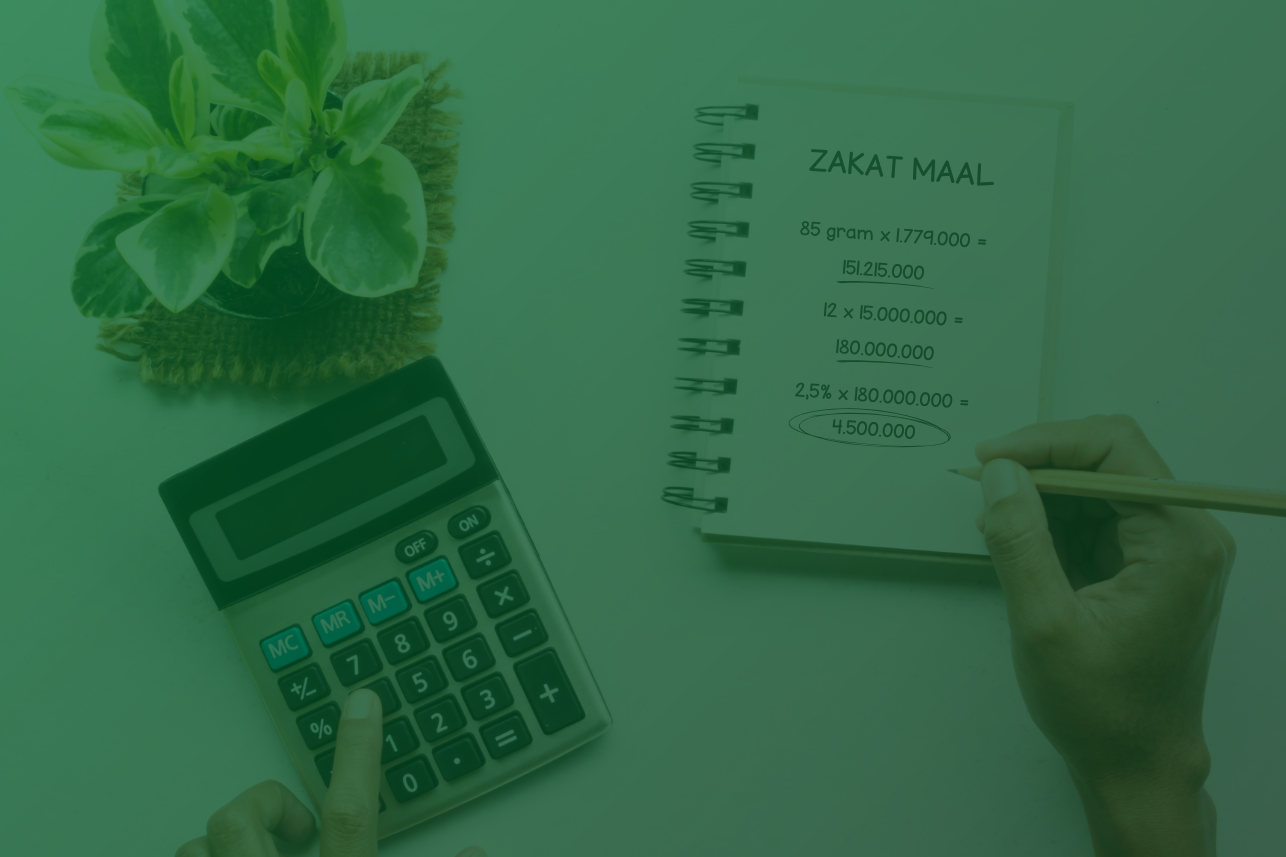
It is important for us to know the calculation of zakat maal so that this obligation can be fulfilled correctly according to Islamic law. Zakat maal is zakat on assets that have reached the nisab and haul, including gold, silver, income, investments, and savings. Islam teaches that some of the wealth we have belongs to others in need. Therefore, paying zakat is not only an obligation, but also a way to purify wealth and foster blessings in sustenance.
The Legal Basis for Zakat Maal in the Qur’an and Hadith
Zakat maal has a clear legal basis in Islam, stated in the Qur’an and the hadith of the Prophet. Allah Almighty says in the Qur’an, “Take zakat from their wealth (to) purify and cleanse them,” (Surah At-Taubah: 103)
This verse shows that zakat serves as a purification of wealth so that it becomes more blessed. In a hadith narrated by Imam Bukhari and Imam Muslim, the Prophet Muhammad also said, “Islam is built on five things: bearing witness that there is no god but Allah and that Muhammad is His messenger, establishing prayer, paying zakat, fasting in the month of Ramadan, and making the pilgrimage to the House of Allah for those who are able.”
The hadith emphasizes that zakat is one of the pillars of Islam that must be fulfilled by every Muslim who is able. Imam Shafi’i in the book Al-Umm also explains that zakat maal is obligatory for those who have growing wealth and have reached the nisab in a full year.
Read also: Income Zakat: What Percentage? Find out the Calculation Here
What are Nisab and Haul in Zakat Maal?
The calculation of zakat maal has two main requirements that must be met to determine the obligation to pay it, namely nisab and haul. Nisab is the minimum limit of wealth that we must have in order to be obliged to pay zakat. If our total wealth has reached or exceeded the nisab in one year, then we are obliged to pay zakat at a rate of 2.5%.
Haul is the ownership of assets for a full year in the Hijri calendar. Zakat maal must be paid if the assets have exceeded the nisab and lasted for 12 months. This zakat maal calculation applies to most types, such as gold, silver, savings, and investments. Understanding the nisab and haul ensures that the zakat issued is in accordance with sharia.
The nisab (minimum amount) of zakat maal follows the gold standard, which is 85 grams of gold. If the current price of gold is IDR 1,779,000 per gram, then the nisab is IDR 151,215,000. This means that if we have assets reaching or exceeding this amount for one year, then we are obliged to pay zakat at a rate of 2.5%.
Read also: Does a salary of 3 million require Zakat on Income? Check the Criteria and Calculation!
How to Calculate Zakat Maal from Various Types of Assets
The calculation of zakat maal for each type of asset has its own method. The following is how to calculate zakat maal based on the type of asset owned:
Calculation of Zakat Maal from Gold and Silver
The calculation of zakat maal from gold and silver has a different nisab. The nisab for gold is 85 grams, while the nisab for silver is 595 grams.
If we have gold/silver in the form of jewelry or bars that reach the nisab, then the zakat is calculated at 2.5% of the total gold/silver owned.
Example:
A person has 100 grams of gold, while the current price of gold per gram is IDR 1,779,000.
Total assets: 100 grams × IDR 1,779,000 = IDR 177,900,000
Zakat to be paid: 2.5% × IDR 177,900,000 = IDR 4,447,500
How to Calculate Zakat Maal from Savings and Investments
Savings and investments are also included in the assets that must be zakatied, if they have reached the nisab and have been saved for a full year. Here is an example of calculating zakat maal from savings and investments.
Example:
A person has savings of IDR 200,000,000.
Zakat to be paid: 2.5% × IDR 200,000,000 = IDR 5,000,000
Calculation of Zakat Maal on Property and Investment Assets
The calculation of zakat maal from property applies only to property that is leased or invested, while property that we use as a place of residence is not subject to zakat. The following is an example of calculating zakat maal from property and investments.
Example:
A person owns rental property with a net profit of IDR 250,000,000 per year.
Zakat to be paid: 2.5% × IDR 250,000,000 = IDR 6,250,000
How to Calculate Zakat on Income or Profession
Income from salary or profession is also subject to zakat if it reaches the nisab in one year. Zakat can be paid monthly or annually. Below is an example of calculating zakat maal from income.
Example:
Monthly salary of IDR 15,000,000 × 12 months = IDR 180,000,000 per year
Zakat to be paid: 2.5% × IDR 180,000,000 = IDR 4,500,000
How to Pay Zakat Maal?
We can pay zakat maal in several ways to make it easier and right on target. We can hand over zakat directly to the poor or distribute it through official zakat institutions such as BAZNAS and Dompet Dhuafa. If you want to be more practical, you can also pay zakat by bank transfer or digital wallet applications that provide online zakat services.
To ease our obligations, we should set aside zakat maal (wealth) regularly from our income every month. That way, when it’s time to pay, the amount collected will be sufficient without feeling burdensome.
Read also: Pay Zakat Maal Online, Is It Allowed in Islam?
Who is Entitled to Receive Zakat Maal?
In the Qur’an, Allah SWT specifies eight groups of zakat recipients in QS. At-Taubah verse 60:
“Zakat is only for the poor, the needy, the amil zakat, those whose hearts have been softened (converts), for the (liberation of) slaves, for the (liberation of) those in debt, for the cause of Allah and for those who are on the road (who need help), as an obligation from Allah. Allah is All-Knowing and All-Wise.” (Surah At-Taubah: 60)
We can give zakat maal to the poor, people in debt, converts, or da’wah institutions that are striving in the way of Allah. If you are confused about how to distribute it, it is better to give our zakat through a trusted zakat institution so that it is more organized and on target.
The Virtue of Paying Zakat Maal
Paying zakat maal is not just fulfilling an obligation, but also brings many benefits. Zakat purifies wealth and makes it more blessed. As the Messenger of Allah (saw) has said in the hadith below:
“Wealth will not decrease because of charity, but rather increase.” (HR. Muslim No. 2588)
In addition, zakat also helps create social welfare by distributing wealth fairly. By paying zakat, we participate in helping those in need and strengthen the solidarity of Muslims.
So Benefit by Paying Zakat
It is important to calculate zakat maal so that we can perform this act of worship correctly. The nisab of zakat maal is equivalent to 85 grams of gold, and the amount of zakat that we are obliged to pay is 2.5% of the total wealth that we have had for one year. The types of wealth that must be zakat-ed include gold, savings, investments, property, and income.
We can pay zakat directly to those who are entitled to it or through a trusted zakat institution. By understanding how to calculate and pay it, we can pay zakat maal more easily and ensure that our wealth remains clean and full of blessings. May Allah always provide for us and make zakat a field of rewards that keep flowing. Aamiin.