


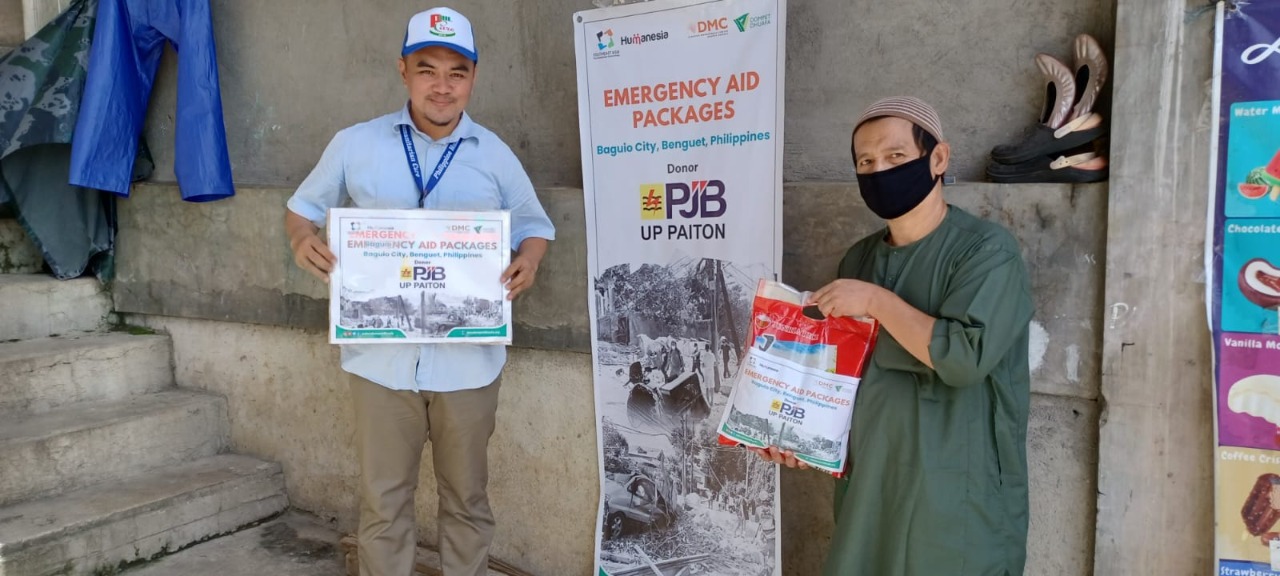
BAGUIO, PHILIPPINES — On Monday (September 19, 2022), PT. Pembangkitan Jawa Bali (PJB) Paiton Power Plant Unit, together with the Southeast Asia Humanitarian Committee (SEAHUM) and the Disaster Management Center (DMC) of Dompet Dhuafa, distributed free basic food supplies to earthquake survivors in the Philippines.
Through their local partner, Philippine Humanitarian Care (Philcare), the food packages were distributed to 100 beneficiaries. “We would like to express our deepest gratitude to PT. Pembangkitan Jawa Bali (PJB) Paiton Power Plant Unit for their contribution and collaboration in the disaster relief program. May Allah SWT reward our good deeds with a worthy reward,” explained Haryo Mojopahit, Chief Executive of the DMC Dompet Dhuafa.


Humanitarian donations from PT. Pembangkitan Jawa Bali (PJB) Unit Paiton were received by DMC Dompet Dhuafa last Tuesday (September 6, 2022). The donations were distributed through the International Earthquake Relief Program for the Philippines on Monday (September 19, 2022).
“As a manifestation of the company’s commitment to every aspect of life, PT. Pembangkitan Jawa Bali (PJB) Paiton Power Plant Unit, in collaboration with DMC Dompet Dhuafa, strives to be present and participate in supporting communities affected by disasters,” explained Agus Prastyo Utomo, General Manager of PT. PJB Paiton Power Plant Unit.


A 7.1-magnitude earthquake struck Luzon Island in the Philippines on Wednesday, July 27, 2022. According to the United States Geological Survey (USGS), the 7.1-magnitude earthquake was located approximately 11 km (six miles) east-southeast of the city of Dolores and occurred at a shallow depth of 10 km (six miles).
Meanwhile, tremors were felt as far as Bucloc, Manabo, and Abra, extending to Manila. However, the damage extended to the cities of Vigan, Sinait, Bantai, San Esteban, Ilocos Sur, Laoac, Pangasinan, and Baguio.
The National Disaster Risk Reduction and Management Council (NDRRMC) reported that the earthquake caused 11 deaths, 574 injuries, and infrastructure and agricultural damage estimated at approximately Php 1.6 billion (equivalent to Rp417 billion).

History records at least 40 earthquakes that occurred between 1589 and 1985, according to the Southeast Asia Association of Seismology and Earthquake Engineering (SEASEE) (1985) report in Abra, Ilocos Norte and neighboring provinces. Ten of these earthquakes had magnitudes ranging from 3.8 to 5.6, which were reported to have affected Abra Province and its surroundings. Two major earthquakes with significant magnitudes are listed below:
In September 1862, an earthquake with a magnitude of 6.2 occurred in Ilocos Norte, causing damage to buildings in various cities, particularly in Piddig and Ilocos Norte. Abra experienced strong ground shaking that lasted approximately one minute. There were four aftershocks with the same magnitude but shorter durations. However, no damage was reported.
Then, in September 1877, the largest earthquake with a magnitude of 5.6 occurred in Bangued, Abra Province. Abra reported some damage to the roofs of residents’ homes. Given the above facts, the Philippines is one of the regions most prone to natural disasters, particularly earthquakes. The assistance provided is of great significance to those affected by natural disasters
“Thank you to the donors who have helped distribute assistance to us,” said Zulaica D. Dibansa, one of the beneficiaries. (Dompet Dhuafa / DMC)