


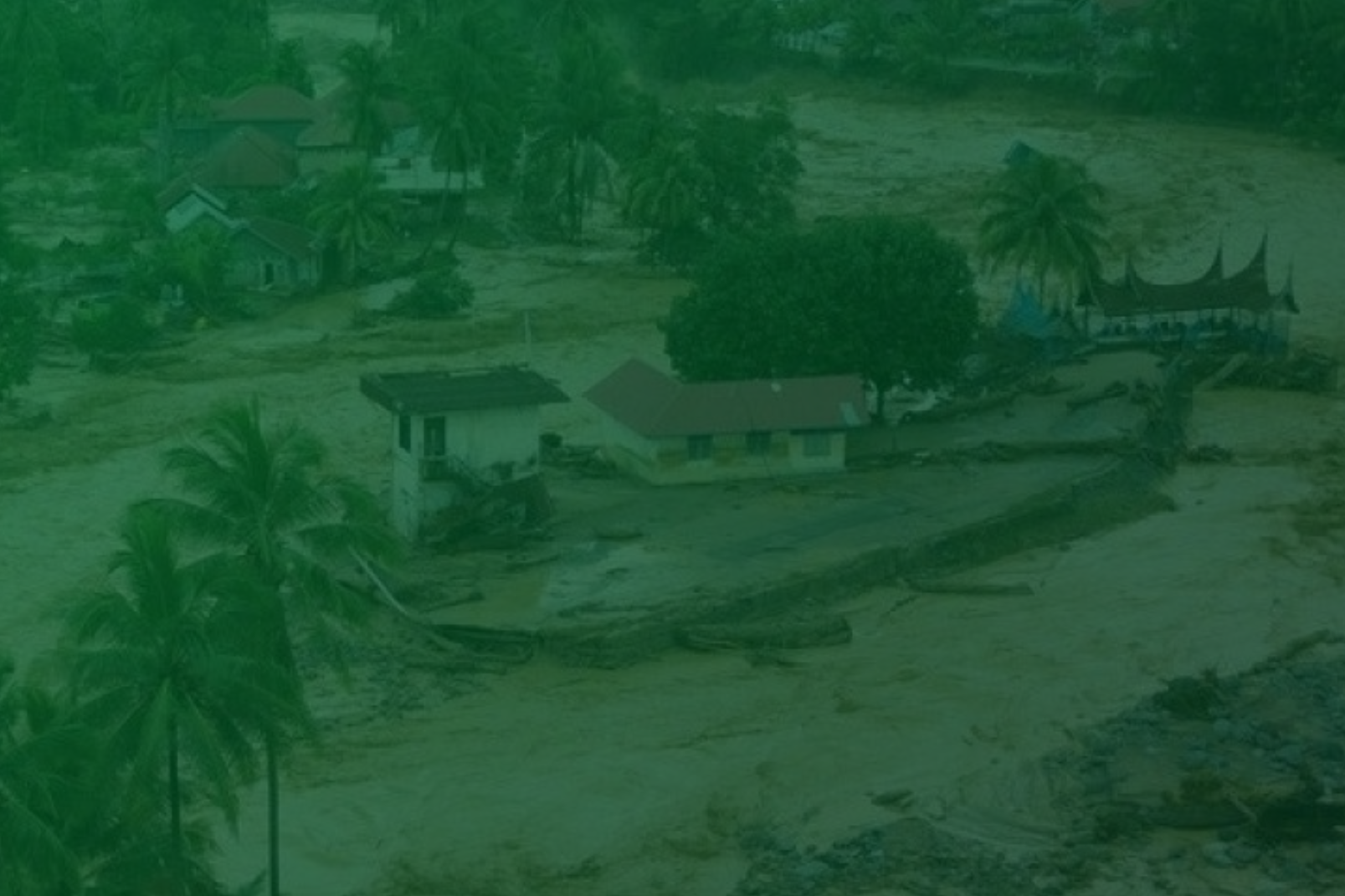
Prayer is a primary obligation for every Muslim who has fulfilled the requirements. Under any circumstances, prayer remains a form of worship that must not be neglected. However, Islam, as a religion that is rahmatan lil ‘alamin (a blessing for all creation), also provides flexibility in the performance of prayer when a Muslim is in an emergency situation, such as a natural disaster like a flash flood, landslide, earthquake, tsunami, or any condition that threatens life safety.
So, how should prayer be performed when a Muslim is struck by a disaster? This article will thoroughly discuss the performance of prayer during natural disasters, complete with the rulings according to the Shafi’i school of thought.
According to an Instagram post by @fawaedsyafiiyah, this summary of the Fikih Syafi’iy books explains how to perform prayer when struck by a flood. See the full explanation below.
Prayer During a Disaster
1. Prayer on a Floor or Muddy Ground
The obligation to pray does not cease even if a Muslim is struck by a disaster. If a Muslim cannot find a suitable place to perform prayer except on a floor or ground covered in mud and sand, then the prayer is still valid.
This is considered valid because the law of every land is that it is pure, until there is an indication that the land has been contaminated. In a sahih Muslim hadith, the Prophet Muhammad said:
“The whole earth has been made for me and my people as a place of prostration and purification.”
In addition, a verse explains:
“The original law of water, soil, clothing, and rocks is that they are pure.”
2. The ruling on praying in puddles
A Muslim who prays in a puddle is still considered valid, as long as the requirements and pillars are fulfilled properly. However, it should be noted that when someone prostrates in a puddle, no water should enter their mouth or ears, as this can invalidate the prayer. This is based on the hadith of Abu Said:
“One day, there were many clouds and heavy rain fell until water flowed from the roof. At that time, the roof was still made of palm leaves. Then prayer was performed, and I saw the Messenger of Allah prostrate on a puddle of water and mud until I saw mud on his forehead.”
3. Prayer in a State of Not Being Wudu and Tayammum
In times of disaster, it is certainly difficult to find clean water for wudu or dust for tayammum. However, prayer remains obligatory even without wudu or tayammum when a Muslim is affected by a natural disaster.
It should be noted that once the situation after the disaster has improved, a Muslim is obliged to make up or perform qada for all prayers performed without wudu and tayammum. Al-Qadhi Al-Imraniy said:
“If both water and dust are unavailable—for example, if he is detained in a place where he cannot find either, or if he can only find unclean dust—then the well-known opinion in the madhhab is that it is obligatory for him to perform prayer according to his circumstances. This opinion was also expressed by al-Laits, Abu Yusuf, Muhammad, and Ahmad.”
Regarding the obligation to repeat the prayer when conditions have returned to normal, there is another opinion that states it is not obligatory. Imam Nawawi said:
“Imam al-Haramain and al-Ghazali quoted Abu Hanifah as saying: every prayer that requires qadha is not obligatory to be performed on time. And that al-Muzani said: every prayer that is obligatory at its time, even if performed with a deficiency (flaw), is not obligatory to be made up. Both of them said: these two opinions were narrated from Imam al-Shafi’i. The opinion expressed by al-Muzani is the one that is chosen (stronger), because he has fulfilled the obligation of time. As for the obligation of qadha, it requires a new command, and there is no evidence to establish it; in fact, there is evidence to the contrary.
Read also: Disaster, Warning, or Punishment for Humans?
4. The ruling on abandoning congregational prayer during a flood
In the event of a natural disaster, the requirement to pray in congregation is waived due to the existence of an excuse. This is explained by Imam Nawawi:
تسقط الجماعة بالأعذار سواء قلنا : إنها سنة أم فرض كفاية أم فرض عين ، لأنا ، وإن قلنا : إنها سنة فهي سنة متأكدة ، ويكره تركها كما سبق بيانه ، فإذا تركها لعذر زالت الكراهة وليس معناه أنه إذا ترك الجماعة لعذر تحصل له فضيلتها ، بل لا تحصل له
its virtue, without a doubt. Rather, it means that the sin and disliked nature are removed.
Our companions agreed that rain alone is an excuse, whether it is day or night. Regarding mud, there are two opinions (the correct one) which the author and the majority have decided upon: that it is an excuse alone.
The requirement to pray in congregation is waived due to the existence of an excuse, whether we consider praying in congregation to be sunnah, fard kifayah, or fard ‘ain. This is because, even if we say that praying in congregation is sunnah, it is a strongly recommended sunnah, and abandoning it without an excuse is makruh, as explained earlier. So if one abandons it due to an excuse, the makruh is removed.
However, this does not mean that a person who abandons congregational prayer due to an excuse will receive the virtue of congregational prayer; this is not the case at all. What is meant is only that the sin and makruh are waived.
The scholars of the Shafi’i school of thought agree that rain alone is a valid excuse, whether it occurs at night or during the day. As for mud (muddy roads), according to the majority of scholars, it is a valid excuse.
5. The ruling on abandoning Friday prayer during a flood
In the event of a disaster, Friday prayer may also be omitted and replaced with the performance of the Zuhr prayer, if there are excuses such as heavy rain, flooding, and muddy ground. Ar-Rouyani said:
وَيَجُوزُ تَرْكُ الْجُمُعَةِ لِلْمَطَرِ وَالْوَحْلِ أَيْضًا
“And it is permissible to leave Friday prayer because of rain and also because of mud (muddy roads).”
6. The ruling on combining prayers due to flooding
Combining prayers is permissible in certain circumstances such as flooding, because flooding is an emergency situation that causes homes or places of worship to be submerged in water, so that people often find it difficult to perform prayers on time. This is also explained by Imam Nawawi:
الْمَعْرُوفُ فِي الْمَذْهَبِ أَنَّهُ لَا يَجُوزُ الْجَمْعُ بِالْمَرَضِ وَلَا الْخَوْفِ وَلَا الْوَحْلِ. A group of our companions said: It is permissible due to illness and mud, as stated by our companions Abu Sulaiman al-Khattabi and Qadi Husain. And al-Ruwaini approved of it.
“The well-known opinion in the Shafi’i school of thought is that it is not permissible to combine prayers due to illness, fear, or mud. However, a group of scholars from among the companions (scholars) of our school of thought are of the opinion that it is permissible to combine prayers due to illness and mud. Among the scholars of our school of thought who are of this opinion are Abu Sulaiman al-Khaththabi and al-Qadhi Husain, and this opinion is supported by ar-Ruyani.”
Read also: Are Victims of Natural Disasters Entitled to Receive Zakat?
Friends, that is the explanation regarding the implementation and laws of prayer when a disaster strikes. Islam is a religion that makes things easy, therefore obligatory acts of worship must be performed regardless of the circumstances. (Dompet Dhuafa)
Author: Reynaldi
Editor: Dhika