


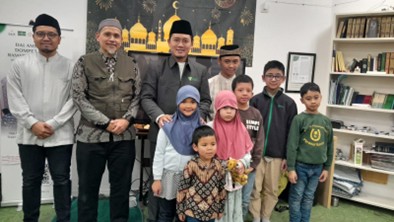
BREMEN, GERMANY —-— On the seventh day of his stay in Bremen, specifically on Monday (February 23, 2026), Wahyu Septrianto, the Dompet Dhuafa Dai Ambassador assigned to Germany, was invited by the KMIB board to lead a study session on the theme “Aqidah as a Stronghold for Muslim Children in Bremen.” Also present at the event were the students and their guardians from the Ar-Raudhah Quran Education Center (TPA) in Bremen.
To kick off the session, I began with an interactive quiz using Quiz.com. The quiz featured questions about the importance of faith as the primary fortress for Muslim children growing up in a minority environment like Bremen. Through this quiz, participants were encouraged to understand that faith is not merely a subject of study, but rather the primary foundation that safeguards the identity, faith, and moral character of Muslim children amidst the challenges of the modern era. The discussion during the session covered several points, as outlined below.
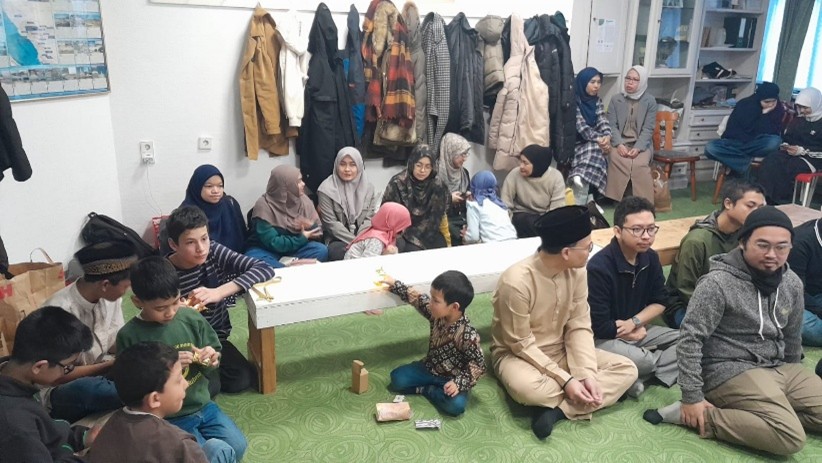
Challenges of the School Environment to Religious Beliefs
The school environment in Germany, including in Bremen, has many positive aspects, such as punctuality, independent learning systems, and the use of technology. However, the greatest challenge for Muslim children does not lie in these academic aspects. Rather, it lies in the normalization of values that do not always align with Islamic teachings.
Values such as unlimited freedom in social interactions, moral relativism, and sensitive issues—such as LGBT topics—are taught openly. These can influence a child’s perspective on religion if not fortified by a strong faith. Therefore, faith education cannot be passive; it must serve as a solid foundation from an early age.
The Wise Approach of Muslim Parents
Living in Bremen means living in the midst of a multicultural society. The best approach for Muslim parents is neither to forbid their children from interacting nor to let them embrace all cultures without any filters. The most appropriate approach is to instill a strong Islamic identity coupled with a tolerant attitude. Children need to understand: who they are as Muslims, what values cannot be compromised, and how to respect others without losing their principles—this is the balance between identity and tolerance.
Maintaining children’s religious practices in a minority community presents unique challenges. In Bremen, common obstacles include the distance to the mosque and a packed school schedule. Praying in congregation, Islamic activities, or Quran study classes are not always easily accessible. Therefore, the home must become the center for cultivating religious practice. If the mosque is far away, the living room should feel like a small prayer room. If schedules are tight, time management must be taught from an early age.
In a minority community, the family’s role becomes central. Parents cannot fully rely on schools. The family is the first and primary school. At home, children learn: how to pray, proper etiquette in speech, how to handle differences, the meaning of halal and haram, the natural inclinations of men and women, and more. One of the greatest challenges for Muslim parents in Bremen is the limited time they have with their children due to work demands. Therefore, the quality of time spent together must outweigh the quantity. Though time may be short, it should be filled with attention, dialogue, and setting a good example.
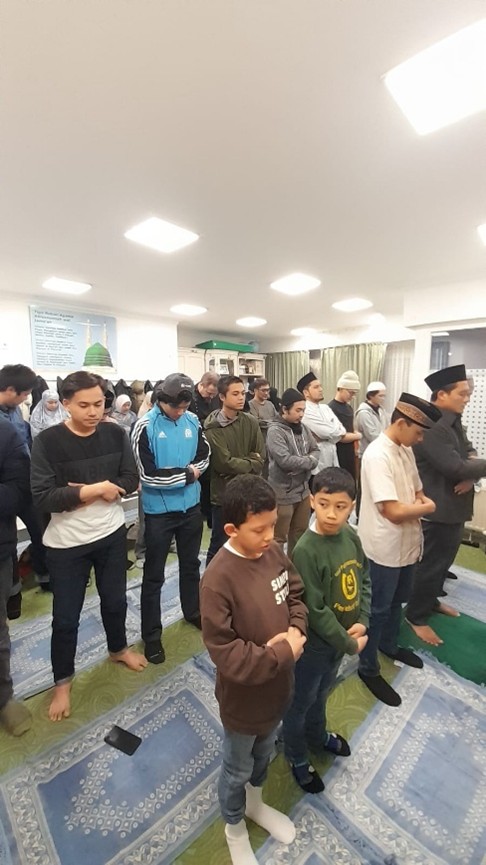
Effectively Instilling Islamic Identity
Islamic identity cannot be instilled through coercion. The most effective methods are through: parental role modeling, cultivating the habit of worship, and age-appropriate open dialogue. Thus, children who understand the reasoning behind Islamic teachings will have a stronger faith than those who are merely commanded without explanation.
“Muslim communities such as KMIB in Bremen play a vital role as safe spaces for Muslim children. The community is not meant to replace the role of parents. Rather, it is to strengthen faith, cultivate good character, foster a sense of community, provide a healthy social environment, and other positive aspects. Thus, through the community, in my view, children have a supportive Muslim environment and will be more confident in preserving their identity,” explained Wahyu Septrianto, Dompet Dhuafa’s Dai Ambassador for the Germany assignment.
Thus, the goal of educating Muslim children in a minority setting is not merely to ensure they excel academically, nor is it to make them exactly like the majority environment. Rather, the primary objective is for children to be able to uphold Islam, faith, ihsan, identity, fitrah, and Islamic character wherever they may be.
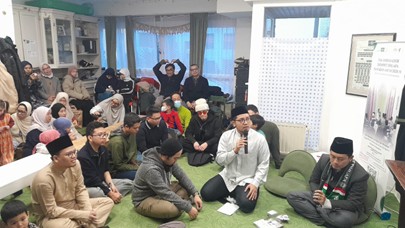
Challenges Facing Muslim Children in a Minority Community
One of the biggest challenges in Bremen is the normalization of LGBT issues in the curriculum and public spaces. This is widely disseminated through social media and the school education system. Parents should not panic, but neither should they be indifferent. The appropriate response when a child asks about LGBT issues is to explain it in a wise manner, in accordance with Islamic teachings and the child’s age, including how the natural disposition of men and women is established in Islamic law. The Islamic principle in addressing this issue is to firmly reject the behavior and those who engage in it. However, one must maintain proper etiquette and humanity toward those involved. The goal of Islamic education in this context is not to foster hatred, but to help children understand the value of human nature in Islam with wisdom and maturity.
Then there is the challenge regarding school policies. When there are school policies related to sensitive issues, the wisest step is to engage in dialogue with the school administration. Additionally, it is necessary to strengthen Islamic education at home and prioritize polite, yet reasoned, communication. A confrontational attitude without dialogue often ends up harming the child.
“Here, the role of the Muslim community is crucial in helping children navigate various social issues. Not by isolating them from society, but by strengthening their Islamic identity, fostering good character, and building self-confidence. A child who knows who they are will not easily be swayed by environmental pressures,” explained Wahyu Septrianto.
At the end of the session, Wahyu Septrianto added that being a Muslim parent in Bremen is no easy task. The challenges are very real and right before our eyes: the school environment, cultural differences, contemporary moral issues, and limited time for dialogue with children. However, with a strong faith, consistent and robust family education, open dialogue, and community support, Insha’Allah Muslim children will be able to grow into a generation that is Islamic, faithful, virtuous, and self-confident, even while living as a minority.
Text and photos: Wahyu Septrianto, Dompet Dhuafa Ambassador on assignment in Germany
Editor: Taufan YN