


In one of his lectures, the renowned scholar M. Quraish Shihab once noted that Eid al-Adha carries a profound meaning: the willingness to sacrifice one’s personal ego for the greater good. According to him, the essence of Eid al-Adha is a day of humanity.
This philosophy is rooted in the story of Prophet Ibrahim (peace be upon him) and Prophet Ismail (peace be upon him). When their obedience was tested, Allah the Almighty replaced the sacrifice with a lamb—a powerful symbol that human life is of immense value and must be respected regardless of ethnicity or nationality. It is this spirit that has driven Dompet Dhuafa in carrying out the Qurbani Animal Distribution Program (THK) since 1994.
For Dompet Dhuafa, the sacrifice is not merely an annual ritual, but a commitment to bridge acts of kindness from urban areas to hard-to-reach regions. In the year 1446 Hijri (2025), the trust placed in us by donors grew remarkably by 33.70%, with a total of 36,709 sheep/goats distributed.
Of this total, 28,445 animals came from the THK Program and 8,264 through the Kurban Network Partners. Dompet Dhuafa Board Chairman Ahmad Juwaini emphasized that the impact of this kurban reaches down to the grassroots level.
“This is the downstream impact of zakat. Qurbani revitalizes the local livestock farmers’ economy across various regions. They receive a decent income and a tangible improvement in their standard of living,” explained Ahmad.
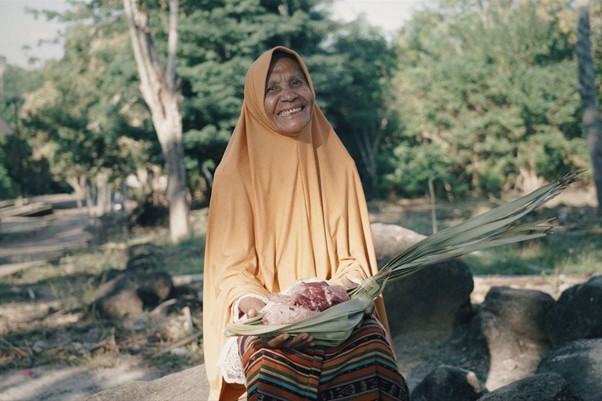
The warmth of Eid al-Adha is truly felt all the way to the easternmost part of Indonesia. On Solor Island, East Nusa Tenggara, Mama Ratna (60) could not contain her gratitude. For a whole year, she had longed for the taste of meat—a luxury hard to attain given her daily life, which consisted only of simple meals of fish or plain rice.
“We often had to go hungry or fast just to buy rice. I’m so happy—finally, there’s sacrificial meat once a year,” Mama Ratna said, her voice filled with emotion.
Similar joy erupted in Bitorik Village, Maluku. After waiting for 26 years, the euphoria of Eid al-Adha returned through the delivery of 9 cows and 1 goat.
“We don’t want to enjoy this alone. We’re also distributing this meat to neighboring villages so everyone can feel the same gratitude,” said Muhammad Yasin, a local community representative.
Last year, the distribution of sacrificial animals reached 26 provinces, 250 regencies/cities, and even across borders to countries like Palestine, Somalia, and Myanmar, benefiting a total of 2,036,320 people. Here’s why:
- Empowering Local Farmers: Boosting the village economy.
- Wide Reach: Reaching even the most remote and forgotten areas.
- Transparent: Comprehensive reports and timely notifications.
- Convenient: You can perform qurbani as easily as using a smartphone.
It’s truly special that qurbani can revive humanity and drive tangible action even to the far corners of the country. So, have we prepared ourselves for qurbani this 2026? Let’s prepare your best offering through digital.dompetdhuafa.org/kurban. (Dompet Dhuafa)
Text and photos: Dhika
Editor: Dedi Fadlil