

We need to understand the law of selling sacrificial animal skins so as not to take the wrong steps in dealing with the skin or head of a sacrificial animal. This is because the skin and head are not as easy to process into food as the meat. Moreover, the selling value of animal skins and heads is quite high. However, if these skins and heads are not consumed by the public, what should be done so that they are not wasted?
The Law of Selling Animal Sacrificial Skins Based on the Hadith
Eid al-Adha is a holiday filled with Eid prayers and sacrificial offerings for those who are able. Then the sacrificial animals that have been slaughtered, the meat is distributed evenly to all Muslims, with priority given to the poor and needy. However, often the skin and head of the sacrificial animal are left over.
Rasullullah said in a hadith narrated by Al Hakim, “Whoever sells the skin of his sacrificial animal, there is no sacrifice for him.” (HR. al-Hakim)
The hadith above shows that the law of selling the skin of sacrificial animals will make the reward for worship null and void. The value of the animal becomes an ordinary sacrifice, not a sacrificial sacrifice.
Read also: Is it okay to cut nails before qurbani?
The Opinion of the Scholars on the Law of Selling the Skin of Sacrificial Animals
There are various opinions from the Imams of the School of Thought on the law of selling the skin of sacrificial animals. This opinion can be a consideration for friends to understand the law of selling the skin of sacrificial animals.
Based on the Book of Imam Shafi’i
There has been a proposal that the parts of sacrificial animals that are not eaten, such as the skin or head, should be sold, and the proceeds used for operational costs or the butcher’s wages.
It is explained in the hadith narrated by Bukhari which reads, “From Ali Radhiyallahu ‘anhu, that the Prophet Shallallahu ’alaihi wa sallam ordered him to take care of his udn (onta-onta hadyu), to divide everything, and to give it to the poor. And he should not give anything (from the sacrifice) to the butcher.” (HR Bukhari no. 1717).
According to Imam Nawawi, based on the editorial text of the Shafi’i school, the intention of the hadith above is not to replace the wages of the sacrificial slaughterer with skin or sacrificial animals. Part of the sacrificial animal may only be given free of charge to the slaughterer. Any recipient of sacrificial meat may not resell it. Whatever the part, including meat, skin, horns, and hair, everything is prohibited.
Let alone being the slaughterer’s wages, the law of selling the skin of sacrificial animals cannot be used for the operation of sacrificial activities. All consumable parts of the sacrificial animal must be distributed without residue.
Imam Nawawi rahimahullah said, “And our madhhab (Shafi’iyah) does not allow the sale of the skin of the hadyu or sacrifice, nor anything from its parts.”
Read also: Complete 2024 Qurban Goat Prices
The Law of Selling Sacrificial Animal Skin According to Imam Hanafi
In the Hanafi School of Thought, it is written that it is permissible to sell sacrificial meat or skin under certain conditions. That is, the proceeds from the sale are donated or used for household needs for the person who made the sacrifice or given to the poor. Comparing the sales proceeds with meat.
Taqiyuddin Al-Hushni Al-Husaini mentions this in Kifayatul Akhyar as follows, “It should be noted that the act of sacrifice lies in the use of the body of the sacrificial animal itself. Therefore, the meat of the sacrifice may not be sold, and this includes selling the skin. In fact, the person who makes the sacrifice may not give the skin to the butcher as payment for slaughtering the sacrificial animal, even if the sacrifice is a voluntary act of worship. People who sacrifice animals may donate the skin. Alternatively, they may use the skin to make khuf (waterproof leather shoes), sandals, buckets, or other objects. But they may not give it to others as a reward for slaughter. The treatment of the horns of sacrificial animals is similar to the treatment of the skin of sacrificial animals.”
Read also: Check the Latest 2024 Qurbani Cow Prices
Utilization of Sacrificial Animal Skins
In the thought of the Shafi’i school of thought, it is stated that the law of selling the skin of sacrificial animals is haram in any form, while in the thought of the Hanafi school of thought, it is permissible to sell it on the condition that it is used for the household needs of the person who makes the sacrifice, or donated to the poor. This difference in thought is not too sharp, because both refuse to sell the sacrificial skin to pay the butcher’s or operational wages. The prohibition on selling the skin of sacrificial animals does not only apply to people who sacrifice animals, but also to people who receive sacrificial meat.
If no one wants to process or eat the skin of the sacrificial animal, it can be processed into other forms of use, such as making water bags, tarpaulins, buckets, or drums. As long as the animal is not a sacrificial animal that is a vow or an obligatory sacrifice that must be given to others. As explained by Imam As-Syarbini in the Book of Al-Iqna’, “Whoever sells the skin of his sacrifice, there is no sacrifice for him. This means that he does not receive the reward promised to the person who makes a sacrifice for his sacrifice,” (HR Hakim in the book Faidhul Qadir, Maktabah Syamilah, juz 6, page 121).
All praise is due to Allah.
Read also: The Beginning and Development of the Tebar Hewan Qurban
Sacrificing an animal for Eid throughout the country with Dompet Dhuafa
Of course, as Muslims who want to perform the sacrifice of an animal for Eid, you need an institution that is trustworthy. From the pre-Eid al-Adha process, by ensuring that the sacrificial animals are healthy and in accordance with Islamic law. On the day of the slaughter of the sacrificial animals, it is carried out safely and in accordance with Islamic law. As well as the distribution of the sacrificial meat to those who are truly in need.
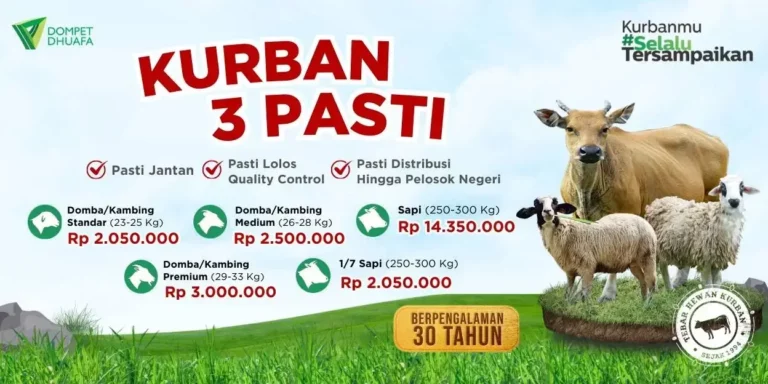
Together with Dompet Dhuafa, your qurbani can be distributed to remote areas of the country, including areas that rarely receive qurbani meat. Fill your eternal reward jar by making a qurbani donation to Dompet Dhuafa. Click the image below for more information.