


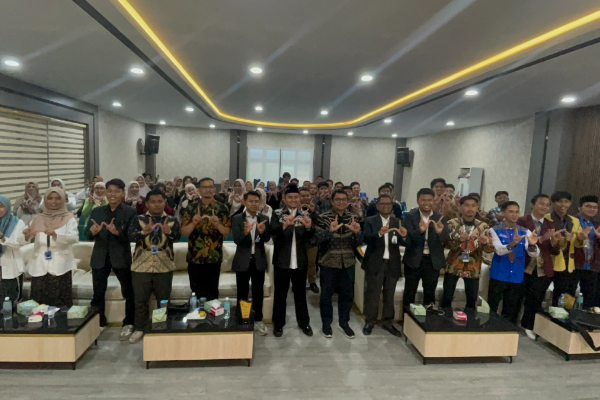
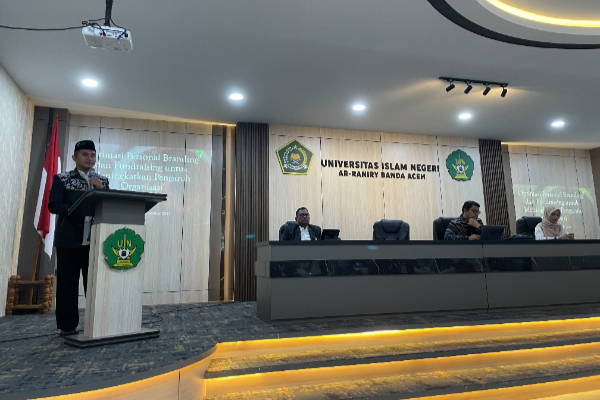
ACEH —— On Tuesday (11/18/25), Dompet Dhuafa together with the Forum Silaturahim Studi Ekonomi Islam (FoSSEI) held a National Seminar on Waqf Goes to Campus at UIN Ar-Raniry Banda Aceh. Through presentations by speakers consisting of academics, Islamic finance practitioners, and professional waqf managers, it is hoped that waqf literacy and the culture of waqf among students will increase.
The National Seminar on Waqf Goes to Campus in Banda Aceh featured three speakers with different backgrounds, including Saiful Musadir as Deputy of Bank Syariah Indonesia, Imam Alfaruq as Head of the Waqf Literacy and Fundraising Department of Dompet Dhuafa, and Prof. Zaharsyah Ibrahim as Professor of Islamic Economics at UIN Ar-Raniry. Through this forum, UIN Ar-Raniry students were invited to see waqf not only as a form of worship, but also as an instrument that can promote the economic sustainability of the community and make it a way of life today.
From the perspective of the Islamic finance industry, Saiful Musadir explained that the growth of Islamic banking institutions will have a direct impact on expanding the economic benefits for the community. According to him, the greater the capacity and assets of national Islamic banking, the greater the scope for encouraging halal business financing, empowering MSMEs, and supporting the development of productive waqf through more innovative schemes.
“With the development of Islamic banking, the hope is that it will become more profitable, and thus its benefits will also expand. This is because Islamic-based banking is required to pay zakat,” said Saiful Musdir.
Read also: Dompet Dhuafa Shares Ideas at Bandung International Conference on Islamic Economics
Meanwhile, Imam Alfaruq explained that Dompet Dhuafa is a nazhir institution that has held an official license from the Indonesian Waqf Board (BWI) since 2004. He emphasized that this legality is not only proof of Dompet Dhuafa’s credibility, but also reflects the institution’s commitment to maintaining integrity and professionalism in waqf management. Currently, Dompet Dhuafa is managing waqf assets worth IDR 244 billion, which are allocated to various programs ranging from education, social, health, to economic empowerment.
Imam explained that the concept of waqf actually has long historical roots and has proven to be the foundation of various civilizations. He cited the practice of endowment funds at world-renowned universities. Harvard University, Stanford University, and Oxford University are clear examples of how “perpetual funds” can support research, education, and innovation for hundreds of years. According to Imam, this fact reinforces that waqf is not only part of Islamic narrative, but also a model of sustainable economic management that is relevant on a global scale.
Furthermore, in front of UIN Ar-Raniry students, Imam clarified the differences between Islamic philanthropy instruments. Imam explained that zakat and waqf have different rules and impacts. He emphasized that the community needs to have a proper understanding so that the distribution of wealth can be carried out effectively and in accordance with Islamic law.
“The purpose of zakat is to provide benefits. Zakat is distributed so that the eight categories of recipients can immediately receive benefits. However, waqf is profit first, then benefits, because the sharia of waqf is to plant the principal and then distribute the benefits. There is a management process first, and from there the benefits can continue to flow,” explained Imam.
Read also: Cash Waqf Literacy, Time for Blessed Investment Through CWLS 006
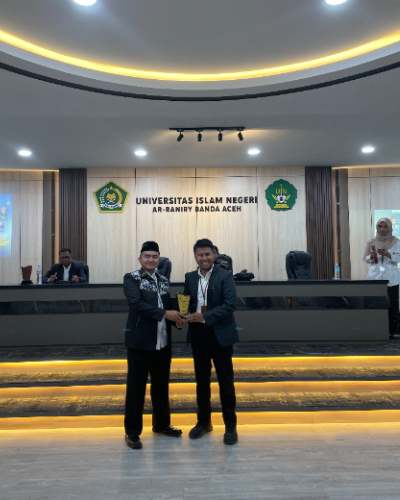
According to Imam, waqf has a unique dimension of sustainability. Unlike direct charity, which is used up, waqf is designed to retain the principal asset and continuously distribute its proceeds to beneficiaries. Therefore, he encourages the younger generation to make waqf a part of their lifestyle.
“Waqf must be cultivated. We must prepare for the hereafter, not just for worldly needs. Because waqf provides eternal benefits. When the benefits continue, the rewards for the waqif (the person who gives waqf) will not stop,” he added.
Through this activity, Dompet Dhuafa and FoSSEI hope that Islamic economics students can become agents of waqf literacy in the campus environment and the wider community. The collaboration between academics, professional waqf administrators, and Islamic banking is expected to strengthen a productive waqf ecosystem that is inclusive, adaptive, and relevant to the needs of Indonesia’s younger generation. (Dompet Dhuafa)
Text and photos: Alwi
Editor: Ronna