


GAZA, PALESTINE —-— How does an artist paint when their world is crumbling? When their canvases, brushes and acrylic paints have been burnt to ashes along with the rubble caused by Zionist air strikes? For Ahmed Muhanna, an artist from Deir Al-Balah, Gaza, the answer is to refuse to give up.
Adapted from an article in SceneNow on Wednesday (16 July 2026), when the war stripped him of all his painting materials, Ahmed discovered an unusual new medium: empty cardboard boxes left over from food aid parcels. And when his supply of coloured paint ran out completely, he used charcoal and leftover coffee grounds to sketch, stroke by stroke, the pain and hope onto the brown cardboard.
Now, his works—created amidst the roar of bombs—have been successfully ‘rescued’ out of Gaza. More than 60 paintings created on these aid cartons are currently touring Europe as part of a travelling exhibition entitled “Gaza: Stories of Hope and Resilience”.
For Ahmed Muhanna, the loss of the paintings he had spent years creating was a devastating blow. These works of art were not merely piles of paper and paint, but fragments of memory and evidence of his life’s journey.
“Losing my paintings is incredibly painful because they are part of my memories and the result of years of hard work. However, when you live in Gaza and lose relatives, your home and memories every single day, losing the paintings is just a small part of a far greater series of losses,” Ahmed told a journalist from SceneNow.
Read also: Gaza Loses a Figure Dedicated to the Cause of Humanity
However, Ahmed soon realised that whilst his body and studio might be destroyed, the ideas in his head could never be bombed. He must continue to be restless and bear witness.
Every time he began to paint, the walls around him would often shake violently from the blast of a bomb. He was also frequently forced to wield his brush by the dim light of a single candle. Yet for him, art is a small window that allows him to keep breathing and maintain his sanity as a human being.
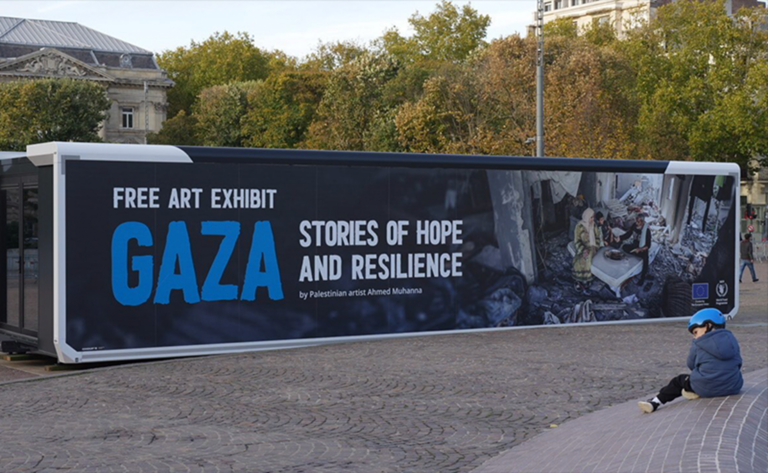
Ahmed’s decision to use food cartons as a canvas was initially purely out of necessity. As time went on, he realised that these cartons held a profound historical narrative and served as tangible evidence of a humanitarian crisis.
“These aid boxes are not just ordinary empty cardboard boxes. They contain food that helps many families survive. I want to show that food is not just about survival, but also about hope,” said Ahmed.
Interestingly, Ahmed deliberately does not paint the entire surface of the boxes. He leaves the stamp bearing the letters “WFP” or “World Food Programme” clearly visible alongside his paintings. For Ahmed, the marks made with felt-tip pens, charcoal and coffee grounds—which he shapes into the faces of Gaza’s residents—serve as a tangible testimony to the humanitarian crisis.
“When I paint on them, I do not alter the function or meaning of the cardboard boxes. Instead, I am adding a human testimony to them,” said Ahmed Muhanna.
Read also: Warm Food Aid from My Day and Jars Social Project for Gaza Refugees
Through his paintings—ranging from the expressions of a screaming child to the anguish of queues for clean water—Ahmed aims to ensure that the suffering of the people of Gaza does not merely end up as a string of statistics on television screens or social media around the world.
With the help of the WFP, these fragile cardboard paintings were quietly smuggled out of Gaza to be exhibited on the streets of major European cities, such as Rome, Brussels, Madrid and Copenhagen.
Seeing his paintings viewed by thousands of pairs of eyes across Europe whilst he himself remains trapped under the Gaza blockade stirs mixed emotions within Ahmed. There is sadness that he cannot accompany his works, yet there is immense relief that his voice has managed to pierce through the walls of isolation.
“I feel as though I am sending a piece of Gaza to the world,” he said emotionally.
For us and the world witnessing it, every stroke on Ahmed’s aid cardboard boxes is a stark reminder. These paintings remind us that behind the cold reality of the humanitarian crisis, there is anguish expressed through art that refuses to surrender, and there are prayers for peace that continue to be voiced in the most honest way. Support them now through Strengthen hope, stand with the Palestinian struggle. (Dompet Dhuafa)
Text and photos: Salma Abdelsalam, SceneNow
Editor: Dhika