


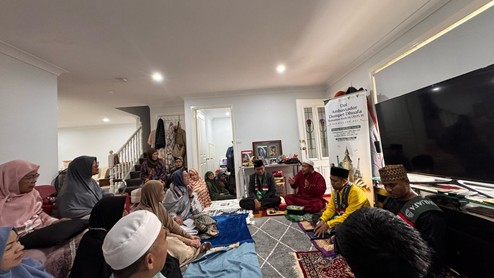
SYDNEY, AUSTRALIA – In the month of Ramadan 1446 AH, Dompet Dhuafa sent 16 Dai Ambassadors to preach in 11 destination countries, one of which was Australia. I became one of the preachers sent to the Land of Kangaroo and was entrusted with conveying the Islamic message to the local Muslim community.
In the second week of my preaching in Australia, I was told by Ustaz Cecep Hajisolehudin, as the Director of Dompet Dhuafa Australia Branch, to convey the teachings of Islam regarding the procedures for paying zakat.
“Ustaz, this week we will focus on discussing zakat mal and zakat fitrah. Please be well prepared,” Ustaz Cecep told me.
“Okay, Ustaz,” I replied, while starting to think about the best way to convey this material to the congregation.
That day arrived. In the middle of my explanation to the congregation regarding the nisab of zakat mal, which is 85 grams of gold or the equivalent of IDR 150 million, Ustaz Cecep said something that caught my attention.
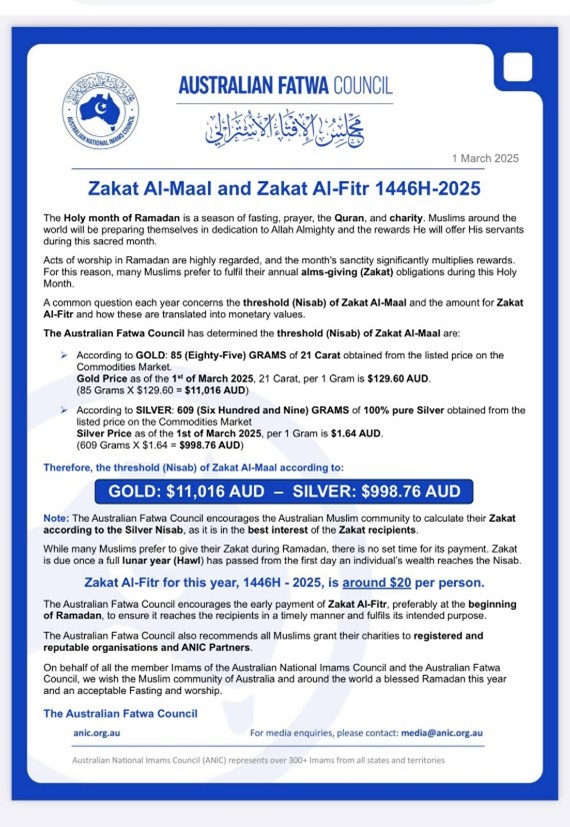
“Ustaz, you can look at the zakat reference from here only, so it’s easy to convert it to dollars,” said Ustaz Cecep.
I was silent for a moment. In my mind, zakat has the same principle everywhere, which is to cleanse wealth and help those in need. However, there are differences in the calculation standards.
In Indonesia, the nisab zakat mal is often calculated based on the price of pure gold. Meanwhile, in Australia, the calculation of zakat mal is adjusted to the market price of gold and silver in Australian dollars. The Australian Fatwa Council has set the nisab zakat mal for 2025 at 11,016 Australian dollars for gold and 4,350 Australian dollars for silver.
“We here recommend the use of the gold nisab, because it is more stable and reflects more established wealth,” continued Ustaz Cecep.
I nodded, realizing that this difference was not just a number, but part of the local scholars’ ijtihad to ensure that zakat could help more those in need.
Not only that, I was also introduced to how Muslim communities in Australia pay zakat fitrah. While in Indonesia zakat fitrah is generally given in the form of 2.5 to 3.5 kg of rice or a monetary value adjusted to the price of the rice, in Australia this year’s zakat fitrah has been set at around 20 Australian dollars per person.
“Not only zakat mal, even zakat fitrah has a different calculation,” I thought.
The problem with zakat fitrah is that the method of calculation differs between countries. In Indonesia, zakat fitrah is often calculated in the form of rice, which is the staple food of the majority of the population, with a cost of around IDR 30,000 to IDR 45,000 per person, according to the prevailing price of rice. Meanwhile, in Australia, due to the difference in the price of basic goods and the higher cost of living, zakat fitrah is set at around 20 Australian dollars per person, equivalent to around IDR 200,000.
Read also: Difference Between Calculating Zakat Fitrah and Zakat Mal in Indonesia
The opinion of scholars in Australia tends to set zakat fitrah in the form of money equivalent to local basic needs. This approach is made to ensure that zakat is more targeted and can help those in need according to local economic conditions.
The difference in the calculation of zakat fitrah is not divisive, but reflects the flexibility of Islam in adapting to various circumstances, with the main goal of purifying wealth and benefitting those in need.
As in the opinion of Imam Abu Hanifah, who allows the payment of zakat fitrah in money, this is considered more practical and beneficial for the recipients of zakat to meet their needs according to the conditions of the time and place.
My experience of preaching in Australia has opened my eyes to the fact that each region has its own zakat policy tailored to its context. This is not just a technical difference, but evidence of the breadth of Islam in accommodating diversity. Islam teaches that in differences there is wisdom, and my first lesson in Australia came from how zakat is practiced taking local conditions into account. (Dompet Dhuafa)
Text and photos: Dai Ambassador Australia, Ustaz Solahuddin Ayubia
Editor: Ronna