



Due to their enthusiasm in welcoming Ramadan, some Muslims begin “fasting practice” in the month of Sha’ban. Or perhaps they panic because Ramadan is approaching, but they have not yet paid off their fasting debts. This causes some people to fast even until the Day of Doubt or the last days of Sha’ban. But did you know that fasting in the days leading up to Ramadan or the Day of Doubt is actually prohibited? Yes, the Day of Doubt.
The Day of Doubt Before Ramadan
The Day of Doubt in Islam refers to the days leading up to Ramadan. Why is it called “doubt”? Because on these days, it is necessary to first confirm whether the next month has begun or whether we are still in the previous month, such as Sha’ban and Ramadan.
In fiqh terms, the Day of Doubt is called Yaumul Syak. This is the day on the 29th or 30th of Sha’ban when it is still unclear whether tomorrow is the first day of Ramadan based on the observation of the crescent moon.
Prohibition of “Preempting” Ramadan
During this period of Days of Doubt, the Prophet Muhammad (peace be upon him) also strictly forbade his followers from preempting Ramadan by fasting one or two days before Ramadan begins. Why?
“Do not precede Ramadan by fasting one or two days before it, except for someone who is accustomed to fasting (routinely), then let him fast on those days.”
(HR Bukhari no. 1914 and Muslim no. 1082)
This is to establish a clear distinction between voluntary acts of worship and obligatory acts of worship. It is also to ensure that, both physically and psychologically, people are better prepared to undergo Ramadan in optimal condition. This is because they are not in a weakened state due to forced voluntary fasting in the last days of Sha’ban.
When is Voluntary Fasting Permitted Before Ramadan?
Although the Prophet forbade his followers from fasting sunnah on the Day of Doubt, there are exceptions for the following groups of people:
- Muslims who regularly fast. Because they are accustomed to fasting sunnah on Mondays and Thursdays or fasting Daud, they are allowed to fast until D-1 Ramadan, if their sunnah fasting schedule coincides with the end of the month of Sha’ban.
- Muslims who are paying off their fasting debts. People who still have the obligation to make up for Ramadan fasts from the previous year are allowed to fast until the day before Ramadan. In fact, this is obligatory and must be completed before Ramadan arrives.
- Muslims who have made a specific vow. People who have made a vow or promise to fast on those days are allowed to perform sunnah fasting.
Read also:
Intention to Pay Off Ramadan Fasting Debts and How to Replace Them for Those Who Are Unable
What is the View of the Scholars?
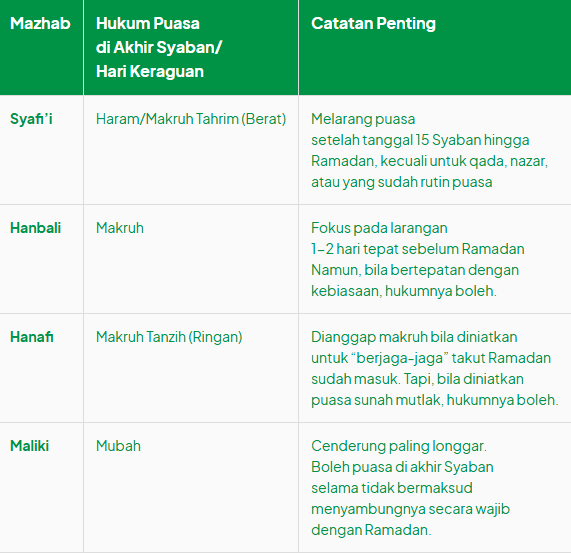
In short, here is the view of classical fiqh scholars from the four madhhabs on whether or not it is permissible to fast on the Day of Doubt:
Conclusion
Friends, the best worship is worship that is done with knowledge. Fasting before Ramadan is recommended as a form of practice. However, we must still pay attention to the restrictions set by Islamic law. Therefore, avoid fasting on the last days of Sha’ban or on the Day of Doubt. Especially if it is done just to be on the safe side. Keep your intentions pure in following the Sunnah of the Prophet Muhammad (peace be upon him). Proper preparation will make our obligatory acts of worship feel more special.
Additionally, let’s start preparing ourselves with other acts of righteousness, such as giving charity, from now on! Morning charity can be an excellent first step. Get into the habit of sharing, even in small amounts. Once this good habit is established, insha’Allah, during Ramadan, our souls and bodies will feel lighter. (Dompet Dhuafa/RQA)