


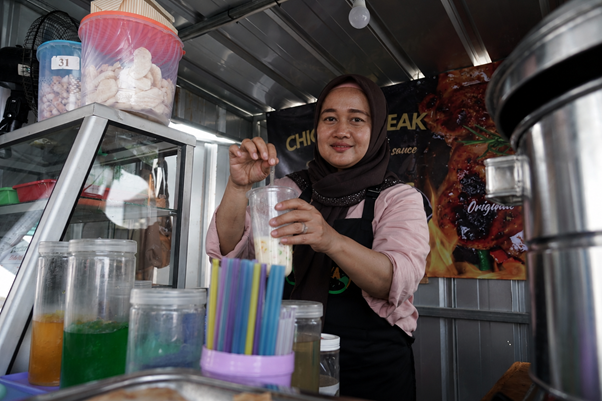
BOGOR —— That morning felt different for Hanisah Pramsiska, even before the sun was fully up. She had already woken up with a burst of energy she could hardly hide; it was evident from her face, which radiated enthusiasm as she looked forward to something she had been anticipating for a long time.
There was no time to linger in bed. Hanisah began her daily routine, one she’d been following for years. One by one, she prepared her cooking utensils. She had already packed a stack of pots, containers of spices, and the ingredients she would be preparing that day.

Once all her supplies were ready, Hanisa headed to the place that would bear witness to her struggle—a place where she would provide for her family. At a roundabout in the middle of a residential area in Pasir Angin Village, Cileungsi Subdistrict, stood a simple kiosk that was now hers. It wasn’t large, but it was sturdy enough to shelter her dreams and meet her family’s needs.
Yes, that little kiosk is now up and running. It is the result of a collaborative effort between Dompet Dhuafa and the OK OCE Humanitarian Foundation. In addition to Hanisa’s kiosk, which bears the sign “Kedai Mamim’s,” several other kiosks have also been set up.

Hanisah immediately set up the tools and materials she had brought from home; it didn’t take her long to reach her stall, which was about 100 meters from her house. Every now and then, she would greet the other stall owners, some of whom she already knew.
Hanisah is one of 10 beneficiaries of the Pasir Angin Nusadaya Food Court program, which was initiated by Dompet Dhuafa through the Indonesia Berdaya Foundation.

“This is one of the dreams of the majority of the people in Pasir Angin Village,” said Hanisah.
For years, Hanisah has relied on a simple food business to support her family’s needs. She has offered a variety of dishes to her customers, ranging from warm baso aci, assorted fried snacks, to pecel ayam, which has become one of her signature dishes.

Never one to stop innovating, she has recently begun offering a new menu item—chicken steak—in the hope of attracting more customers.
Before she had her own kiosk, Hanisah ran her business despite all the limitations. She sold her goods from home and occasionally moved from one location to another, following the crowds. One of the places she often went to was the Car Free Day (CFD) area, where people gather to exercise and enjoy the weekend.
However, selling on the go is no easy task. Her income is often unpredictable. There are days when her goods sell well and she almost sells out, but it’s not uncommon for her to have to go home with some unsold inventory. That uncertainty is part of the struggle she faces every week.

“We used to sell only from home and even then, we only accepted pre-orders—and not even every day—while we have daily expenses. Now, we might be able to sell today but not tomorrow,” Hanisah lamented.
On top of that, Hanisah is also burdened by various significant operational costs. In a single day, she often spends money on various fees, ranging from sanitation fees to dues collected by several groups at her sales location. This doesn’t even include the registration fee she must pay to be allowed to sell in that area.
On the other hand, her high level of mobility also drives up her transportation costs. Gas expenses for round-trip travel on Saturdays and Sundays can reach around 100,000 rupiah. These various expenses often eat into the profits she makes from selling.

“Meanwhile, my house is less than 100 meters away—I can walk there. Before, I had to buy gas to sell my goods on the go, but now I’ve been able to cut those costs. Plus, we’ve been provided with a booth or kiosk like this, so we don’t have to set up a tent,” Hanisah continued.
In addition to receiving a booth, Hanisah also received capital assistance to help ease the burden on her business, as well as training and guidance on legal matters, licensing, and halal certification. Dompet Dhuafa has also partnered with the University of Indonesia Halal Center (UIHC) to assist each MSME in obtaining halal certification.
Previously, her income was unpredictable, ranging from Rp150,000 to Rp400,000, but lately she has often been preoccupied and haunted by the specter of the current economic uncertainty. Compounding this is the rupiah exchange rate, which in early June 2026 briefly reached around Rp18,100 per U.S. dollar, driving up the prices of various business and household necessities.
This pressure has become even more acute as fuel prices have risen. For Hanisah, who has long relied on a vehicle to sell her goods on the go, the increase in transportation costs has become an additional burden that is hard to avoid.
“Clearly, that money was set aside because, as it happens, one of my children is working on their thesis, and another is in high school—both of whom need a lot of money. So, the money I would have spent on those expenses, I was able to save up and send to my child who’s studying out of town,” Hanisah explained, relieved.
“In fact, we were even able to save more than that,” she added.
Read also: Zakat’s Charitable Aid Revives the Spirit of MSMEs After Disaster

Hanisah hopes that in the future, her business will become even more popular and successful. She explained that after receiving two years of mentoring from Dompet Dhuafa, she and the other vendors have become self-reliant—including owning their own shop units.
“We feel that we’ve been helped, and I’m so grateful for this program—the support from Dompet Dhuafa, OK OCE Kemanusiaan, and the UI Halal Center. This program has been a huge help, especially for me—a stay-at-home mom who used to just sell things from home—and now I can have a booth as nice and cool as this… alhamdulillah. I hope this program continues in the future so that even more people can benefit from it,” Hanisah concluded. (Dompet Dhuafa)
Text and photos: Anndini Dwi Putri
Editor: Dhika