


The enthusiasm of Indonesian Muslims to perform the sacrifice every Eid al-Adha never wanes. The excitement of the sacrifice is evident from the makeshift livestock pens that appear along the roadsides. This act of worship not only brings us closer to Allah SWT, but also to our environment and the surrounding community. It even connects us with our Muslim brothers and sisters in remote areas who rarely have the opportunity to enjoy meat in their daily lives. It is no wonder that various methods are employed to make sacrifices possible, one of which is through collective sacrifice contributions.
Collective sacrifice contributions are not merely a form of social cooperation but also a reflection of collective faith—that the sacrifice to draw closer to Allah SWT can be undertaken collectively. When one cow is divided among seven people to share the reward of the sacrifice, there is no reason to give up in the face of circumstances. However, what about the ruling on sacrificial animal contributions in Islam? Is the act of worship still valid?
The Ruling on Sacrificial Animals
The four well-known schools of Islamic jurisprudence—the Hanafi, Maliki, Shafi’i, and Hanbali schools—have formulated different rulings regarding the act of sacrificial animal offerings. Some require sacrifice for those who are able, while others only recommend it or consider it a strongly recommended act. There are even those who encourage a Muslim to take a loan in order to perform the sacrifice. For more information on the rules of sacrifice, you can read the article at The Rules of Sacrifice According to the Four Imams.
So, what about the rules on joint sacrifice offerings? The answer is thoroughly discussed in the sharia consultation below with Ustaz Ahmad Fauzi Qasim, Sharia Council of Dompet Dhuafa.
Joint Sacrifice Offerings
Currently, joint sacrifice contributions are quite common among the community. The number and purpose of these contributions vary widely. Can such joint sacrifice contributions be categorized as valid sacrifices according to Islamic law?
Joint sacrifice contributions must meet the minimum number of sacrificial animals. A goat sacrifice is only permissible for one person and may be intended to represent one family. Meanwhile, a cow or camel sacrifice may be shared among a maximum of seven people. Therefore, the only permissible joint sacrifice is for cows, buffaloes, or camels.
Although permissible in Islam, some scholars explain that sacrificing one goat is better than a joint sacrifice of a cow or camel involving seven people. Why? Because seven goats provide more benefits than one cow. This opinion is cited from Shahih Fiqh Sunnah (2:375) written by Sheikh Abu Malik Kamal bin As-Sayyid Salim, Fatwa Lajnah Daimah (no. 1149), and Syarhul Mumthi’ (7:458).
On the other hand, Imam As-Saerazi Asy-Syafi’i stated, “A goat (alone) is better than a cow shared by seven people. Because the person performing the sacrifice can shed the blood (slaughter) alone.” (Al Muhadzab 1:74)
Based on the opinions of the scholars mentioned above, it can be concluded that the economy of Arab societies is either good or average, allowing people to afford one sacrificial animal per person. In Indonesia, however, there are still many people from the lower-middle class, making the practice of pooling resources to sacrifice one cow for seven people a viable solution to fulfill the obligation of sacrificial offerings.
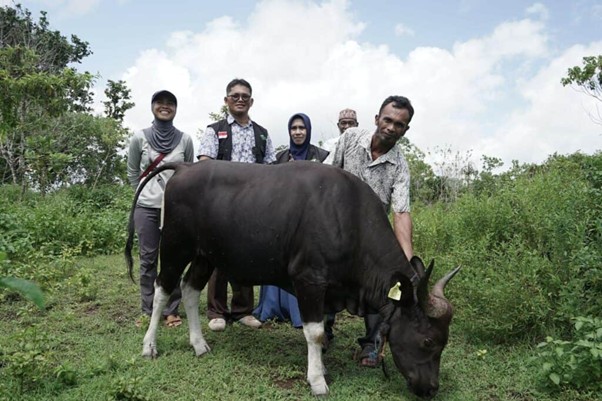
The Ruling on Joint Sacrifice
The ruling on joint sacrifice is found in a hadith narrated by Ibn Abbas in the book Al-Mustadrak by Imam Al-Hakim.
We were with the Messenger of Allah, peace be upon him, on a journey when the time for sacrifice arrived, so we pooled our money to buy a cow for seven people.
“We were traveling with the Messenger of Allah, peace be upon him, and the day of sacrifice (Eid al-Adha) arrived. We pooled our resources to buy a cow for sacrifice, with seven of us sharing the cost.”
(HR. Al-Hakim)
Additionally, there is a narration in Sahih Muslim from Jabir bin Abdullah:
“We were performing the tamattu’ pilgrimage with the Messenger of Allah, peace and blessings be upon him, and we slaughtered a cow for seven people, sharing it among us.”
“We once performed the tamattu’ pilgrimage (performing umrah before hajj) with the Messenger of Allah, peace and blessings be upon him, and we slaughtered a cow from the collective contribution of seven people.”
(Reported by Muslim)
From the above evidence and opinions of scholars, it can be concluded that the ruling on sharing the cost of sacrificial animals is valid and permissible.
Benefits of Sharing the Cost of Sacrificial Animals
Sharing the cost of sacrificial animals is a form of charitable giving that fosters solidarity among Muslims. Through this practice, those who sacrifice receive reward while also helping those in need to enjoy a meal of meat.
Read also: B Things That Can Make Your Sacrifice Invalid: Characteristics of Animals That Are Prohibited for Sacrifice
Sacrifice at Dompet Dhuafa
Friends, don’t miss this Eid al-Adha moment by making a sacrifice with Dompet Dhuafa. Dompet Dhuafa also provides cows for sacrifice that can be shared by a maximum of seven people. In fact, there are also options for cows or buffaloes in Palestine, Myanmar, and Somalia.
There are many benefits you can get by entrusting your sacrifice to Dompet Dhuafa. First, the sacrificial animals are guaranteed to come from local farmers, which means we are supporting the sustainability of their businesses while also helping their economic conditions. Second, Dompet Dhuafa always inspects the health and cleanliness of the sacrificial animals through a quality control process to ensure the animals we purchase are of the highest quality. Third, the process is transparent and trustworthy. Dompet Dhuafa keeps donors informed about the entire sacrificial process, from selection, slaughter, to the distribution of the meat through an integrated system that is easily accessible to donors. (RQA)