


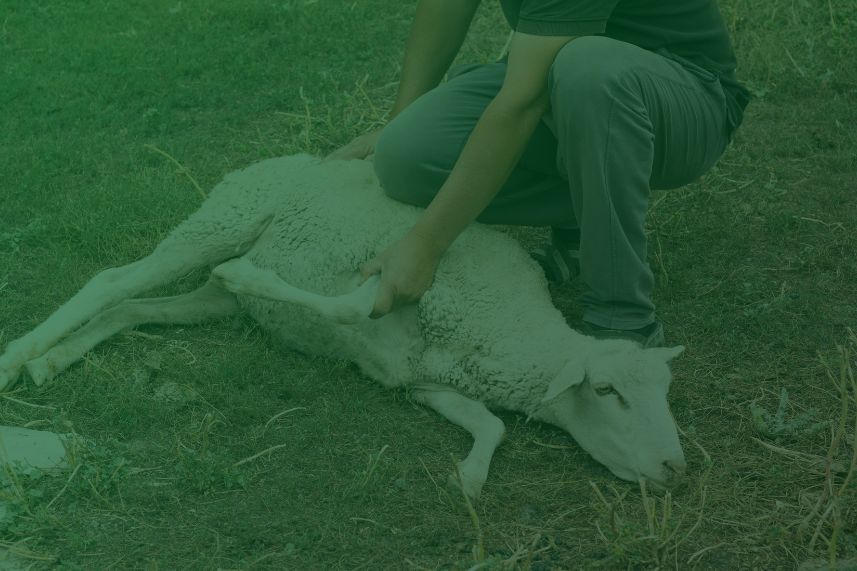
After going through the process of selecting the best sacrificial animal, it is now time for you to learn the proper way to slaughter the animal according to Islamic law. On Eid al-Adha, which only comes once a year, your sacrificial animal will be slaughtered. It would be a great pity if your sacrifice was deemed invalid simply because you made a mistake or missed a step in the proper slaughtering procedure according to Islamic law. Therefore, before the holiday arrives, we need to learn the proper procedures for slaughtering sacrificial animals so that our worship is perfect. Let’s take a look at the following explanation!
Procedures for Slaughtering Sacrificial Animals
“Indeed, Allah has enjoined upon you to do good in all things. If you kill (carry out qisas or slaughter an animal), then do so in the best manner. And if you slaughter, then slaughter in the best manner. Let one of you sharpen his knife and make the animal pleasant for itself.”
(HR Muslim, No. 1955)
Islam teaches the proper and correct method of sacrificial slaughter, meaning that the animal to be slaughtered should not be harmed. Below are the detailed steps for sacrificial slaughter derived from the hadith and explanations of scholars:
1. Those who sacrifice and slaughter animals must be in a state of purity.
2. The place where the sacrificial animals are slaughtered must be relatively clean of dirt.
3. Be gentle toward the sacrificial animals; do not pull them roughly, let alone hit them.
4. Give the sacrificial animals water to drink before slaughtering them to practice the principle of al-ihsan taught by the Prophet Muhammad (peace be upon him).
5. Face the sacrificial animal toward the qiblah.
6. When slaughtering, the slaughterer recites the prayer:
اَللَّهُمَّ صَلِّ عَلَى سَيِّدِنَا مُحَمَّدٍ وَعَلَى آلِ سَيِّدِنَا مُحَمَّدٍ
“O Allah, bestow Your mercy upon Prophet Muhammad and his family.”
Then recite the prayer:
بِسْمِ اللهِ وَاللهُ أَكْبَرُ اللَّهُمَّ مِنْكَ وَ إِلَيْكَ فَتَقَبَّلْ مِنْ …..
Meaning: “In the name of Allah and Allah is Great. O Allah, this sacrifice is from You and for You, accept this sacrifice from me…”
7. Upon entering the first day of Zulhijah, it is recommended not to cut nails or hair until the sacrificial animal is slaughtered.
From Umm Salamah, the Prophet Muhammad (peace be upon him) said:
“If the first ten days of Zulhijah have begun and any of you intends to sacrifice, let him not touch (cut) his head or body hair (interpreted by some scholars as nails) at all.”
(Reported by Muslim, No. 1977)
8. Sharpening the knife used for slaughtering.
9. Speeding up the slaughtering process so that the sacrificial animal does not suffer for too long.
10. Reciting the takbir during the slaughtering process.
11. The slaughtering should be done in the presence of the community so that many people can pray for and witness the act of sacrificial worship.
12. It is recommended for the sacrificer to take a portion of the animal they sacrifice, even if it is small, provided it is not a sacrifice made as a vow or ta’yin.
These are the proper procedures for sacrificial slaughter according to Islamic law. Friends, if you want to ensure that your sacrifice is valid and meets the slaughter procedures outlined above, you can entrust it through Dompet Dhuafa with online sacrifice. Before deciding to perform an online sacrifice, you can read more information about the rules of online sacrifice in the article What Are the Rules for Online Sacrifice?.
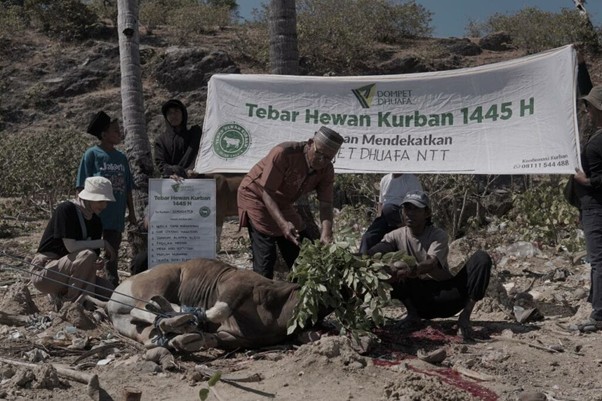
The Time for Sacrificial Slaughter According to Islamic Law
The recommended time for sacrificial slaughter is from sunrise on the 10th of Zulhijah or precisely on the day of Eid al-Adha.
It is best to perform the sacrifice after the Eid prayer. Thus, there are three conditions that must be met before sacrificing the animal: sunrise, completion of the two-rak’ah Eid prayer, and the sermon. At that point, the time for sacrificing the animal is appropriate. For those who do not perform the Eid al-Adha prayer, you should estimate or wait for the prayer and sermon to conclude at the nearest mosque.
Meanwhile, the deadline for slaughtering sacrificial animals is at sunset on the last day of Tasyrik on the 13th of Zulhijah.
Narrated by Al-Barra’ bin ‘Azib, the Prophet Muhammad said, “Whoever slaughters a sacrificial animal after the Eid al-Adha prayer, then the slaughter is complete and he is in accordance with the Sunnah of the Muslims.”
(HR Bukhari no. 5546)
It is important to note that if you slaughter the sacrificial animal before the designated time or after the recommended time, such as slaughtering it on the night of Eid al-Adha, then the slaughter is not considered a sacrificial act but rather a regular act of charity.
Narrated by Al-Barra’ bin ‘Azib, the Prophet Muhammad (peace be upon him) said, “Indeed, the first thing we do on this day is to perform the prayer (Eid al-Adha), then we return home and slaughter (the sacrificial animal). Whoever does so has followed our Sunnah. As for those who slaughter their sacrificial animals before the Eid al-Adha prayer, their slaughter is merely meat they give to their families and is not considered part of the sacrificial animal (as intended).”
(HR Bukhari no. 965)
Sacrifice with Dompet Dhuafa
Don’t have much time to choose the best sacrificial animal? Dompet Dhuafa has the solution! There are four definite benefits you will get when you perform sacrifice with Dompet Dhuafa. What are they?
First, it is definitely male. Your sacrificial animal is guaranteed to be male. Why must it be male? Because Dompet Dhuafa cares about the sustainability of livestock. If too many female animals are used as sacrificial animals, the female population may become unbalanced, making it difficult for them to reproduce.
Second, guaranteed quality control. Dompet Dhuafa always ensures the physical condition and health of the sacrificial animals are good and of high quality. The quality control process goes through many stages, from weighing the animals, ensuring they are healthy, to ensuring they are free from defects according to Islamic law.
Third, distribution is guaranteed to reach even the remotest areas of the country. Dompet Dhuafa is committed to distributing sacrificial meat to remote and rural areas. Why? Because in these areas, many people are unable to perform the sacrifice and therefore cannot consume meat. According to a study by IDEAS, most sacrificial animals are still concentrated in large cities, where the meat ends up piling up.
Fourth, we guarantee fast reporting. The sacrificial process at Dompet Dhuafa is transparent and trustworthy. As much as possible, we report the condition of the sacrificial animals in real time, starting from the selection, slaughter, to the distribution of the meat through an integrated system that can be easily accessed by you, the donors.
In addition to the four key benefits mentioned above, by sacrificing through Dompet Dhuafa, you are also helping to empower local farmers. Dompet Dhuafa sources livestock from local farmers with the aim of supporting the sustainability of their farming businesses, ensuring that the economy of farmers is equitable and runs smoothly. (RQA)