

Every year, when Eid al-Adha arrives, Muslims around the world welcome it with enthusiasm and emotion. One of the main practices performed is the traditional sacrifice of animals, which not only reminds us of the sacrifice of Prophet Ibrahim AS, but also sharpens our social awareness and sincerity of faith. However, is sacrifice obligatory? What is its status in Islamic law?
In Islam, the ruling on sacrificing animals is a strongly recommended sunnah (sunnah muakad). This means that sacrificing animals is not an obligation like prayer or zakat, but abandoning it for those who are able to do so is considered makruh (disliked) by the majority of scholars.
Imam Malik, Imam Shafi’i, and Imam Ahmad agree that sacrificing animals is a sunnah muakad. Meanwhile, Imam Abu Hanifah opines that sacrifice is obligatory for Muslims who are financially capable and meet certain conditions. The key word here is “capable.” If someone has financial leeway on the days of Eid al-Adha, it is highly recommended for them to perform sacrifice. This is a form of worship that not only fosters obedience to Allah but also strengthens compassion for others.
Reviving the Sunnah, Strengthening the Heart
Although not obligatory, qurban has extraordinary virtues. It is an act of worship that touches three aspects at once: spirituality, sociality, and sincerity. By performing qurban, a Muslim is invited to:
- Emulate the sacrifice of Prophet Ibrahim and Prophet Ismail
- Strengthen the vertical relationship with Allah through obedience
- Continue horizontal relationships with others through the distribution of meat
The Prophet Muhammad SAW said:
“There is no deed of the son of Adam on the day of Eid al-Adha that is more beloved to Allah than the sacrifice of an animal…” (HR. Tirmidzi)
For many people, sacrifice may have become an annual routine. But if we reflect deeper, sacrifice is an education of the heart. It trains us to give up the things we love for the good of others.
In an increasingly individualistic world, sacrifice teaches us that abundance is not only to be enjoyed by ourselves. Others have a right to it too. When someone willingly sets aside some of their wealth to buy a sacrificial animal and then gives it to those in need, they are planting the seeds of empathy within themselves.
Read also: Slaughtering Kurban Animals in the Midst of Islamic Minorities
Not everyone is given the opportunity to perform sacrifice. Therefore, when we have sufficient provisions and are among those who are able, performing sacrifice becomes one of the best ways to express gratitude for Allah’s blessings.
“Indeed, We have given you many blessings. So establish prayer for your Lord and sacrifice [for Him].” (QS. Al-Kautsar: 1–2)
This verse teaches us that one way to show gratitude is by sharing and getting closer to Allah through sacrifice.
Don’t Delay Doing Good
Sometimes, because they feel it is not obligatory, people postpone or even neglect sacrifice. However, in the Sunnah Muakkadah, there is a virtue that cannot be overlooked. If there is abundance in one’s provisions, why not utilize it to perform an act of worship whose rewards continue to flow?
Even if one cannot afford to buy an animal, there are now many social organizations like Dompet Dhuafa that facilitate collective sacrifice. This opens opportunities for anyone to participate in this act of worship according to their ability.
Sacrifice is not just about cows and goats, but about a sincere heart. It is not merely about slaughtering, but also about purifying oneself from excessive love for the world.
Although it is only a Sunnah, sacrificing an animal is an act of worship that leaves a deep imprint on the life of a Muslim. It is a field of blessings, a social bridge, and a spiritual means to draw closer to Allah.
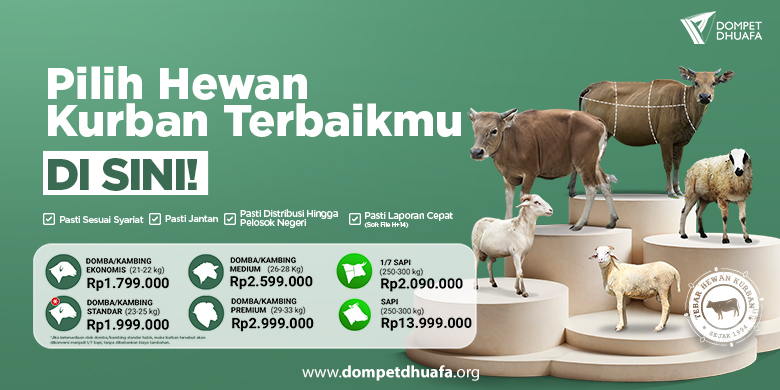
Channel your best sacrifice through Dompet Dhuafa. Let us revive the Sunnah, strengthen our hearts, and sharpen our compassion through this meaningful act of worship.