


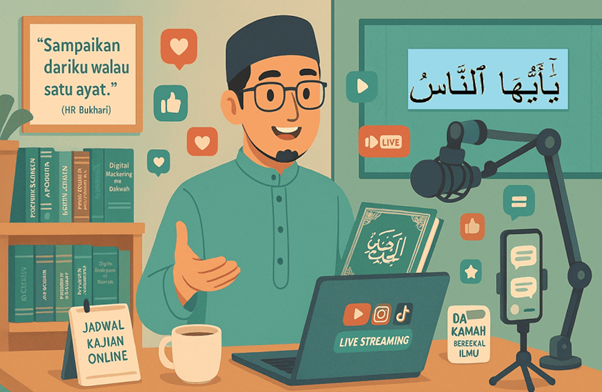
JAKARTA — Amidst the ease of accessing information via fast-paced and distraction-filled social media, there is an interesting phenomenon amongst Gen Z youngsters: hijrah. Whilst in the past, hijrah was more commonly known as a term referring to the Prophet Muhammad’s physical journey from Mecca to Medina, today the meaning of hijrah is far broader than simply moving from one place to another.
Among Gen Z, ‘hijrah’ is now understood as a lifestyle change, moving towards a better path in line with religious values and a life in harmony with the teachings of Islam.
Interestingly, this trend of hijrah is actually booming thanks to social media. The modern-day process of hijrah has become a choice for Gen Z. For many in this generation, social media has even become a place to seek inspiration and motivation for hijrah, whilst also finding communities with similar goals.
Statistical data further reinforces this trend. A survey conducted by Ahmad Hidayat (2021) showed that 78 per cent of Muslim teenagers aged 15–22 in major Indonesian cities access social media to view religious content at least twice a week. YouTube (69 per cent), Instagram (61 per cent) and TikTok (52 per cent) are the most dominant platforms for consuming Islamic content.
According to the 2025 Survey on the Quality of Religious Life among Muslims, published by the Directorate-General for Islamic Community Guidance at the Ministry of Religious Affairs, Gen Z recorded the highest score in the ability to read the Qur’an at 56.29 per cent compared to other generations. Furthermore, Gen Z also achieved a score for religious tolerance of 80.03 per cent, higher than that of Millennials (78.77 per cent), Generation X (78.97 per cent) and Baby Boomers (78.81 per cent).
Gen Z and Social Media
Before delving further into Gen Z’s version of hijrah, let us discuss the characteristics of Gen Z, known as digital natives – a generation that has been intimately familiar with various digital devices, such as smartphones, tablets and computers, since childhood. Hellen Chou P states that Gen Z, also known as the digital generation, is a young generation with a high level of dependence on digital technology.
From scrolling through Instagram, watching YouTube, joining live sessions on TikTok, to live-streaming the latest games – these are all activities that are almost inseparable from young people’s daily lives. However, behind all the enjoyment offered by this digital world, many in Gen Z also feel jaded.
Although they appear to be constantly up to date with the latest trends, there lies a sense of exhaustion stemming from the pressure to always appear perfect on social media. This is where hijrah begins to emerge as a choice; many feel the need to take a break from a life that is too worldly-oriented, and hijrah becomes the answer for those seeking a deeper meaning in life.
Digital platforms make it easy to learn about religion from anywhere. Many hijrah influencers, as well as young ustaz and ustazah, are actively sharing educational content about hijrah through short videos, Instagram posts, or threads on X.
For example, on TikTok, we often come across short videos sharing inspiring stories about the journey of hijrah. These range from stories of people giving up bad habits, starting to wear the hijab, practical tips for staying steadfast on the right path, to choosing a more Islamic lifestyle. All of this is easily accessible, and the style of presentation is relaxed and relatable, ensuring young people don’t feel lectured to, but are instead motivated.
For instance, there are influencers who were once known as Instagram celebrities with a free-spirited lifestyle, but are now actively sharing Islamic content. This has inspired many Gen Zers to embark on their own hijrah. They reason that if even these influencers can change, why can’t we?
Today, perhaps we do not need to leave the city where we live. However, there may be other things we must leave behind to make our lives better. Muharram, as the start of the Islamic New Year, is the perfect time to ask ourselves:
“If today were the start of my hijrah, what would I have to leave behind?”
Leave Toxic Relationships Behind
We must understand that not everyone in our lives brings us good. Some relationships help us grow, whilst others cause us pain. Relationships filled with manipulation, that undermine self-esteem, hinder growth, or distance us from values of goodness often leave us with nothing but emotional exhaustion.
Of course, it’s not easy to break free from the cycle of toxic relationships; many victims fear that leaving someone with whom they share an emotional bond will lead to loneliness, uncertainty, or even the anxiety of losing someone who has long held such significance in their lives.
Unhealthy relationships usually erode self-confidence, leading victims to believe they’ll never find another partner. This is also due to emotional dependence, trauma bonding resulting from manipulation, and the fact that many victims are trapped by false hopes that their partner will change.
Moving on sometimes means having the courage to create some distance. Not out of hatred, but to protect oneself and remain mentally and spiritually healthy. After all, not every separation is a loss. Some separations are, in fact, a form of salvation.
Avoid Doomscrolling and Hate Comments
We now live in a world where a single tap of a finger allows us to see anything. Have you ever intended to check social media for just five minutes, only to realise an hour has passed?
Without realising it, we’ve become trapped in the phenomenon of doomscrolling—the habit of endlessly scrolling through social media timelines whilst consuming negative content or news. As a result, time is wasted, our minds are cluttered, yet our hearts remain empty.
What’s more dangerous is that what we see every day gradually influences the way we think. Seeing too much drama on social media, getting caught up in endless debates, or constantly comparing our lives to others’ can fill our hearts with envy, anger, and even distance us from the good things in life.
A modern-day version of Hijrah might mean choosing to stop following accounts that fill our hearts with envy and resentment, or gossip pages, or even those that encourage bad habits. It could also mean cutting back on the habit of scrolling for hours on end, and replacing it with reading the Qur’an, reading books, or learning something new or a new skill.
‘Hijrah’ can also mean changing the way we speak on social media. Moving from being quick to judge to being wiser. From being quick to spread anger to more often sharing things that bring benefit.
Not Laziness, But Procrastination
Have we ever felt, “Why does it feel like my life’s goals are still so far away?”, even though we already have plenty of plans and dreams? It’s true that everyone has a different timeline.
But many dreams fail not because of a lack of ability, but because we say all too often:
“Later. I’ll study later. I’ll start my business later. I’ll improve myself later. I’ll take my worship more seriously later. I’ll give charity later.”
The word “later” sounds simple, but if repeated constantly, it can become the excuse that prevents us from ever truly getting started. Yet time never waits. The habit of putting things off—or procrastination—may seem minor, but its impact is enormous. It steals opportunities bit by bit until, eventually, we realise that year after year has passed without much change.
The same thing often happens when it comes to giving charity. Many people think that charity must wait until one is rich. In fact, Islam does not teach us to wait until we are rich before sharing.
We often say, “Once my salary reaches double figures, I’ll start giving regularly” or “Once I’ve got my own business, I’ll give more generously”. Yet, that opportunity may never come if we keep putting it off.
Muharram reminds us that life marches on. So one of the greatest changes we can make is to stop putting off the good deeds that could actually begin today.
A Shift Away from a Consumerist Lifestyle and FOMO
Trends are constantly changing. New products keep appearing. Discounts come along almost every day. If we’re not careful, we’ll end up buying things not because we need them, but because we’re afraid of being seen as out of touch. Not to mention the phenomenon of FOMO (Fear of Missing Out), which makes many people feel they must own something so as not to be seen as left behind.
Consequently, we buy things not because we genuinely need them, but because we’re afraid of falling behind trends, want to emulate others’ lifestyles, or simply want to appear “up to date”. Yet, not everything that’s currently trending is something we actually need.
Hijrah also means learning to control our desires. Buying only what we need, managing our finances wisely, and realising that happiness does not always come from new possessions. Because Islam teaches balance, not excess.
Even in matters of work and daily life, hijrah means improving our intentions. Working is not just about chasing a salary, but also a means of bringing benefit to others. Studying is not merely about chasing grades, but rather a foundation to enable us to make a greater contribution.
The modern-day version of hijrah actually teaches us to start with small steps. Setting aside Rp5,000 or Rp10,000 every day may seem simple, but if done consistently, its value far exceeds that of good intentions that are constantly put off.
Now, there is no longer any excuse that giving charity is difficult. Through the Dompet Dhuafa App, for example, we can make charitable contributions, infaq, zakat or humanitarian donations anytime and anywhere simply via our mobile phones. The technology we often use for scrolling through social media can also be a means to increase our good deeds.
Especially now that we are entering the month of Muharram, a month in which we can honour orphans. Honouring them doesn’t always have to mean making a large donation; it can also mean becoming a ‘Besteam’ or ‘Bestian Sama Yatim’ – someone who accompanies an orphan as they grow and achieve the dreams they aspire to. Let’s become a bestie to an orphan via digital.dompetdhuafa.org/donasi/bestianyatim. (Dompet Dhuafa)
Text and photos: Anndini Dwi Putri
Editor: Dhika