


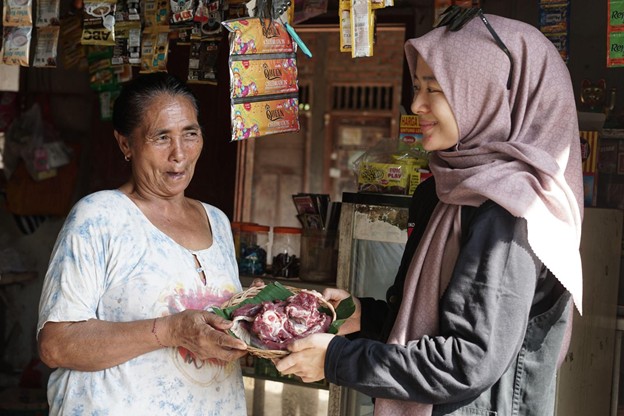
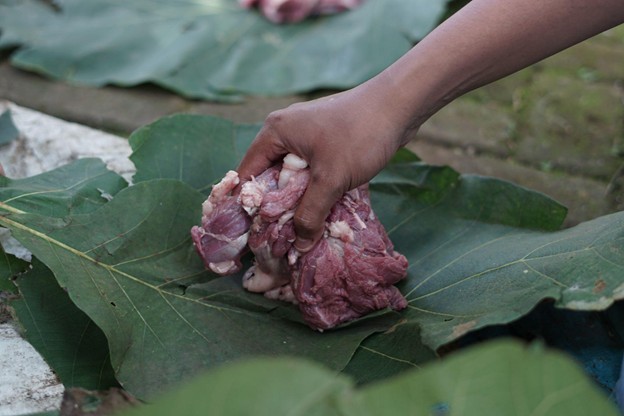
JAKARTA — During Eid al-Adha, Indonesia, as one of the countries with the largest Muslim population in the world, performs the qurbani ritual of slaughtering livestock on the 10th of Dhu al-Hijjah and the three days that follow (the day after Eid). Generally, Indonesians slaughter livestock such as goats, cows, and sheep, which are then distributed to the poor.
Apart from fulfilling worship, this ritual can also be a means of sharing with others and an opportunity to spread improved nutrition to people in need.
Unfortunately, the momentum of joy is not felt equally by the people of Indonesia. Some areas in Indonesia actually experience a deficit of sacrificial meat. This is due to poverty and uneven distribution of meat.
Read also: The Law of Sacrifice for Those Who Can, Is it Obligatory?
Haryo Mojopahit, a researcher and Director of the Institute for Demographic and Poverty Studies (IDEAS), said that the cause of the qurbani meat deficit in certain regions has certain characteristics.
On the island of Java itself, the main cause of the meat deficit is high poverty, so that the residents cannot afford to sacrifice animals for qurbani. This is in contrast to areas outside Java, which tend to be isolated and underdeveloped due to geographical conditions, making them difficult to access.
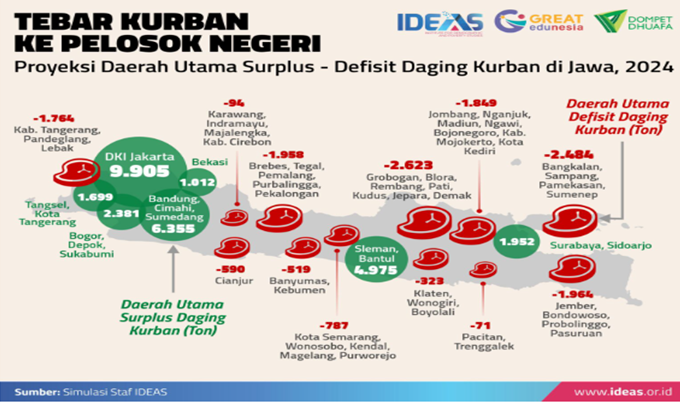
The results of the IDEAS study show that areas such as Grobogan, Blora, Rembang, Pati, Kudus, Jepara and Demak in Central Java experienced a qurbani meat deficit of up to 2,623 tons in 2024. The Madura Island area, East Java, touched a deficit figure of 2,484 tons. Then Jombang, Nganjuk, Madiun, Ngawi, Bojonegoro, Mojokerto, and Kediri in East Java, reached a deficit of 1,849 tons.
In the areas mentioned, such as Ngawi Regency, the average population consumes only 0.01 kg/capita/year of meat. Then Pandeglang Regency has 0.06 kg/capita/year and Magelang Regency has 0.18 kg/capita/year.
Outside of Java itself, areas that have limited access to the distribution of sacrificial meat include Kubu Raya Regency, West Kalimantan with an average meat consumption of 0.08 kg/capita/year; Sigi Regency, Central Sulawesi with 0.16 kg/capita/year; to North Halmahera Regency and West Seram Regency, in Maluku, which only reached 0.01 kg/capita/year and 0.11 kg/capita/year, respectively.
This is in contrast to city centers such as DKI Jakarta, which will experience a meat surplus of 9,905 tons by 2024. The same goes for areas in West Java such as Bandung, Cimahi, and Sumedang, which will reach 6,355 tons, as well as Sleman and Bantul in Yogyakarta, which will reach 4,957 tons.
The figures mentioned above reflect the disparity in meat consumption in Indonesia. According to Haryo, it is important to carry out nutritional interventions by distributing sacrificial meat evenly to all corners of Indonesia. Not only that, but collaboration from various elements of society is needed to make this happen.
Read also: Slaughtering Kurban Animals in the Midst of Islamic Minorities
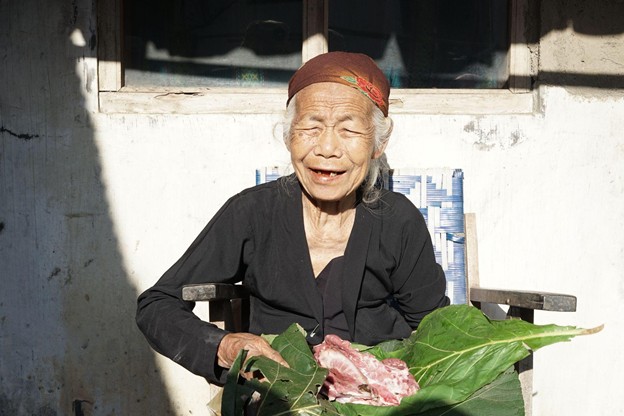
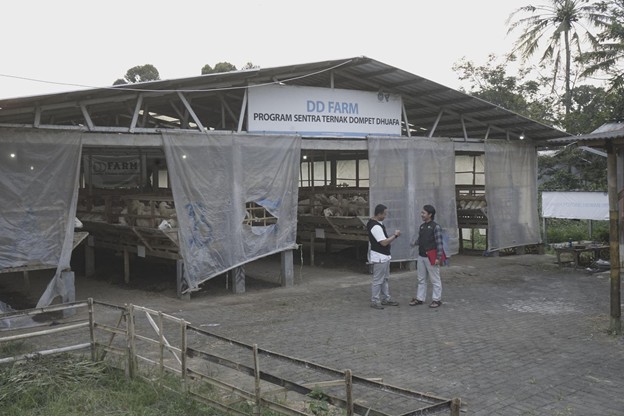
For the areas of Java, Haryo suggested improving the process of identifying the recipients of meat or mustahik in remote areas. For areas outside Java, the ability to open up access to the remoteness of the area is needed.
Of course, this brings its own notes for the qurban committee in Indonesia which in general is still decentralized in thousands of temporary local qurban committees. So that the data regarding the mustahik is not centralized and is not updated every year. As well as distribution which is still based in mosques, prayer rooms, Islamic boarding schools, educational institutions, and companies.
Every year, Dompet Dhuafa holds the Tebar Hewan Kurban (THK) or the Distribution of Sacrificial Animals in an effort to distribute sacrificial meat equally to those in need. Not only that, since its inception in 1994, THK has also addressed the surplus of meat in urban areas by distributing it to remote areas or 3T areas.
For those of you who are planning to sacrifice an animal this year, you can visit digital.dompetdhuafa.org/kurban. Let’s sacrifice an animal and spread happiness evenly to all corners of the country! (Dompet Dhuafa)
Text: Hany Fatihah Ahmad
Photo: Hany Fatihah Ahmad, IDEAS
Editor: Dhika