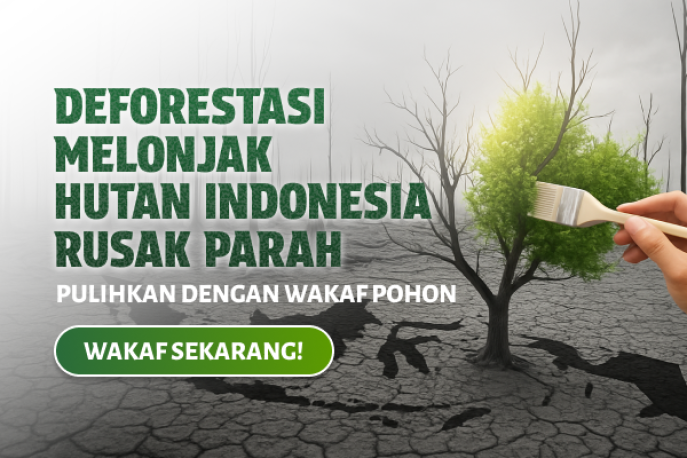


In recent years, natural disasters have become increasingly frequent and severe. Floods occur one after another, landslides destroy settlements, and droughts threaten livelihoods. Many of these disasters do not occur suddenly, but are the result of long-term environmental degradation. In Sumatra in 2025, heavy rains caused uncontrolled flooding. Rivers could no longer contain the water flow, homes were submerged, and farmland was damaged. However, this event was not merely about heavy rainfall. It was closely linked to the condition of forests that had lost their natural function as buffers.
Data from the Ministry of Environment and Forestry indicates that millions of hectares of land in Indonesia are in critical condition. When trees are lost, the soil’s ability to absorb water also diminishes. Consequently, water flows unchecked, and disasters become inevitable. In such situations, short-term approaches are no longer sufficient. Solutions capable of delivering sustainable impact are needed. This is where the concept of tree waqf becomes relevant—not merely as a religious act, but also as an effort to maintain the balance of nature.
What Is Tree Waqf
Tree endowment is a form of endowment carried out by planting trees to provide long-term benefits for the environment and human life. Unlike conventional endowments such as land or buildings, tree endowment focuses on ecosystem sustainability. The trees planted not only grow physically but also provide various ongoing benefits. They keep the soil stable, absorb water, produce oxygen, and serve as a source of life for many creatures.
In Islam, planting trees holds immense religious merit. The Prophet Muhammad ﷺ said: “Every tree planted and utilized by living creatures is an act of charity.”
(Narrated by Bukhari and Muslim). This hadith indicates that every benefit derived from the tree becomes part of a continuous flow of reward. This is what makes tree endowment one of the forms of ongoing charitable deeds relevant to the needs of our time.
Tree Endowment as an Environmental Solution
When forests diminish, the impact is felt not only by nature but also by humans. Floods, droughts, and soil degradation are consequences we must face. Tree endowment offers a different approach. It does not merely provide temporary relief but builds a system capable of preventing future problems. Some of the main benefits of tree waqf include:
- helping to mitigate and reduce flood risks
- preserving water sources
- improving soil quality
- supporting the livelihoods of farmers and surrounding communities
By planting trees, one not only contributes to the environment but also to the social and economic well-being of the community.
Read also: Waqf for Climate Change
An Enduring Act of Charity for the Earth and Humanity
One of the unique features of waqf is its sustainable nature. As long as the benefits of the waqf are still being felt, the reward will continue to flow.
In the context of tree waqf, every leaf that grows, every drop of water absorbed, and every living creature that benefits becomes part of this ongoing charitable deed. This is a form of worship that does not end at a single moment but continues to grow alongside the tree’s development.
This concept makes tree waqf not merely an environmental solution but also a form of investment for the afterlife with long-term impact.
Tree waqf has two interconnected dimensions. On one hand, it maintains the balance of nature. On the other hand, it provides direct benefits to humans. When trees are planted in areas in need, the impact can be felt by the surrounding community. The soil becomes more fertile, water resources are better preserved, and the risk of disasters can be reduced. In this context, tree waqf is not just about the environment, but also about a better life for humanity. It is a form of compassion that is felt not only today but also in the future.
The environmental crisis is no longer a distant issue. It has become part of the reality we face today. If no concrete action is taken, the impact will grow increasingly severe and difficult to control. Tree endowment offers everyone the opportunity to contribute. There is no need to wait for large-scale efforts, as every tree planted holds significant value.
The Tree Waqf: Enduring Charity for the Earth and Humanity program from Dompet Dhuafa is here as an effort to address this challenge. Through this program, waqf is not only an act of worship but also a real solution for protecting the environment. Every tree donated as waqf will become part of a larger system, helping to reduce disaster risks, preserve natural resources, and provide benefits to the community.
Plant Today, Reap Forever
Tree waqf teaches us that goodness doesn’t always have to be grand from the start. It grows slowly but yields far-reaching impacts. A single tree planted today can become a protector in the future. It can retain water, stabilize the soil, and serve as a source of life for many creatures. From a religious perspective, this is a form of continuous charity. Every benefit generated becomes part of a reward that flows endlessly.
Dompet Dhuafa invites you to be part of this movement. Through tree endowment, you not only contribute to the environment but also leave a legacy of kindness that will endure. Channel your tree endowment now through Dompet Dhuafa, and let every tree become a charitable deed that grows for the earth and humanity.