

Not all livestock may be used as qurban animals. Islam has established clear guidelines regarding the types of animals that are permissible for qurban—ranging from the species, minimum age requirement, to the physical conditions that must be met. Understanding this is important to ensure that your qurban is valid and accepted.
Here is a quick summary of the types of animals permitted for Qurban:
Animal Type Minimum Age Notes Can It Be Shared?
- Sheep 1 year old Permitted 6 months old if already castrated No (1 person)
- Goat 1 year (2nd entry) Must be musinnah No (1 person)
- Cow/Buffalo 2 years (3rd entry) Must be musinnah Yes (max. 7 people)
- Camel 5 years (6th entry) Must be musinnah Yes (max. 7–10 people)
See the full explanation for each type of animal and its requirements below:
The Legal Basis for Types of Qurbani Animals in Islam
The provisions regarding the types of qurban animals are derived directly from the Qur’an and the hadith of the Prophet Muhammad (peace be upon him). Allah the Almighty states:
“And for every community We have prescribed a form of qurban, so that they may mention the name of Allah over the livestock He has provided for them…”
(Quran 22:34)
This verse affirms that qurban animals must come from the category of bahimatul an’am—specific livestock designated by Islamic law. Scholars agree that this category includes camels, cows, buffalo, goats, and sheep. Animals outside this category—including chickens, ducks, or fish—are not valid for qurban, even if they are expensive.
5 Types of Qurbani Animals Permitted in Islam
1. Sheep
Sheep are one of the most commonly chosen qurban animals, primarily due to their more affordable price. In the history of the qurban ritual, sheep hold a special place—Allah substituted a sheep for Prophet Ishmael when Prophet Abraham was about to slaughter him as an act of obedience.
Age requirements for sheep for qurban:
- At least 1 year old or have lost their baby teeth (permanent teeth)
- Exception: a 6-month-old sheep may be sacrificed if it appears large, healthy, and physically complete like an adult sheep—provided it is difficult to find a 1-year-old one
- 1 sheep per person performing the qurban—pooling is not allowed
2. Goats
Goats are the most commonly chosen qurban animals in Indonesia because they are easy to find and relatively affordable. Unlike sheep, goats have no age exemptions—the requirements are stricter.
Age requirements for goats for qurban:
- At least 1 year old and has entered its second year
- Must be musinnah—has lost its baby teeth and grown permanent teeth (poel)
- 1 goat per person performing the qurban—pooling is not allowed
3. Cattle
Cattle are the primary choice for those wishing to perform a collective qurban or pool resources. Valid qurban cattle must meet stricter age and physical condition requirements than goats or sheep.
Age requirements for qurban cattle:
- At least 2 years old and must be in their third year
- Must be musinnah—must have permanent teeth
- One cow is permissible for 7 sacrificers collectively
4. Water Buffalo
Water buffalo hold the same status as cows in the jurisprudence of qurbani. Although less popular than cows, water buffalo remain valid as qurban animals under the same conditions.
Age requirements for water buffalo for qurbani:
- At least 2 years old and must have entered the third year—same as cows
- Must be musinnah
- One buffalo is sufficient for 7 people performing the qurban collectively
5. Camel
Camels have the highest age requirement among all types of qurbani animals. In Indonesia, camels are rarely found as a local qurban option; however, for those wishing to qurban a camel—for example, through an overseas qurban program—these requirements still apply.
Age requirements for camels for qurban:
- At least 5 years old and must be in their 6th year
- Must be musinnah
- One camel is permissible for 7 to 10 people performing the qurban collectively
Physical Requirements for Qurban Animals That Must Be Met
In addition to type and age, the physical condition of the qurban animal also determines the validity of the act of worship. The Prophet Muhammad (peace be upon him) said:
“There are four defects that are not permitted in qurban animals: being blind in one eye and the blindness being clearly evident, being sick and the illness being clearly evident, being lame and the lameness being clearly evident, and being so emaciated that there is no marrow in the bones.”
(Hadith by Muslim, no. 1963)
Below is a complete table of defects that affect the validity of the qurban animal:
Types of Defects / Legal Conditions for Qurban Animals
- Blind in one or both eyes (obviously so) = Invalid
- Severe illness that is clearly visible = Invalid
- Limping that is clearly visible = Invalid
- Extremely thin — no bone marrow = Invalid
- Ear partially or completely cut off = Invalid
- Tail partially or completely cut off = Invalid
- Horn broken or cracked Makruh = (permissible, not recommended)
- Teeth cracked or broken Makruh = (permissible, not recommended)
Important Note
Animals with defects that are makruh (broken horns, chipped teeth) may be qurbani, but it is better to avoid them. Meanwhile, defects that invalidate the qurban (blindness, lameness, illness, extreme emaciation, severed ears or tail) render the qurban invalid even if the animal is of the required age.
Other Requirements for a Valid Qurban Animal
- The Animal Must Be Legitimately Owned by the Sacrificer
The qurban animal must be legitimately owned by the sacrificer—acquired through a halal purchase or raised by the sacrificer themselves. Animals obtained through theft, robbery, or other unhalal means are not valid for sacrifice.
- The Animal Must Not Have Consumed Impure Substances
Ask the seller or farmer about the type of feed given. Avoid animals known to be routinely fed impure substances, as this can affect the quality of the meat and the validity of the qurban.
- Slaughtered at the Proper Time
The slaughter of qurbani animals is only valid after the Eid al-Adha prayer on the 10th of Dhu al-Hijjah until the end of the Days of Tashriq (13th of Dhu al-Hijjah). Slaughtering outside this timeframe is not considered a valid qurban.
Tips for Choosing the Right Qurban Animal at the Market
After understanding the requirements, here are some practical tips for selecting a qurban animal directly at the market:
- Check the condition of the eyes—ensure they are clear, free of discharge, and not blind
- Check how the animal stands and walks—ensure it does not limp
- Examine the condition of the ears and tail—ensure they are intact and not cut
- Note the body weight—animals that are too thin risk not meeting the requirements
- Ask the seller to show the teeth—check if they are worn down appropriately for the animal’s age
- Inquire about the feeding history—ensure they have not been fed impure food
- Request a written statement from the farmer if possible
Additional Tips
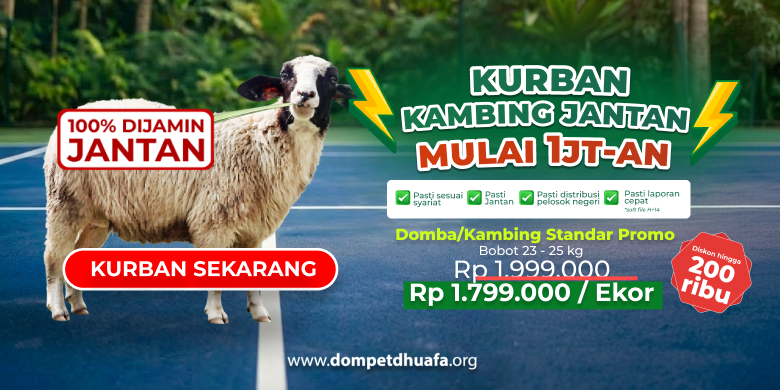
If you have difficulty verifying the above requirements yourself, entrust the purchase of qurbani animals to a trusted organization that conducts strict quality control—such as Dompet Dhuafa. Every animal is ensured to meet all requirements before slaughter.
FAQ: Frequently Asked Questions About Types of Qurbani Animals
- Can chickens or ducks be used as qurbani animals?
No, they are not permitted. Qurbani animals must come from the category of bahimatul an’am (large livestock), namely camels, cows, buffalo, goats, and sheep. Poultry such as chickens and ducks are not valid as qurban animals, according to the consensus of scholars from the four schools of Islamic jurisprudence. - Can one goat be used for the qurban of two people at the same time?
No, it is not permitted. Goats and sheep are only permitted for one person performing the qurban. The only animals that may be shared are cows, buffalo, and camels—with a maximum of 7 people per cow or buffalo, and 7 to 10 people per camel. - Can female qurbani animals be used?
Yes. There is no specific prohibition regarding the gender of qurban animals in Islamic law. Both male and female animals are valid for qurban, provided they meet the required age and physical conditions. - What if the qurban animal is found to be defective after purchase?
If the animal develops a defect that invalidates the qurban after purchase—and the defect is not due to the sacrificer’s negligence—the qurban remains valid. However, if the defect occurs due to negligence, it is best to replace it with a new animal that meets the requirements. - Is it permissible to perform a qurban through an organization without seeing the animal in person?
It is permissible and valid, as long as the trusted organization ensures the qurban animal meets all requirements according to Islamic law before slaughter. Ensure the organization conducts strict quality control and provides a transparent report to the person making the qurban.
Qurban with Dompet Dhuafa
Don’t have time to choose a qurban animal yourself? Entrust your qurban to Dompet Dhuafa. Every qurban animal we select has undergone strict quality control—including checks on species, age, and physical condition in accordance with Islamic law. Here are the benefits you’ll receive when sacrificing through Dompet Dhuafa:
- 5-parameter quality control—animals are guaranteed to meet sharia requirements
- Reaching 102 regencies/cities and 7 countries, including Palestine
- Transparent reporting: location, documentation, and proof of meat distribution
- Empowering 48 local livestock farmer partners across Indonesia
Ready to make your qurban? Let’s perform the qurban together with Dompet Dhuafa; insha’Allah, your qurban will bring blessings and happiness to others across the nation! (Dompet Dhuafa/RQA)