



Paying zakat is an obligation for every Muslim who meets the requirements, therefore, as Muslims, we should set aside our wealth to pay zakat in accordance with the law so that our deeds will be accepted by Allah SWT. One type of zakat that must be paid is zakat on wealth, also known as zakat maal. This zakat must be paid by the muzakki (the person obligated to pay zakat) through an official zakat collector, who then distributes it to the mustahik (those entitled to receive zakat). Therefore, it is important to understand the conditions of wealth that are subject to zakat.

Read also: What are people who are entitled to receive zakat called? Here is the explanation
As Muslims who serve the teachings of Allah SWT, paying zakat is an obligation that cannot be separated from the daily lives of those who meet the requirements. Therefore, it is necessary to clearly understand the requirements for wealth that must be given in zakat so that our deeds will be accepted by Allah SWT. As Allah SWT has said:
Meaning: “Establish prayer, give zakat, and bow down with those who bow down.” (QS. Al-Baqarah: 43)
So, what are the requirements that need to be considered if we want to pay zakat on our wealth to fulfill our obligations? Check out the following.
Requirements for Wealth that is Obligatory to Pay Zakat on
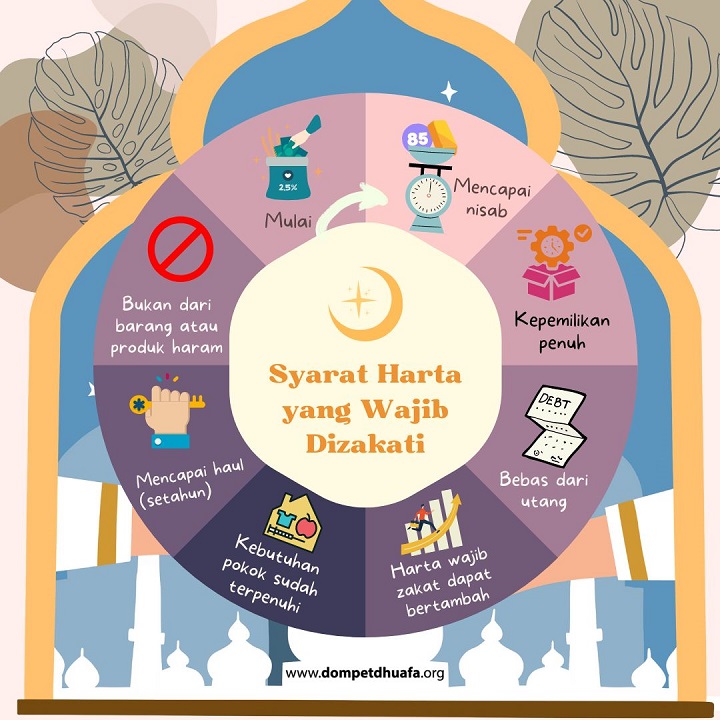
Not all assets are subject to zakat, even though the assets intended for zakat are general in nature. These assets must meet the following conditions.
1. Reaching the nishab is a definite requirement for wealth to be subject to zakat
The nishab referred to in zakat is the minimum amount of wealth that is subject to zakat if the ownership of the wealth has reached haul or one year, because there is no zakat on wealth if it has not reached one year. Depending on the type of zakat, the unit of zakat wealth may vary. Zakat on wealth can be classified based on the source of income, such as crop yields, marine yields, mining yields, discoveries, and livestock yields. Each type of zakat has a different nishab and calculation method.
2. Full ownership
Assets are subject to zakat if they have been owned for one year (haul) and can be used in full. However, if we are in debt and cannot use our assets in full because they are the property of the person we owe, then zakat is not obligatory.
3. Freedom from debt is a requirement for assets to be subject to zakat
As explained earlier, as long as the debt has not been paid off within the specified time, the assets do not fully belong to us and must be paid off before zakat is paid.
4. The assets can increase
One of the requirements that must be considered is that the assets can continue to increase in real or estimated value. Examples of assets that are not subject to zakat because they do not increase in value include office equipment, shops, factory buildings, and anything used as business tools or capital.
5. Basic needs have been met
To pay zakat, we must first consider whether our basic needs have been met, as this is our individual responsibility. Zakat can only be paid on assets that remain after basic needs have been met.
6. Ownership of the assets has reached haul (one year)
If the assets have been owned absolutely for one year (without any other person’s ownership rights), then it is obligatory to pay zakat on them. However, it should be noted that this condition does not apply to agricultural zakat and treasure, which have different laws.
The above conditions must be followed so that your zakat can be considered valid according to Islamic law. However, we also need to know the types of assets that are prohibited from being given as zakat.
8 Objects of Zakat That Are Not Obligatory to Give
The following are types of assets that are prohibited from being given as zakat
- Assets needed to meet basic needs, such as family expenses, household needs, housing, and other daily necessities.
- Outstanding debts.
- Antiques or paintings used for decoration that are considered reasonable in the eyes of the general public. If they are unreasonable and excessive, then these antiques are subject to zakat.
- Assets that have been frozen by a bank or other party, but if the freezing period has ended and exceeded one year (haul), then these assets are subject to zakat.
- Jewelry such as precious metals, gemstones, watches, and other jewelry that is considered reasonable in the eyes of the general public. If it exceeds the limits of reasonableness, then it is subject to zakat.
- Assets owned by the state, mosques, waqf, educational institutions, social organizations, and other assets used for social purposes.
- Assets that do not generate income, such as factories, shops, business vehicles, and office equipment.
- Assets obtained through activities that are prohibited in Islamic law.
Thus, these are the conditions and prohibitions of zakat. Hopefully, with this information, you can perform your zakat properly and correctly so that it will be accepted by Allah SWT. Do not delay your obligation to our friends out there who are in need and your place in the hereafter. Let’s give zakat!