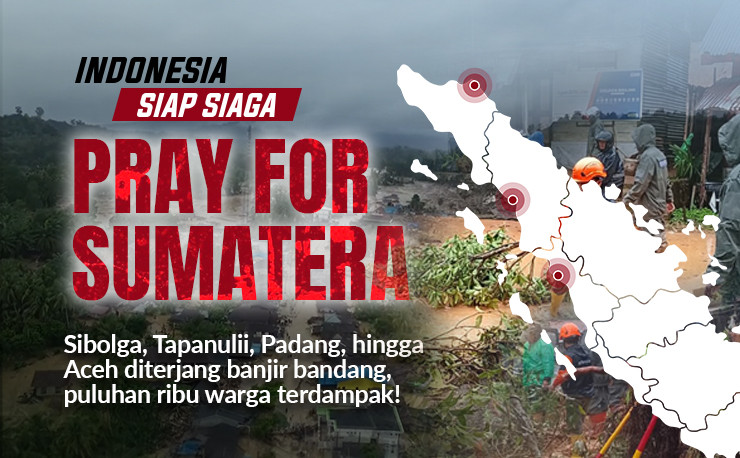


Allah’s warning about disasters is a message that invites humans to reflect on their life journey, understand the meaning of trials, and return to Him. In the Quran and hadith, the discussion of disasters is not presented to scare people, but to guide them to be wiser in facing the realities of life. For in every calamity, Allah always has wisdom, both visible and only felt by those who are willing to think.
“No disaster (of any kind) befalls on earth or to yourselves, except that it is recorded in the Book (Lauhulmahfuz) before We bring it into being. Indeed, that is easy for Allah.” (QS. Al-Hadid verse 22).
Read also: Zakat for Humanitarian Aid Accelerates Recovery in Affected Areas
Allah’s Warning about Disasters as a Reminder of His Power
When talking about Allah’s warning about disasters, the Quran places disasters as one of the signs of His power. In QS. Al-An’am verse 65, Allah explains that He is able to bring punishment from above, from below, or divide humans into groups. This verse serves as a reminder that life in this world is completely under Allah’s control. No calamity occurs without His permission and will.
From Anas bin Malik, the Prophet (peace be upon him) said, “If Allah desires good for His servant, He will hasten his punishment in this world.
If Allah wills evil for him, He will delay the punishment for his sins until it is paid on the Day of Judgment.” (HR. Tirmidhi no. 2396, hasan sahih according to Shaykh Al Albani). As humans, we need to realize that human strength and abilities are very limited.
A sturdy house can collapse in seconds, still ground can suddenly move, and calm seas can turn into huge waves. All these phenomena show that humans cannot live relying only on themselves. This awareness is the starting point for a person to deepen their piety and return to making Allah their place of reliance.
Read also: Are Victims of Natural Disasters Entitled to Receive Zakat?
Disasters as a Test of Faith
In addition to demonstrating His power, Allah’s warnings about disasters also serve as a test of faith. In Surah Al-Baqarah verse 155, Allah says, “We will surely test you with a little fear and hunger, loss of wealth, lives, and fruits. Give good news to those who are patient,”
The above verse confirms that calamities are part of a believer’s life journey. Without trials, the journey of faith will not be complete. When a person faces a disaster, they are confronted with a situation that shakes many aspects of their life. They lose their homes, their families are injured, and they even lose their livelihoods to support themselves and their families. In such conditions, being patient and trusting in Allah is the only option. Patience does not mean being silent, but remaining steadfast in carrying out one’s obligations. Guarding the heart from despair and continuing to seek a solution that is pleasing to Allah. The calamities or disasters that Allah gives are not a sign of hatred, but an opportunity to improve the quality of one’s faith.
Read also: Zakat for Disasters: Efforts to Reduce the Impact of Humanitarian Crises
Allah’s Warning About Disasters as a Means of Self-Introspection
In daily life, humans are often complacent with routine. However, when disaster strikes, it shakes the soul and opens space for introspection. This is one of the meanings of Allah’s warning about disasters.
Allah says in Surah Ar-Rum verse 41, “Corruption has appeared on land and sea because of what the hands of men have wrought, that He may make them taste a part of that which they have done, so that they may return (to the right path).”
“Whatever good (blessings) you obtain (comes) from Allah, while whatever evil (disaster) befalls you is caused by (the mistakes) of yourself. We sent you (Prophet Muhammad) as a Messenger to (all) mankind. Allah is sufficient as a witness.” (QS. An-Nisa verse 79).
In the two verses above, Allah explains that disasters are part of sunnatullah. That is, the law of cause and effect that applies consistently and is part of human life on earth. These verses remind us that some of the destruction on earth is the result of human actions. Such as deforestation, environmental pollution, or excessive use of resources. When this damage leads to disaster, the Quran directs humans to improve their behavior and be more responsible for the earth’s trust.
Disasters can also be interpreted as an opportunity to reflect on the direction of life. Understanding this warning can help us learn about steadfastness and also learn about Allah’s love, which always invites His servants to do good.
Read also: 4 Causes of Natural Disasters According to the Quran
Fostering Empathy and Social Awareness During Disasters
Disasters are not only a test for the victims, but also for those who are not affected. This is where Allah’s warning about disasters also has a social function. When we see our brothers and sisters who have lost their homes or families, our hearts should be moved to help. The misfortune that befalls some people serves as a reminder for others to strengthen their solidarity.
In QS. Al-Hujurat verse 10, Allah says, “Verily, the believers are brothers, so reconcile your two brothers (who are in conflict) and fear Allah so that you may be blessed.”
Allah states that believers are brothers and are commanded to reconcile and help one another. This verse affirms that maintaining brotherhood is not only in times of ease, but also in times of hardship. When disaster strikes, ukhuwah is tested in its most tangible form.
In the book Al-Baqiyatus Shalihat by Rabi’ Abdul Rauf Az-Zawawi, it is explained that love between fellow Muslims is likened to unity in one body. The Prophet Muhammad said, “The example of believers in their mutual love, compassion, and unity is like one body. If one member feels pain, the whole body stays awake and feels feverish” (HR Muslim No. 2586).
The above hadith indirectly conveys the understanding that disasters are not only misfortunes for the victims, but also a call to every Muslim to be present and bring goodness.
Read also: Scholars’ Opinions on Income Zakat and Its Relevance Today
Allah’s Warning about Disasters as a Way to Strengthen Our Relationship with Him
In many human experiences, closeness to Allah often grows during difficult times. This is another dimension of Allah’s warning about disasters. When all worldly support collapses, a person will realize that the only place to rely on is Allah. This is because the main strength of a servant does not lie in wealth or position, but in the steadfastness of the heart in relying on his Lord.
Allah says in Surah Al-Ankabut verse 69 that those who sincerely seek His pleasure will be guided by Allah. This verse gives hope that every difficulty can be a way to obtain His guidance. When someone faces a disaster with a patient and hopeful heart, Allah will not let that effort be in vain.
The Prophet Muhammad also gave a special prayer for facing calamities: “No servant is afflicted with a calamity and then recites: Innā lillāhi wa innā ilaihi rāji‘ūn, except that Allah will reward him and replace it with something better” (HR. Muslim). This hadith teaches us that calamities are not the end of everything, but the beginning of an opportunity to receive greater goodness from Allah.
Read also: 3 Levels of Husnul Khotimah in Islam and How to Achieve Them
Strengthening Faith Through Calamities
By understanding Allah’s warnings about calamities, we learn to see misfortunes more clearly and meaningfully. Disasters are messages that bring humans to a new awareness: that this world is temporary, that our power is limited, that relationships with others are important, and that Allah always opens the way for His servants who return to Him. Through the verses of the Quran and the words of the Prophet Muhammad, we are invited to face disasters not with fear, but with wisdom, determination, and empathy.
May every warning from Allah about disasters become a lesson that guides us to live better, be more caring, and be closer to Allah. May every calamity that occurs become a way for us to strengthen our faith and rediscover the meaning of life in the midst of trials. Aamiin.