


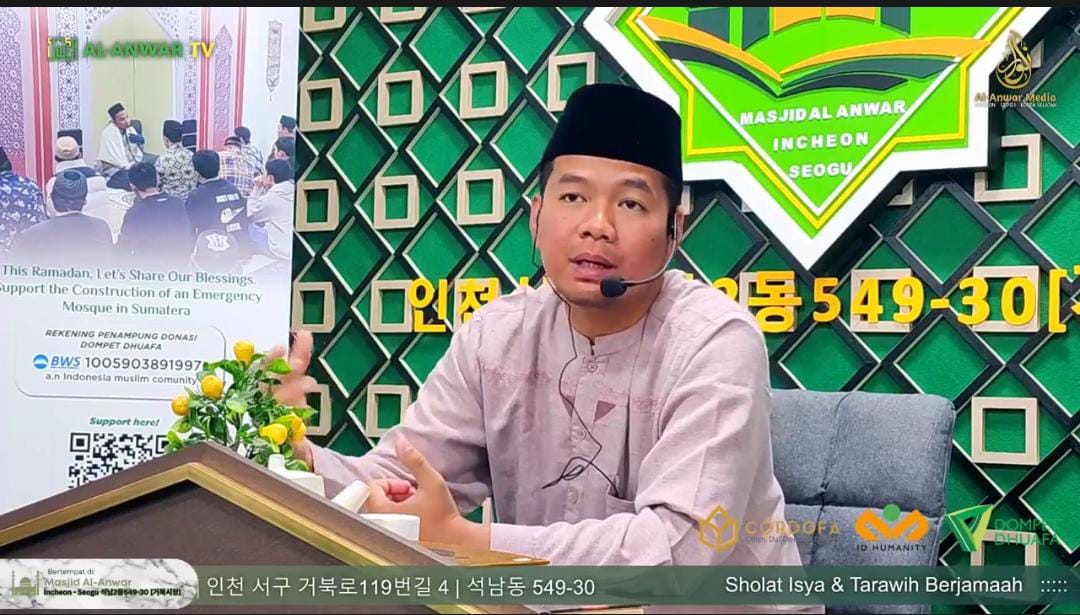
INCHEON, SOUTH KOREA —-— Amidst the glitz and glamour of winter, the air remains frosty in the city of Incheon, South Korea, specifically in the Seo-gu district, where a different atmosphere prevails in one corner of the city. While most South Koreans enjoy the Lunar New Year holiday, known as Seollal in the land of ginseng, Indonesian citizens are preparing to welcome a much more anticipated guest: the Holy Month of Ramadan.
Amidst the hustle and bustle of Korean family traditions of visiting and gathering, Indonesian citizens who are members of the Korean Muslim Community (KMI) are preparing their hearts and steps to welcome the month of mercy. They gather at the Al Anwar Incheon Mosque, a mosque that serves as a spiritual oasis for Indonesian migrant workers (PMI), students, and Indonesian Muslim families living in the area.
Ramadan 1447 AH feels special this year. In addition to coinciding with a long holiday, PMI have more time to prepare themselves spiritually. Usually, factory work and long working hours pose a challenge in bringing Ramadan nights to life. However, this time, the atmosphere feels different. Eager faces were seen as they cleaned the mosque, prepared simple meals, and arranged the schedule for tarawih prayers and religious studies.

“We are grateful for this opportunity. The migrant workers who are currently enjoying their holidays are very enthusiastic about welcoming Ramadan. This momentum is a gift from Allah. We hope that this Ramadan will be a means of increasing knowledge, strengthening ukhuwah (brotherhood), and deepening religious understanding through the lectures that will be delivered by the Dai Ambassador,” said Imam Hanafi, President of KMI.
A Boost of Enthusiasm for Worship from the Dai Ambassador
The presence of Dai Ambassador Dompet Dhuafa 2026, M. Luqman Hambali, provided a boost of enthusiasm within the community. In one of the opening lectures for Ramadan delivered at the Al Anwar Mosque, Ust H. M. Luqman Hambali, B.Sh., M.A. emphasized that the joy of welcoming Ramadan is not just an ordinary feeling, but a sign of faith.
“The scholars explain that whoever rejoices at the arrival of Ramadan, Allah will forbid his body from the fire of hell. That happiness is not just a verbal expression, but is reflected in self-preparation, longing for worship, and sincerity in improving one’s deeds. Especially if we truly fill Ramadan with worship, observing the fast, performing tarawih prayers, reading the Qur’an, and of course increasing our charity. Then that happiness turns into salvation,” said Ustaz H. M. Luqman Hambali, B.Sh., M.A., to the team at Dompet Dhaufa.

Read also: The Story of Dai Ambassador: The Beginning of Preaching in Bangkok
For PMI members, this message was very touching. In a country where Muslims are a minority, maintaining one’s faith is not an easy task. A heterogeneous work environment, language barriers, and cultural differences often pose challenges. However, it is precisely in such conditions that the joy of welcoming Ramadan becomes a source of extraordinary spiritual energy.
When the Korean Muslim Federation (KMF) declared that Ramadan would begin on Thursday, February 19, 2026, a sense of gratitude enveloped the migrant workers at the Al Anwar Mosque. Laughter and warm greetings momentarily replaced their longing for their families back home. That evening, the rows for tarawih prayers were filled to capacity. Some still wore thick jackets because the cold had not completely gone away. Others came straight from work. In between rakaats, soft sobs could be heard as prayers were offered for parents in Indonesia, for distant children and wives, for halal and blessed sustenance, and for the strength to remain steadfast.
Weather Becomes a Challenge for Fasting
“Ramadan in South Korea also presents its own challenges in terms of fasting duration and weather. However, that is precisely where the value of mujahadah is felt. The migrant workers encourage each other, share tips on maintaining stamina, and ensure that no one feels alone. The mosque becomes a center for social activities, Islamic discussions, learning to read the Qur’an, and designing care programs for fellow migrant workers in need,” added Ustaz Luqman.

Amidst a Korean society celebrating its ancestral traditions, KMI celebrates the tradition of the sky to welcome the month of the descent of the Qur’an. The two celebrations run side by side, reflecting the beautiful harmony of diversity in this country. Ramadan in Seo-gu, Incheon, is not just an annual event. It is proof that faith knows no geographical boundaries. It grows anywhere, as long as there are hearts that nurture it. At Al Anwar Mosque, every takbir tarawih is a testament that these migrants are not just seeking livelihood, but also upholding their duty as servants of Allah.
May this year’s Ramadan in South Korea be a Ramadan that strengthens, unites, and gives birth to strong individuals who, when they return to their homeland, will not only bring home the fruits of their labor, but also a more mature faith and a purer heart.
Text and Photos: Muhammad Luqman Hambali (Dompet Dhuafa Ambassador 2026 assigned to South Korea)
Editor: Taufan YN