

For Muslims, sacrifice is a form of worship that symbolizes the willingness to let go of worldly things for higher spiritual values. However, in modern times, which are shrouded in a culture of consumerism, the meaning of sacrifice feels increasingly relevant to be reflected upon more broadly.
At its core, sacrifice is not merely about slaughtering animals, but also about sacrificing the consumerist aspects within ourselves—the excessive lifestyle that, unconsciously, has damaged the environment, marginalized the weak, and widened the social divide.
Sacrifice has also become a symbol of self-control. In its tradition, sacrifice is performed by selecting the best animal to be slaughtered. This symbolizes that to draw closer to God, we must be willing to “sacrifice” what we love, such as wealth, status, or even personal comfort.
Kurban, or animal sacrifice, can also be interpreted as the slaughter of animalistic traits, consumerist ego, energy-intensive lifestyles, food, and goods that encourage the exploitation of nature. In the past, Prophet Ibrahim was tested by being asked to sacrifice his son, but today, we are tested by being asked to sacrifice worldly pleasures that cause social inequality.
Read also: Puspa Nusantara Dompet Dhuafa: Empowered and Cultured for Education in Indonesia
A report by the Global Footprint Network shows that humans are now consuming natural resources 1.7 times faster than the Earth’s capacity to regenerate. This means that our current lifestyle is sacrificing the future of generations to come. Ironically, much of this consumption is driven not by necessity, but by a culture of showing off and a psychological urge to feel superior to others.
Dompet Dhuafa’s Tebar Hewan Kurban (THK) program comes as a means to challenge this massive trend. Sacrificial offerings at Dompet Dhuafa teach us that the best wealth is not to be hoarded, but to be shared. That true enjoyment does not lie in how much we have, but in how much benefit we spread.
Some parties are now beginning to link the act of sacrifice with sustainability missions, including the Tebar Hewan Kurban (THK) program initiated by Dompet Dhuafa. This program not only distributes sacrificial meat to underserved areas but also economically empowers small-scale farmers, not exploitative large-scale farms.
Additionally, THK promotes a more equitable sacrificial practice, avoiding concentration in major cities. Through its network of branches and partners in remote areas, THK revitalizes rural economies without significantly increasing carbon footprints. With this approach, sacrifice becomes more than a ritual. It becomes a tool for social transformation and a global ecological commitment.
However, linking sacrifice to a consumerist lifestyle does not mean rejecting progress or denying the joys of life. Rather, it is a call to shift the focus of consumption from mere self-gratification to something more beneficial for many. In other words, spending one’s wealth is permissible, provided it is not solely for self-indulgence but for the benefit of others.
Therefore, Eid al-Adha should not only touch the spiritual realm but also inspire us to reshape our daily lifestyles. Every piece of sacrificial meat we share, every farmer we empower, every child in remote areas who smiles upon receiving fresh meat—all of these are the fruits of our courage in sacrificing and letting go of our old selves to become new, more compassionate, and just individuals.
Read also: Social Worship: Sacrifice as a Model for Sustainable Empowerment Amid Social Inequality
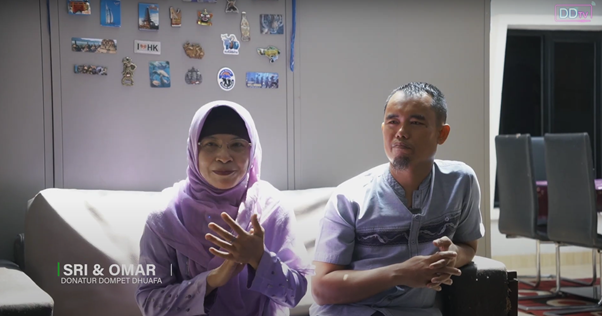
Sri and Omar are a married couple living in Bogor, Jabodetabek. The reason this couple chose to make their sacrifice through Dompet Dhuafa is because of its excellent distribution. They saw Dompet Dhuafa’s portfolio in managing the sacrifice trust as very good. Both of them also believe that it is wiser to have the sacrifice managed professionally rather than doing it individually on their own.
“The strength of the community is maximized when it is well-organized. If we do it individually, we might only reach a limited number of people. However, when organized through Dompet Dhuafa, it is definitely more effective, targeted, and has a greater impact,” said Omar during his sacrifice to Dompet Dhuafa on Tuesday, April 29, 2025.
“In this neighborhood, everyone is the same. Many people are well-off. Every year, they also perform their sacrifices. The recipients of the sacrificial meat are the same, whether rich or poor. Meanwhile, outside, many people who enjoy the meat have to wait until Eid al-Adha,” added his wife on the same occasion.
Thus, sacrifices at Dompet Dhuafa have a significant impact and influence on the perspective of those who perform sacrifices toward social issues. Every sacrificer who participates in Dompet Dhuafa’s Tebar Hewan Kurban (THK) program demonstrates social value and concern for small-scale farmers and beneficiaries in remote areas. How impactful is sacrificing through Dompet Dhuafa? Prove it through Tebar Hewan Kurban 1446 H. (Dompet Dhuafa)
Text and photos: Riza Muthohar
Editor: Dhika