


There are concerns that FMD infection will affect the quality of sacrificial meat, rendering it unfit for consumption. Therefore, the Indonesian Ulema Council (MUI) issued MUI Fatwa No. 32 of 2022 on FMD Sacrificial Animals as a preventive measure.
Ahead of Eid al-Adha, the outbreak of Foot and Mouth Disease (FMD) in sacrificial animals has become a public concern. The disease, known as Foot and Mouth Disease, is an animal disease caused by a highly contagious virus that attacks even-toed or cloven-hoofed animals, such as cattle, goats, sheep, and buffalo.
Categories of sacrificial animals infected with Foot and Mouth Disease (FMD)
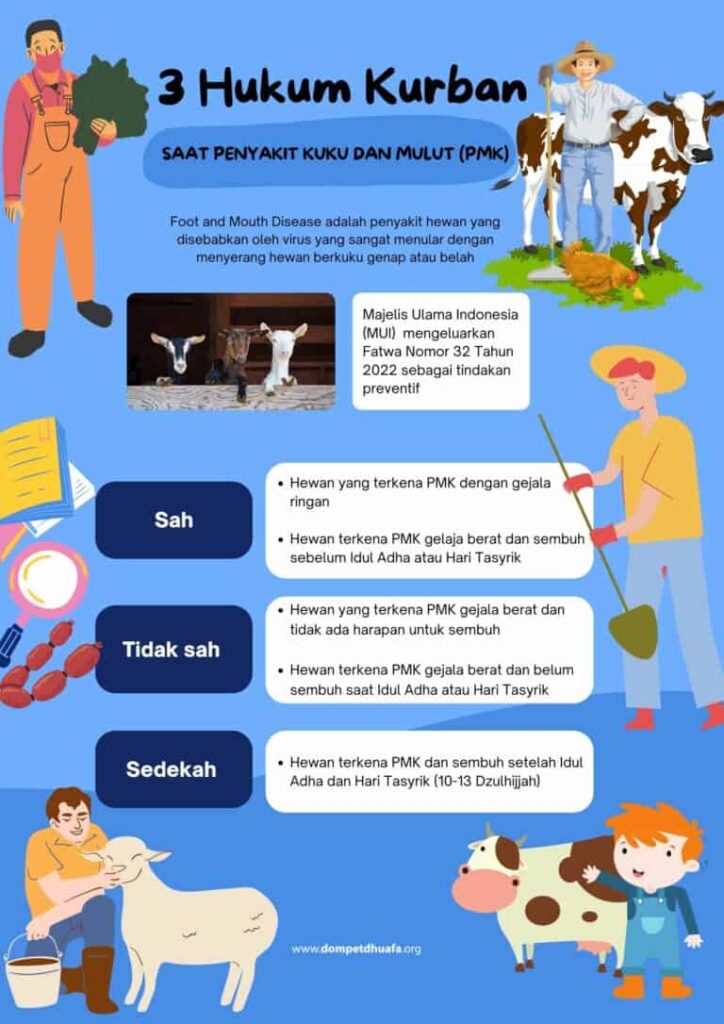
The characteristics of PMK in qurbani animals depend on the level of infection. Broadly speaking, the MUI divides the validity of slaughtering qurbani animals affected by foot-and-mouth disease into three categories, namely:
1. Valid
The Head of the MUI Fatwa Division, KH Asrorun Niam Sholeh, during a presentation at the press conference on Fatwa Number 32 of 2022 regarding the Law and Guidelines for Performing Sacrificial Rituals during an FMD Outbreak, Tuesday (31/5).
Read also: Types of Sacrificial Animals According to Islamic Provisions
Mild symptoms of foot-and-mouth disease are characterized by mild blisters on the hoof, lethargy, loss of appetite, and excessive salivation. According to KH Niam, such animals are valid for sacrifice.
Mild symptoms can still be cured with wound treatment to prevent secondary infection, as well as the administration of vitamins and minerals or herbs for about 4-7 days to maintain the animal’s immune system.
2. Invalid
Sacrificial animals affected by severe Foot and Mouth Disease (FMD) are characterized by blisters on the hooves that cause them to fall off and/or cause lameness, or inability to walk, extreme emaciation to the point of visible bones, and a long healing process or even the possibility of being incurable. If severe symptoms are indicated, then it is not valid, meaning it cannot be used as a sacrificial animal.
Read also: Dompet Dhuafa Lampung Collaborates with Puskeswan to Conduct Routine Checks on Livestock
If the animal recovers from FMD before the sacrifice period from 10 Zulhijjah to 13 Zulhijjah, then it is valid to be slaughtered as a sacrificial animal.
3. Alms
If an animal infected with severe FMD symptoms recovers, but it is past the valid Eid al-Adha period, which is 10 to 13 Dhu al-Hijjah, then the slaughter becomes alms. The livestock cannot be referred to as sacrificial animals.
Requirements for Valid Qurbani Animals
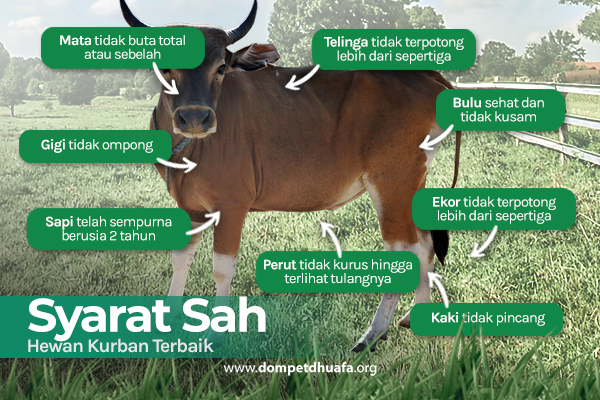
In order for sacrificial animals to be healthy, farmers and sacrificers must pay attention to the requirements for valid animals. That way, PMK infection can be prevented as much as possible in a hygienic manner. These are the requirements for valid sacrificial animals according to Islamic law:
- Sacrificial animals are livestock, namely camels, cows, and goats, whether sheep or regular goats.
- They must have reached the age required by Sharia, which is jaza’ah (half a year old) for sheep or tsaniyyah (one year old) for other animals.
- Ats-Tsaniy from camels are those that have reached the age of 5-6 years.
- Ats-Tsaniy from cows are those that have reached the age of 2 years.
- Ats-Tsaniy from goats is one that has reached the age of 1-2 years.
- Al-Jadza’ah from sheep is one that has reached the age of 6 months.
For the sake of caution, there are 18 types of animal defects that are not suitable for sacrifice, namely:
- Al-Amya, which is total blindness in both eyes,
- Al-Aura Al Bayyin ‘Uruha, which is total blindness in one eye,
- Maqthu’ah al-Lisan Kulliha, which is a severed tongue,
- Maqthu’ah Ba’dh al-Lisan, which is a partially severed tongue,
- Al-Jad’a, which is a severed nose,
- Maqthu’ah al-Udzinain aw Ihdahuma, which is the severing of one or both ears, including congenital ear defects,
- Maqthu’ah Ba’dh al-Udzun, which is the partial severing of the ear,
- Al-Arja’ al-Bayyin ‘Urjuha, which is the inability to walk, such as walking from the starting point to the place of slaughter,
- Al-Jadzma, which is the absence of the front and rear legs, either completely or partially, whether acquired or congenital,
- Al-Jadzza’, which is a female sacrificial animal whose udder is severed or dry because it cannot produce milk,
- Maqthu’ah al-Ilyah, which is an animal whose tail is severed, except if it is congenital since birth,
- Maqthu’ah al Miqdar al-Katsir Min al-Ilyah, which is an animal whose tail is mostly severed,
- Maqthu ‘ah al-Dzanab, which is an animal that does not have or has a broken lower/rear end of its spine,
- Maqthu’ah al Miqdar al-Katsir Min al-Dzanab, which is an animal that is missing most of its tail,
- Al-Maridhah al-Bayyin Maradhuha, which is an animal that is clearly sick,
- Al-Ajfa Ghair al-Munquyah, which is an animal that is severely ill in its bones or marrow, which can be identified by its inability to walk or other signs of weakness.
- Musharramah al-Athibba, which is an animal that has been treated for illness and is no longer able to produce milk.
- Al-Jallalah, which is an animal that eats feces due to being confined for a long time.
Kiai Niam also encourages people to make sacrifices through religious social institutions that organize animal sacrifice programs from livestock centers. Then, Muslims who are part of the sacrifice committee must be accompanied by health workers to monitor the health of the animals, the slaughtering process, and the handling of meat, offal, and waste.
Read also: ROIS OJK Collaborates with Dompet Dhuafa to Distribute Sacrificial Animals in Eastern Indonesia
Ensuring the type of sacrificial animals to be slaughtered requires time and strict control over the development of the animals. Dompet Dhuafa’s livestock center has a team that constantly monitors the condition of the sacrificial animals to be slaughtered, so that their quality is maintained and the meat is healthy when distributed to the poor and needy.
As an effort to protect sacrificial animals from disease outbreaks, watch the educational video clip about PMK to ensure health from start to finish.
Dompet Dhuafa needs your help so that more people in remote areas of the country can consume fresh and healthy sacrificial meat. In fact, according to IDEAS research in 2021, the upper class consumes 51 times more meat than the average population in the lowest decile (the poorest class).
Due to this disparity, Dompet Dhuafa has launched the Tebar Hewan Kurban program as an initiative to improve community welfare while elevating the status of farmers in remote areas of Indonesia.
Perfect your worship by sacrificing again this year. Don’t worry, sacrificing at Dompet Dhuafa brings peace of mind because you can order online from home with the quality of sacrificial animals guaranteed to be healthy, fit, and good. Let’s benefit again from qurbani!