


BANTUL, YOGYAKARTA — Various technological innovations are constantly being improved year after year. Dompet Dhuafa, with its Tebar Hewan Kurban (THK) #JadiManfaat program, is ready to help the community perform qurbani and support the economy of livestock farmers in a number of regions.
The development of livestock and farming centers by Dompet Dhuafa is carried out through a blended finance funding mechanism, combining productive zakat funds, endowments, and investments.

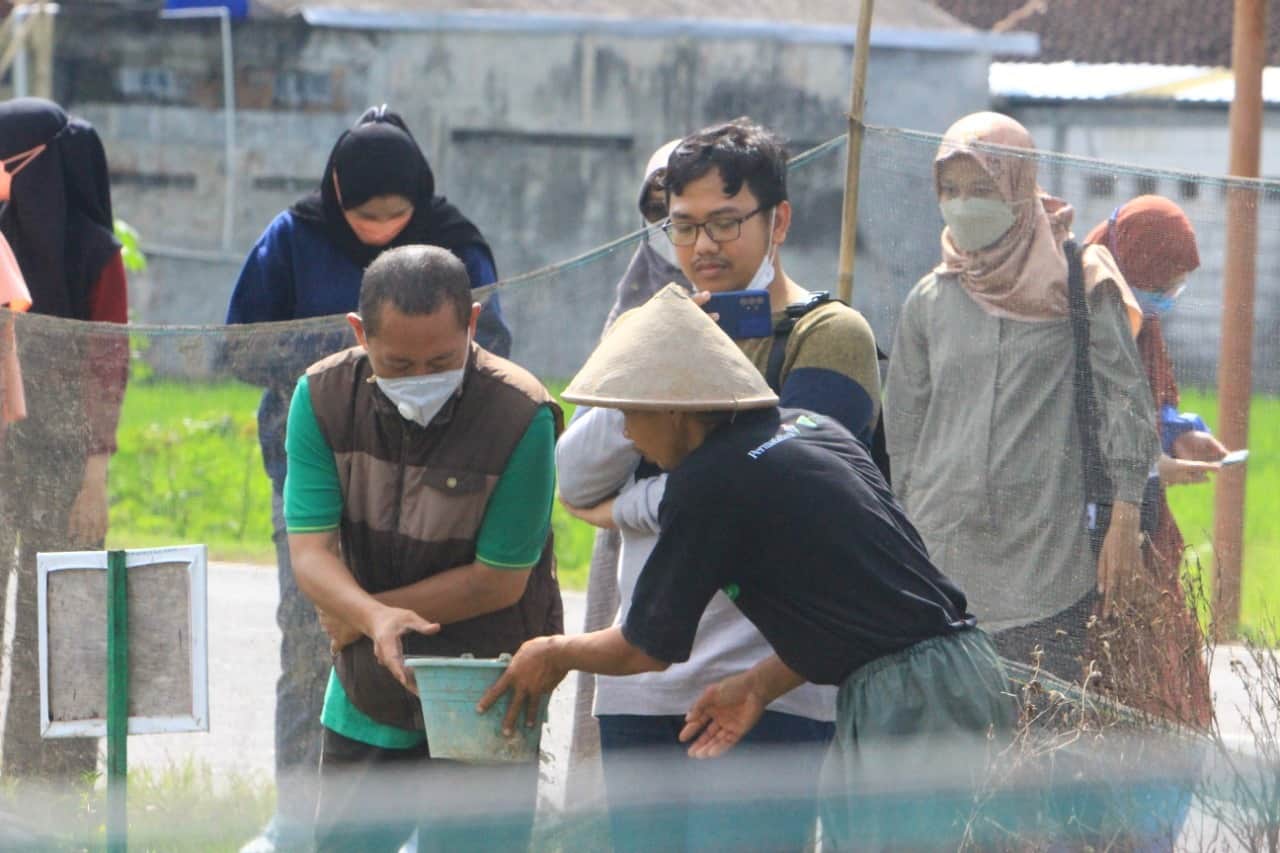
On Wednesday and Thursday (June 29-30, 2022), Dompet Dhuafa held an event themed “Journey to JogjAgroWisata Tebar Hewan Kurban 1443 H #JadiManfaat” (Journey to JogjAgroWisata Spreading Sacrificial Animals 1443 H #BeBeneficial), inviting journalists and bloggers to visit the farming and livestock centers that are fostered and guided by Dompet Dhuafa. In addition to seeing the Dompet Dhuafa program firsthand, the journalists and bloggers gained knowledge about the management of productive zakat, waqf, and investment. The first series of activities took place at DD Farm in Kulonprogo, Mina Padi in Polaman hamlet, and Lidah Buaya in Gunungkidul, Yogyakarta.
The agricultural potential in the area is quite good, so the hope is that Mina Padi will increase in terms of rice yields and fish sales from the rice fields. Zahron also explained that there has been an increase.

“From the beginning, we started with 800 meters, now it is 3.5 hectares. Dompet Dhuafa also formed institutional groups to help each other so that they can strengthen each other when the crop season is not lacking,” said the head of the Yogyakarta branch of Dompet Dhuafa, Zahron, adding that in the Mina Padi process, we act as facilitators.
On the other hand, the THK Dompet Dhuafa program not only distributes sacrificial animals, but also empowers farmers and livestock breeders who are part of the Kampung Ternak Nusantara program. In other words, the THK Dompet Dhuafa program is a manifestation of a social business model that helps lift the economy of the livestock breeders who have been part of the program all this time.

One way is by increasing technological creativity and education in the livestock industry by developing ASLIS (Livestock Monitoring Technology), which is an IoT-based livestock weight growth monitoring technology connected to a special dashboard to assist in data collection, livestock risk mitigation, and connecting livestock data to owners. Future technologies to be utilized in the livestock industry are expected to trigger growth in both the quality and quantity of livestock.
” Coincidentally, there is currently an installation of weighing equipment called ASLIS. They are trying to make the sale of sacrificial animals unnecessary by entering the barn, but rather by finding a way to easily record the sacrificial animals, which will then be entered into the application. Every month, there will be updates on the sacrificial animals, such as their weight, photos, and so on, so that if there are buyers who want to buy, they can immediately see it on their cell phones. They just have to select the animal and see the latest photos. If they want to buy, they just click ‘buy.’ We will collaborate with one of the startups.” Said Satiya Jati, Head of the Dompet Dhuafa Farm pen.

In addition to livestock farming, Dompet Dhuafa has developed the Mina Padi Fish Market in the hamlets of Polaman, Sedayu, Bantul, Madu Wanagama, and Lidah Buaya in Gunungkidul, Yogyakarta. Journalists were invited to observe and participate directly at each location to learn about the methods and processes involved from start to finish.
Through the “Journey to JogjAgroWisata Tebar Hewan Kurban 1443 H #JadiManfaat” agenda, journalists were introduced to the ASLIS technology that will be used by Dompet Dhuafa in the future, as well as to socialize Dompet Dhuafa’s productive zakat empowerment and development program based on animal husbandry, agriculture, and MSMEs, and to disseminate accurate information to farmers and consumers regarding the identification and prevention of PMK outbreaks in sacrificial animals.
At the end of the JogjAgrowisata agenda, the group visited the Aloe Vera empowerment program. Widodo, a beneficiary of the Aloe Vera program, explained, “A total of 100 families from 7 RTs in Katongan Village received assistance in the form of 50 Aloe Vera seeds per family. Since then, Aloe Vera plants have begun to adorn every corner of the houses in the village. Because they grow regardless of the season, the women are now more productive in cultivating Aloe Vera.“
”In the past, each family received 50 Aloe Vera seeds, which amounted to 100 families in this village. So every house has Aloe Vera. That’s why this village is known as the ‘Aloe Vera Village’,” concluded Widodo.
It’s not just about giving out seeds; Dompet Dhuafa is also involved in developing Aloe Vera-based products in Katongan Village. Through discussions and several trials, an Aloe Vera-based beverage product was finally created. The packaging, which was once simple, is now more attractive. (Dompet Dhuafa / DIY)