


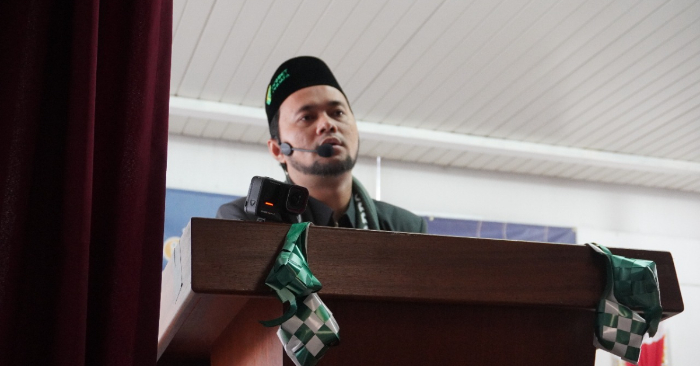
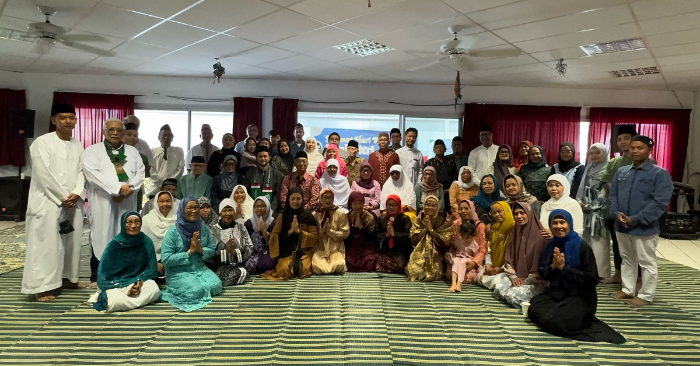
NEW CALEDONIA — The atmosphere of Eid al-Fitr 1446 H in the neighborhood of the Consulate General of the Republic of Indonesia (KJRI) Noumea, New Caledonia, felt so warm. Muslims from various backgrounds gathered and joyfully celebrated the day of victory.
In this blessed moment, Dai Ambassador Dompet Dhuafa assigned to New Caledonia, Ustaz Basyir Arif, had the opportunity to be the Id prayer preacher. In his sermon, Ustaz Basyir emphasized the importance of strengthening ukhuwuah islamiyah in the midst of the diversity of New Caledonian society.
The islands have their own uniqueness in terms of their people. The country has a diverse mix of cultures and ethnicities, ranging from the indigenous Kanak people, French descendants, to Arab Magrebin and Javanese Indonesians. This is a true reflection of multicultural life. Not only that, Muslims from Comoros and Montenegro are also present and active in the Association des Musulmans de Nouvelle-Calédonie (AMNC) community.
Muslims of Indonesian descent also have various organizations that serve as a forum for togetherness and da’wah, such as the Indonesian Community and Its Descendants Association (PMIK), the Indonesian Community and Its Descendants Islamic Community Association (PUIMIK), and the Indo-Calédonienne Da’wah and Social Association.
Islam and Multiculturalism: The Charter of Medina
History Islam teaches how the Prophet built a harmonious society in the midst of differences. When he migrated to Yathrib (Medina), the city was not only inhabited by Muslims, but also by Jews, Christians, and followers of other faiths. However, with an extraordinary vision of leadership, the Prophet created the Charter of Medina, an agreement that guarantees freedom of religion and the right to live together peacefully.
This concept is an example of how diversity is not a barrier to living in harmony. On the contrary, with mutual respect and cooperation in kindness, society can grow stronger. This is very relevant for Muslims in New Caledonia who also live in a diverse environment. By emulating the Prophet’s policy of maintaining relations between religious communities, ukhuwah Islamiyah can become even stronger and more meaningful.
Uniting People in the Midst of Diversity
The story of the Prophet in uniting the people is not only seen in the Charter of Medina, but also in various other events. One of the interesting ones was when Mecca was hit by a major flood and the Kaaba had to be renovated. When it came to the installation stage of the Black Stone, the leaders of the Quraish disagreed as to who had the greatest right to put it back in its place.
When the situation became more tense and almost sparked a conflict, the Prophet emerged with a clever solution. He spread out a piece of cloth, placed the Black Stone in the middle, then asked each tribe to hold the ends of the cloth and lift it together. In this way, everyone felt they had a part in the honor, and the dispute subsided.
From this story, we learn that unity is not about who is more entitled or superior, but rather about how each individual feels they have a role and responsibility in a community. This principle can be applied to the life of Muslims in New Caledonia. By prioritizing togetherness, not differences, various challenges can be faced more easily.
Read also: Portrait of the Life of Javanese Muslims in New Caledonia: Forgotten Javanese, Proficient in French
Pluralism and the Challenges of Da’wah in New Caledonia
Pluralism is not just about coexistence, but also about how we can understand and respect each other without losing our identity. One of the biggest challenges facing Muslims in New Caledonia is the lack of access to Islamic education, which makes it easy for the younger generation to lose understanding of their religion. Many of them end up being influenced by foreign cultures without having a strong grasp of Islamic teachings.
To answer this challenge, concrete steps are needed. The construction of mosques in various locations, such as in Kone, Poindimié, and across the island of Lifou, can become centers of religious activity as well as gathering places for the community. In addition, the availability of proper Muslim cemeteries is also important so that the community can carry out burial traditions in accordance with Islamic teachings.
Equally important, Islamic education must be strengthened by establishing madrasas that provide in-depth understanding to the younger generation, so that they remain proud of their Islamic identity amidst cultural diversity.
Diversity is a gift, not a challenge to be avoided. With strong ukhuwah Islamiyah, Muslims in New Caledonia can be an important part of creating a peaceful, respectful, and tolerant society. As exemplified by the Prophet, unity is always stronger than division. By uniting, no challenge is too great to face. (Dompet Dhuafa)
Text and photos: Dai Ambassador for New Caledonia, Ustaz Basyir Arif
Editor: Ronna