


BARRU, SOUTH SULAWESI —— On Wednesday morning (10/22/2025) at around 9:00 a.m. WITA, a group of mothers and their toddlers gathered at the Mawar Health Center in Mangempang Village, not far from the center of Barru Regency, South Sulawesi. Many toys were scattered around, after the toddlers had happily played with them.
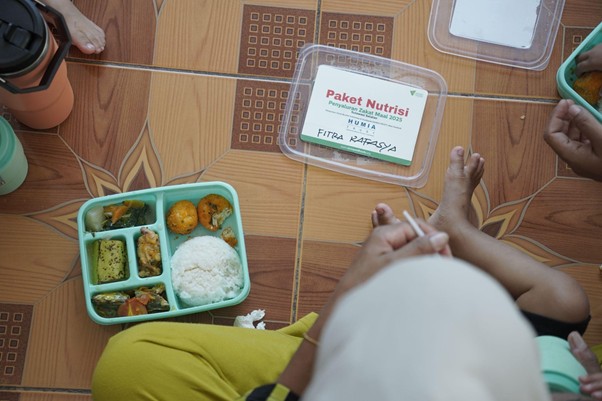
They were waiting for a special meal prepared by the mothers and Posyandu cadres. The menu that day consisted of mackerel, capcay vegetables with tofu, corn fritters, white rice, bananas, and pudding, which attracted the toddlers to immediately eat it.
Posyandu Mawar is one of the locations for the implementation of the Nutrition Post program initiated by Dompet Dhuafa through the Free Health Service (LKC) of South Sulawesi. The focus is on assisting in the improvement of stunting cases in children during the first thousand days of life.
A total of 20 toddlers will participate in this program for the next three months. Each child will be evaluated before and after the Nutrition Post program is implemented. If the child experiences an increase in weight and height, then the child will need ongoing assistance to obtain more nutritional intake. However, if there is no progress or stagnation, then the child will be referred to a health facility for further screening.

Increasing Stunting
It is not without reason that this Nutrition Post program was launched. Data on stunting in Barru Regency released by the Indonesian Nutrition Status Survey (SSGI) from 2022 to 2024 does not show an improvement, but rather the opposite. At least, the stunting rate improved in 2022 to 14.1%, but in 2023 it rose to 22.1%.
In 2024, the stunting rate rose to 26.9%, which is quite alarming considering that in the period before 2022, the stunting rate had improved. The high stunting statistics in 2024 place the district, nicknamed ‘Bumi Colliq Pujié’, in the top five districts/cities with the lowest stunting rates in South Sulawesi.

Ermy Eka Niswan, Secretary of the Barru District Health Office, stated that stunting should not be viewed merely as a statistic but as a serious threat to children’s future.
“Many mothers with toddlers do not understand that their children’s weight and height are not appropriate for their age, which threatens their current growth and development. The impact will be felt in the future when the children grow up,” said Ermy Eka Niswan.
In addition to stunting, the Barru Health Office still has a lot of work to do. Among other things, exclusive breastfeeding coverage is still below 70%, maternal and infant mortality rates are high, and access to nutrition education for toddlers is still low. All of this cannot be left to the health office alone; it is a task that must be tackled together.

Read also: Zakat blessings help Ita and Fatih fight stunting
Zakat as a Means of Eradicating Stunting
Zakat is no longer understood merely as the transfer of wealth from the muzakki (the person who pays zakat) to the mustahik (the person who receives zakat). With the passage of time and the increasing complexity of social challenges, zakat has evolved into an instrument of empowerment that can bring about real change. Dompet Dhuafa sees that proper, measurable, and sustainable zakat management can play a significant role in overcoming community issues, one of which is reducing stunting rates. Through nutrition, health, and mustahik family empowerment interventions, zakat is increasingly relevant as a strategic solution in creating a healthier and more productive generation.
The high stunting rate in Barru Regency has prompted LKC Dompet Dhuafa South Sulawesi to provide intervention through the Pos Gizi Program. This effort is not carried out alone; the Pos Gizi program is made possible through zakat maal paid by Humia Trust, an Indonesian Muslim community in Auckland, New Zealand. The vast distance between New Zealand and Indonesia does not diminish their concern for the future of the nation’s children; rather, it strengthens their commitment to creating a healthier and more empowered generation.
“Stunting itself is closely related to economic capacity, and economic incapacity refers to asnaf (zakat recipients), namely the poor and needy. The beneficiaries or mustahik receive their rights through this program,” said Wulan Cahya, Nutrition Post Program Facilitator.
In addition to economic factors, low education or literacy also plays a major role in contributing to high stunting rates. Wulan Cahya observed this phenomenon in Mangempang Village. Children have been accustomed since infancy to consuming ultra-processed foods (UPF) instead of real food. This phenomenon occurs because parents consider UPF to be ‘healthy’ food; they do not have information about the effects of UPF when consumed in the long term.

Improving Stunting Literacy
Indirectly, the implementation of the Nutrition Post program has helped build parents’ awareness of good and nutritious food for children. Nur Indah Sari, head of the Mawar Posyandu cadre, is very pleased to be able to collaborate with LKC South Sulawesi in this program. She explained that there has been a significant difference in both toddlers and parents since the introduction of the Nutrition Post intervention compared to the previous pattern.
“It’s very helpful. Before, toddlers were underweight, and we were confused about how to intervene, other than weighing and measuring them. Now, with the Nutrition Post, we and the parents of toddlers can see the food ingredients for ourselves and prepare them together. Everyone is learning together,” explained Nur Indah Sari.

The Nutrition Post program is carried out over three months, divided into three stages each month. In the first month, which lasts 12 days, parents are involved in cooking together, eating together, and distributing nutrition packages to take home. In the following month, weight monitoring is carried out regularly at the health center. In the third month, there are direct home visits to toddlers.
One of the beneficiaries of the Nutrition Post program is a toddler named Fitra. Fitra’s mother, Irna, feels the direct impact. She is happy that her child can eat heartily without being picky and no longer has difficulty eating. In fact, Irna is now a little overwhelmed because the nutrition packages she receives must be cooked and shared with Fitra’s three older siblings.
“Fitra ate a lot today. I’ve learned many strategies for when children are picky eaters—we have to be diligent and patient, all for his own good so that he gains weight,” added Irna while holding Fitra.

Read also: Reducing Stunting, Nutrition Post and Darling Enter Karihkil Village
Nutrition Posts as Role Models
In addition to expressing their appreciation, the Barru District Health Office considers the methods implemented in these Nutrition Posts to be innovative. The Nutrition Post method could serve as a role model for similar programs to reduce stunting rates in the future. The method involves an educational approach to the community, starting from food processing and distribution, so that they can become independent and empowered.
Previously, there was a similar program with a different method, where food was prepared by a third party and distributed directly to health posts or homes, and then children could enjoy it. An evaluation of the program found that the food was not fresh due to the long distribution process, the food was prone to contamination, parents were not involved, and there was no education process.
Pos Gizi prioritizes community empowerment methods. Parents are taught how to choose food ingredients, they are involved in the food preparation or processing process, and they learn new recipes or menus based on local ingredients so that children do not get bored. If children simply receive food and then eat it, it will be gone, but if mothers are given the knowledge of how to make healthy and nutritious food, then children will be protected from the threat of stunting.

HUMIA Trust, through Dompet Dhuafa, distributes and manages zakat funds to reduce stunting rates in Indonesia. May this act of kindness spark collective awareness to take part in joint efforts to combat stunting. Come on, join us in helping to reduce stunting rates for the future of the nation’s children through digital.dompetdhuafa.org/zakat/maal. (Dompet Dhuafa)
Text and photos: Aryo Prasojo, Ronggo Wirasanu
Editor: Dedi Fadlil