

The environment is increasingly damaged, as evident from the more noticeable weather changes around us. Forests are shrinking, rivers are overflowing, and disasters are occurring with increasing frequency. In recent years, flash floods have occurred in various regions, including in Sumatra at the end of November 2025. This event has caused many people to reflect on the direction of human life and our relationship with nature.
Environmental damage does not happen overnight. It is the result of decisions made years earlier. When forests are cleared without control and the soil loses its support, rainwater is no longer properly absorbed. Rivers become overloaded and overflow into residential areas. Floods make humans feel the impact of a damaged environment.
Read also: History of Flash Floods Around the World
Traces of Environmental Damage in Human History
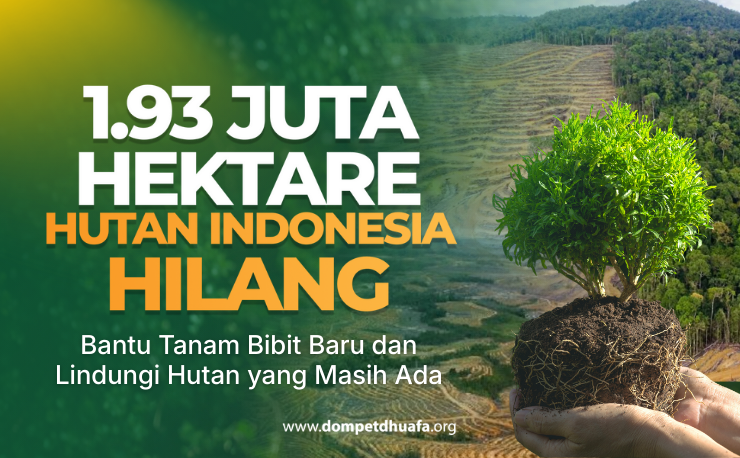
A report by the World Wildlife Fund (WWF) shows that the world has lost millions of hectares of forest every year over the past two decades. This deforestation has a direct impact on climate change, the water cycle, and ecosystem stability. This fact shows that environmental issues are global and interconnected from one region to another.
Human history has never been separated from the natural conditions around it. When the environment is preserved, life flourishes and civilization can thrive. However, when nature is damaged, humans begin to face various difficulties. History records that the decline in the quality of soil, water, and forests is often followed by food crises, disease, and massive population displacement.
Environmental historians also note that many once-fertile regions have become vulnerable due to excessive and continuous exploitation of nature. One example often discussed by historians is the Fertile Crescent in the Middle East. This region was once a center of agriculture and human settlement due to its fertile soil and abundant water.
However, continuous deforestation and unbalanced land management slowly changed these conditions. The soil became dry, water became increasingly difficult to obtain, and agricultural yields declined. Environmental historian Jared Diamond notes that exploitation of nature without restoration made this region increasingly vulnerable to food crises and social decline.
Similar patterns have emerged in various other regions of the world. Environmental damage often occurs slowly, so it is not immediately apparent. By the time the impact is felt, the situation has become difficult to remedy. Environmental damage is not just a natural problem, but a human problem. The way humans treat nature today will determine the quality of life in the future, as reflected in the long history of humankind.
Read also: The Flood of Noah, What Valuable Lessons Can We Learn?
The Impact of Environmental Degradation on Life
Environmental degradation is not limited to statistics. Its impact is felt directly in everyday life. When forests disappear, floods come more quickly. When landslides occur, roads are cut off. When rivers are polluted, clean water sources are disrupted.
In Sumatra today, flash floods have forced thousands of residents to leave their homes. Economic activity has stopped, schools are closed, and health services are disrupted. This situation shows that environmental damage always leads to human suffering. Nature and social life cannot be separated.
Islam views nature as a trust that must be protected. Allah reminds humans not to cause destruction on earth after it has been created in a state of balance. Allah says:
“Do not cause corruption on earth after it has been set in order. Pray to Him with fear and hope. Indeed, Allah’s mercy is very close to those who do good.” (QS. Al-A’raf: 56)
The above verse clearly shows that protecting the environment is part of humanity’s moral responsibility. Environmental destruction is not only a technical issue, but also an ethical and religious one. When humans ignore the warning in this verse, the negative impact will eventually return to humanity itself.
Read also: History of Flash Floods in the World
Environmental Damage is a Sign of the Apocalypse or a Result of Human Behavior
Some people associate environmental damage with signs of the end of times. Islam does teach that before the day of judgment, there will be major changes on earth. However, the Qur’an does not teach humans to be preoccupied with guessing the timing, but rather invites humans to improve their attitudes and deeds.
Allah says: “For him (man) there are (angels) who accompany him in turns from before and behind him who guard him by Allah’s command. Indeed, Allah does not change the condition of a people until they change what is in themselves. If Allah wills evil for a people, no one can repel it, and there is no protector for them other than Him.” (QS. Ar-Ra’d: 11).
Quran Surah Ar-Rad verse 11 explains that humans are the main agents of change. The destruction of nature that is happening today can be seen as a result of human choices, not just fate that comes without cause.
The increasing destruction of nature does not automatically mean that the end of the world is near; it could be a warning sign for humans to realize their mistakes and improve the situation. Allah says in Quran Surah Ar-Rum verse 41, “Corruption has appeared on land and sea because of what the hands of humans have done. (Through this) Allah makes them taste some of the consequences of their deeds so that they may return (to the right path).”
Read also: Disasters: Warnings or Punishment for Humankind
Floods in Sumatra Due to Environmental Degradation
The flash floods in Sumatra show a direct link between environmental degradation and disasters. Deforestation alters water flow and reduces soil absorption. Rivers receive large amounts of water in a short period of time. When heavy rains fall, flooding is inevitable.
Water carries soil and logs from the mountains, hitting residential areas at the foot of the mountains. This causes residents’ houses to be washed away in the floods, damaged, and even causes villages to disappear due to flash floods and landslides. This situation shows that disasters are often preceded by signs that have long been ignored. When humans ignore these signs, the risks that arise become greater and more difficult to control.
Read also: Aid for Sumatra: What Can We Do?
The Increasingly Damaged Environment Is Our Shared Responsibility
Repairing the increasingly damaged environment cannot be done by one party alone. The government, the community, and humanitarian agencies each have their own roles to play. Shared awareness is the key to ensuring that recovery efforts are sustainable. When the community is involved, change has a greater chance of lasting.
In Islam, caring for others is part of faith. The Prophet Muhammad said, “Whoever alleviates the hardship of a believer in this world, Allah will alleviate his hardship in this world and the hereafter.” (HR. Muslim).
Helping others has high spiritual value. In the context of disasters, social care is a tangible manifestation of Islamic teachings. Helping flood victims, supporting environmental restoration, and protecting our shared life are forms of collective responsibility.
Small steps such as protecting green areas, reducing exploitation, and supporting forest rehabilitation have a long-term impact. These actions do not directly eliminate the potential for disasters, but they do minimize the risk in the future.
One of the efforts we can make is to support tree planting programs. Dompet Dhuafa has initiated a tree planting movement in various areas affected by deforestation. This program invites the community to participate in restoring forests as part of a long-term solution.
Through this program, the community can contribute to planting and caring for trees. These efforts help restore soil absorption, preserve water sources, and repair damaged ecosystems. This movement also opens up opportunities for public participation in protecting the earth in a tangible way. Supporting environmental restoration efforts through tree planting is one of the steps we can take today. By contributing, we are taking part in protecting life and our shared future. Every tree planted represents new hope for the earth’s recovery.