



Every year around Eid al-Adha, the topic of distributing sacrificial meat becomes an interesting annual discussion. Usually, sacrificial meat is distributed raw. Then, how is processed sacrificial meat, such as corned beef and shredded beef, distributed to the poor? Let’s read on to find out!
The Law on the Distribution of Processed Sacrificial Meat
Processing and packaging sacrificial meat into corned beef, shredded beef, rendang, and other forms is one way to optimize the implementation of the sacrifice ritual. Thus, what is distributed to the recipients of the sacrifice is meat that has been processed and cooked.
According to Sharia Consultation Dr. Oni Sahroni, a member of the National Sharia Council of the Indonesian Ulema Council, distributing processed sacrificial meat is permissible as long as the following conditions are met:
1. The slaughter of animals is carried out at the appointed time.
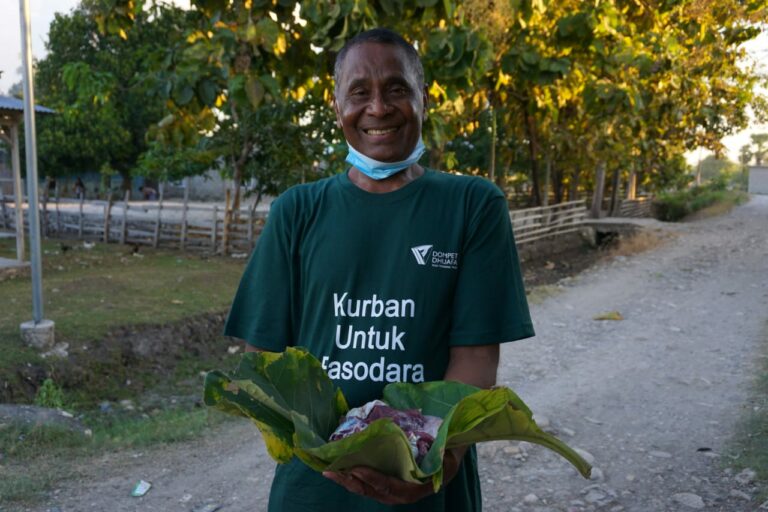
The slaughter of qurbani animals takes place on the day of Eid al-Adha after the Eid al-Adha prayer on the 10th of Dhu al-Hijjah until the days of Tasyrik on the 11th, 12th, and 13th of Dhu al-Hijjah. If the animals are slaughtered before the day of Eid, the qurbani is invalid.
Read also: 13 Procedures for Sacrificial Slaughter in Accordance with Islamic Sharia Sunnah
Then, distributing the sacrificial meat in processed form can provide more benefits to the recipients. This is based on a hadith from Salamah bin Al-Akwa, who said that the Prophet SAW said:
“Whoever slaughters a sacrifice, there should be no remains in his house after three days, even if it is only a little.”
The following year, people asked, “O Messenger of Allah, should we do as we did last year?” He said, “Eat and give to people and keep the rest. In fact, last year many people suffered from famine, so I wanted you to help them.” (HR Bukhari and Muslim).
Based on this hadith, it is permissible to store sacrificial meat for future needs. Furthermore, processing sacrificial meat for beneficiaries can provide more lasting benefits because it can be stored.
2. In accordance with the purpose of sacrifice to help those in need
Apart from being a form of gratitude, the sacrifice ritual aims to help those in need, strengthen relationships, and boost the economy in the trade sector. The distribution of sacrificial meat in processed form is also in accordance with the Indonesian Ulema Council (MUI) Fatwa Number 37 of 2019, which states that sacrificial meat may be:
a. Distributed on a deferred basis (‘ala al-tarakhi) to maximize its value (benefit).
b. Managed by being processed and preserved, such as canned and processed into corned beef, rendang, or similar products.
c. Distributed to areas outside the location of slaughter.
However, it is acceptable to give sacrificial meat in its raw state because the beneficiaries can then process it more freely. In addition, distributing processed meat takes longer, and this is still permissible in Islam.
Dompet Dhuafa needs your help so that more people in remote areas of the country can consume healthy sacrificial meat. In fact, according to IDEAS research in 2021, the upper class consumes 51 times more meat than the average population in the lowest decile (the poorest class).
Due to this gap, Dompet Dhuafa presents the Tebar Hewan Kurban program as a breakthrough for the welfare of the community while also raising the class of farmers in remote areas of Indonesia.
Perfect your worship by sacrificing again this year. Don’t worry, sacrificing at Dompet Dhuafa brings peace of mind because you can order online from home with the quality of sacrificial animals guaranteed to be healthy, fit, and good. Come on, reap the benefits of sacrificing again!