


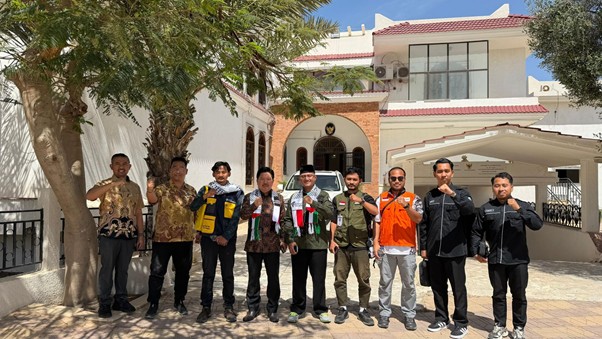
LIBYA —-— Imam Alfaruq, the Indonesian delegate from Dompet Dhuafa participating in the Global Sumud Flotilla (GSF) 2.0 Land Convoy mission, shared an update on Thursday (May 21, 2026) at 1:00 p.m. local time regarding the situation of the volunteers who remain stranded in the Libyan desert, approximately 65 kilometers from the city of Sirte.
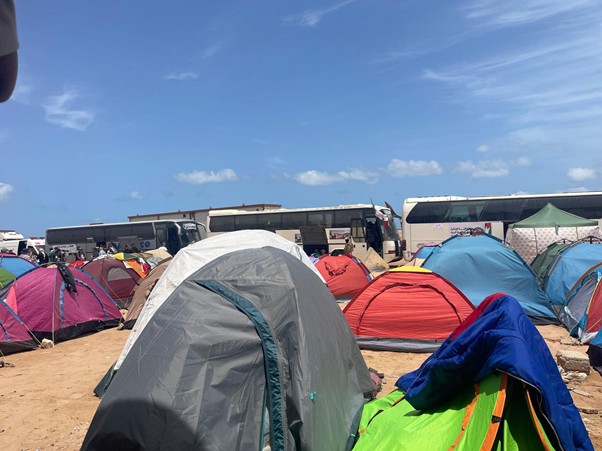
Now in its fifth day, the Land Convoy group remains in a barren location said to lie between the territories controlled by Western and Eastern Libya. Imam described the area as almost like “no man’s land.”
“There are no wells, no surface water. There is only seawater about two kilometers from the campsite,” Imam wrote in his report on Thursday (May 21, 2026).
It is suspected that Haftar’s militia controls the area surrounding the campsite. Meanwhile, the GSF Committee continues to negotiate with the Government of Eastern Libya to secure permission for the convoy to cross into Gaza. However, these efforts have yet to yield results.
On Monday (May 19, 2026), the GSF 2.0 Committee, along with an international delegation—including the Indonesian delegation—held a meeting with the Eastern Libyan Red Crescent. During that initial meeting, the response received was quite positive. In fact, the Red Crescent reportedly expressed readiness to receive and escort humanitarian aid to Gaza.
Read also: Communication Access Limited; GSF Land Delegation Still Stuck in Libya
However, that hope has not yet become a certainty. When asked to provide an official response on Wednesday (May 20, 2026), the parties who had previously attended could not be reached and did not show up at the campsite as promised.
On Thursday (May 21, 2026), the GSF 2.0 delegation set out again for Sirte to meet with representatives of the Libyan Red Crescent to ensure that aid could indeed be delivered to Gaza. This is because, to date, the Government of Eastern Libya has not granted permission for the Land Convoy to pass through.
Amid this uncertainty, conditions for the volunteers have grown increasingly difficult. Imam described the immense pressure felt by both the organizing committee and the participants.
“It’s not uncommon for us to see committee members suffering from severe flu with IV needles still attached to their hands,” he wrote.
Internal meetings continue to be held two to three times a day. On several occasions, delegation representatives from various countries were also involved to hear direct instructions from the GSF 2.0 Committee.
Read also: Ahmad Juwaini: Indonesian Volunteers on the GSF 2.0 Mission Are Safe and Secure
Extreme environmental conditions also began to affect the participants’ health. Desert dust, dry weather, and water shortages caused some volunteers to experience the flu, rashes, digestive issues, and even sore throats. During the day, temperatures inside the tents were extremely hot. Conversely, nights through early mornings are extremely cold, with temperatures reportedly dropping to around 15 degrees Celsius or lower.
Despite this, the GSF 2.0 Committee continues to work toward getting the land convoy operational as soon as possible. In their guidance, organizers urged all participants to remain “sumud”—strengthening their patience and resilience throughout this humanitarian endeavor.
Despite facing various limitations, Imam confirmed that the seven Indonesian delegates are still in good health. Some of them have indeed experienced the flu, sunburn, and even sore throats, but these are considered part of the consequences of the struggle.
“They are all still on fire to continue this noble journey,” wrote Imam. (Dompet Dhuafa)
Text and photos: Riza Muthohar
Editor: Dhika