


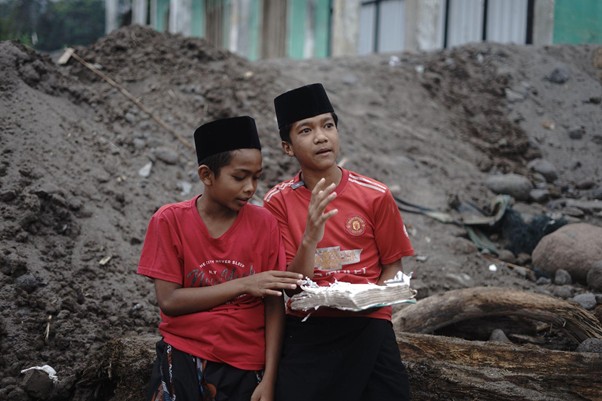
JAKARTA —-— “Alif lam mim, this is the Book; there is no doubt in it—a guidance for the righteous, who believe in the unseen, establish prayer, and spend from what We have provided them,” the faint sound of children reciting the Quran could be heard. Soft, yet their voices were steady.
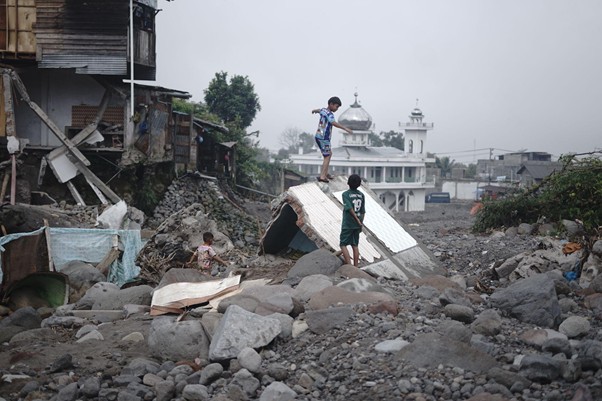
From a distance, the sound of children reciting the Quran could be heard, but not at the Meunasah; rather, it came from the ruins of a building that had once been the study hall where they used to study.
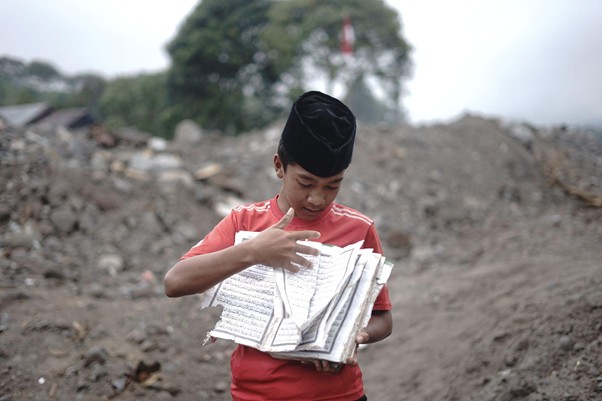
At that spot, there was a large tree trunk left behind by the flood and landslide, and they were reciting the Quran there. However, there was something even more concerning than the sight of the children reciting the Quran: the Quran itself—a holy book serving as a guide to life that contains everything humanity has ever needed throughout the ages. That Qur’an was the only one left; it seemed to bear witness to the fury of the flood and landslide that had also swept through Gampong Lampahan Timur, Timang Gajah Subdistrict, Bener Meriah Regency, Aceh.
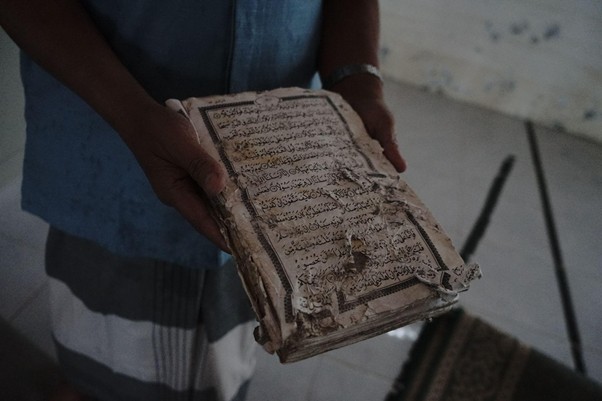
Yet, it seemed to possess a certain resilience. Despite being on the verge of being swept away, the Quran was found outside the Meunasah, covered in mud, with its cover torn off and split in two. Some of the ink was no longer legible, and the front and back pages were torn. This Quran stood as the sole remaining memento.
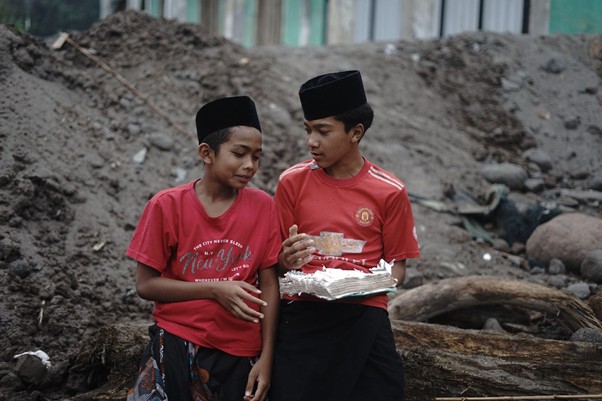
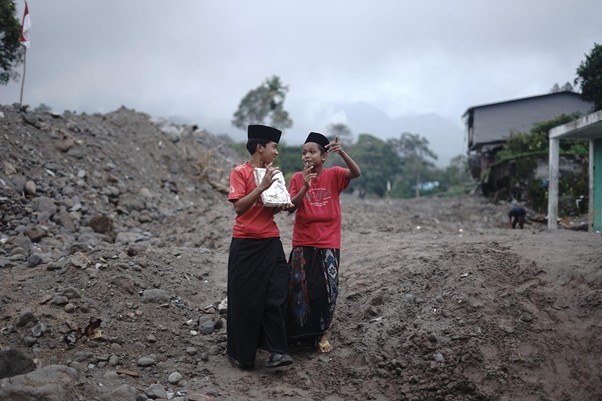
“Our Qur’an has been ruined, Zis, because it got flooded. What are we going to do for Ramadan here, Zis?” asked a boy named Daffa to his friend, Azis.
“Back then, big brother, there was a community hall here—it was also a place for Quran study sessions—but now the hall is gone, and the kids are studying the Quran up there on the second floor of the Meunasah,” he continued.
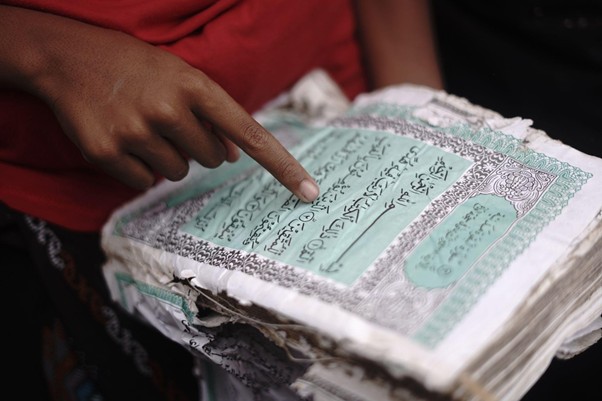
Nevertheless, Daffa and Azis remained enthusiastic about reading the Qur’an and reciting its verses. The voices that had been faint yet distinct were like the sound of hope, chanting the sacred verses from the only remaining copy of the Qur’an.
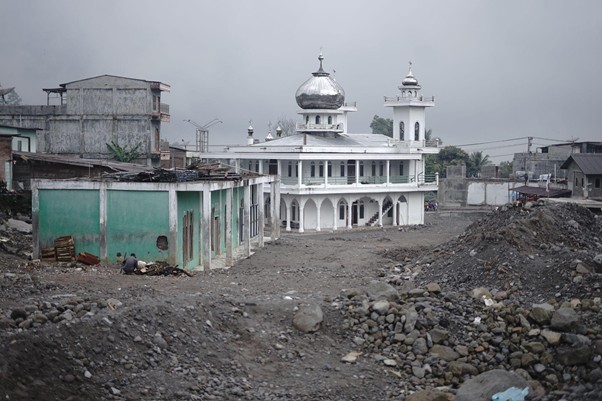
Next to the study hall, which no longer exists, stands a two-story Meunasah that remains firmly in place. The scent of fresh paint wafts from its walls, indicating that the Meunasah was recently repainted after floods and landslides struck Gampong Lampahan Timur, Timang Gajah Subdistrict, Bener Meriah Regency, Aceh.
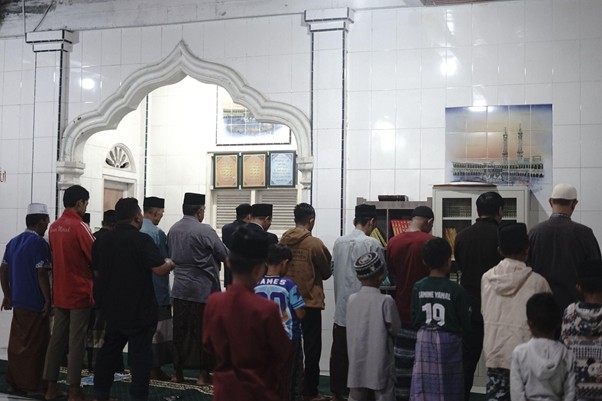
Standing firm at Meunasah Al Taqwa, always active in leading the five daily prayers, is Karim Harahap, a muezzin at Meunasah Al Taqwa. Karim was the one who found the Quran that had been carried quite far from the mosque by the floodwaters.
“Yes, this is the only remaining copy of the Quran; all the prayer items were lost, and we managed to save a few prayer mats, but after that the water kept rising so we didn’t have time anymore. We found this Quran outside; we dried it on purpose so that if anyone wants to read it, they have to do so page by page very slowly because many pages are still stuck together—they’ve absorbed mud, and the front cover is already destroyed,” said Karim.
Karim also recounted how he called the final azan just before the flood and landslide struck. Since the night before, Karim had had a premonition that the water would overflow. This was because the flowing water was pitch-black and emitted a foul odor. It was never usually like that, but that night the smell could be detected all the way inside the Meunasah.
It was just before dawn on November 25, 2025. The power was out, and communication was becoming limited. Karim tried to save the generator so he could call the azan and use it at the evacuation center, in the pitch-black early morning, and he felt as if he were racing against time because the water was rising rapidly as dawn approached.
Read also: Distributing Qur’an Alms, Dompet Dhuafa Sows Qur’anic Seeds in Sriwijaya Earth
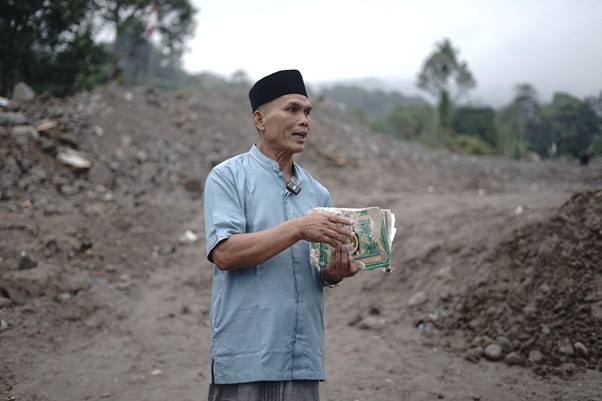
“I wanted to bring out the generator so we could call the azan; it was pitch black and everyone was terrified, so I finally brought it out by feel. I pulled it out, turned it on, and then called the azan. Yes, that was the last azan before the disaster struck. Deep down, I was already anxious, but I kept thinking, ‘Oh Allah, protect me, save me; I am carrying out Your command,’ and then I called the azan,” said Karim.
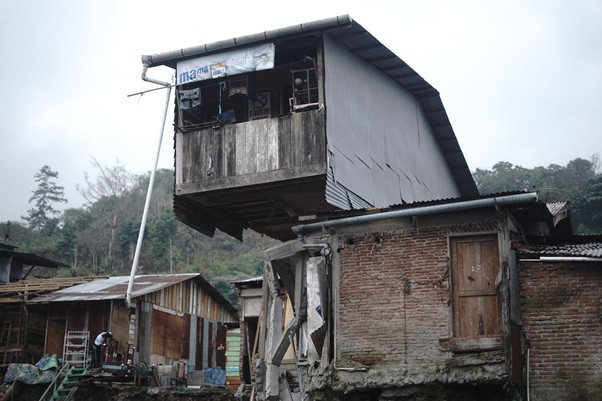
The floodwaters and mud kept rising; the water nearly reached the roof and touched the lights on the first floor. Several permanent structures, such as the religious study hall, the village head’s office, and the warehouse, were completely destroyed, while the Meunasah facilities—including the ablution area and restrooms—were also damaged.
The flood finally began to recede after 48 hours, specifically on November 27, 2025. Karim explained that despite various limitations, the cleanup process was carried out through community cooperation by the residents alongside volunteers. Without heavy machinery, they worked together to clear the remaining mud and debris.
“Al-Qur’an—praise be to God—is the book we always read, no matter how many copies we receive. There are indeed many children attending Quran study sessions here. The Qur’an is truly our guide and our role model; whenever donors give us Qur’ans, and whenever the community needs them, I distribute them to the people,” Karim concluded.
The children’s enthusiasm for studying the Quran amidst the scarcity of copies and Karim’s steadfastness serve as proof that nothing that is destroyed can ever truly extinguish faith. In Gampong Lampahan Timur, a disaster may have destroyed buildings. However, it could not destroy their faith. In the grip of a Quran that was nearly lost, and in the belief that as long as those verses are still being read, hope will always remain.
Support and provide the Quran for children affected by disasters, especially in Sumatra and across the archipelago. Let’s be part of the effort to keep that hope alive. A single copy of the Quran can be a source of hope for those who wish to continue learning, reciting, and observing Ramadan in a more meaningful way through digital.dompetdhuafa.org/donasi/sedekahjariyahquran. (Dompet Dhuafa)
Text and photos: Anndini Dwi Putri
Editor: Ronna