



Have you memorized the intention for fasting on Eid al-Adha? During the first 10 days of the month of Dhu al-Hijjah, Muslims are encouraged to fast. This is especially true on the 8th and 9th of Dhu al-Hijjah, which are known as very special days.
Three Excellent Times to Perform the Fast
In Islam, there are three times that are considered excellent for fasting. This is because the virtues of these three times are very beneficial for Muslims who fast. When are they? They are the sunnah fast during the first 10 days of Muharram, the obligatory fast during the last 10 days of Ramadan, and the sunnah fast during the first 10 days of Dhu al-Hijjah.
1. Fasting for the First 10 Days of Muharram
First, fasting during the first 10 days of Muharram. Muharram is referred to as the month of Allah because it holds great significance in Islamic history. It was during this month that the Prophet Muhammad SAW migrated from Mecca to Medina. Other important events include the creation of Prophet Adam (peace be upon him) on the 10th of Muharram, the birth of Prophet Ibrahim (peace be upon him), the healing of Prophet Ayyub (peace be upon him) from his illness by Allah, and many other important events.
Read also: 5 Tips for Easy, Fast, and Affordable Sacrificial Offerings
Such is the great blessing that Allah bestows upon this month that Muslims are encouraged to perform the sunnah fast for 10 days at the beginning of Muharram. For Muslims who fast on the 9th and 10th of Muharram, known as the Tasu’a and Asyura fasts, they will receive the virtue of fasting by having their sins from the previous year forgiven.
It is narrated from Abu Qatadah RA that someone asked the Prophet Muhammad SAW about the Asyura fast, and he said: “Fasting on the day of Asyura erases the sins of the past year.” (HR. Muslim).
2. Fasting During the Last 10 Days of Ramadan
The second time is during the last 10 days of Ramadan. A great event occurs, known as Lailatul Qadar, the night when the Quran was revealed. This event is described directly by Allah SWT in the Quran, Surah Al-Qadr, verses 1-5, which means:
“Indeed, We have revealed it (the Quran) on the night of glory. And do you know what the night of power is? The night of power is better than a thousand months. On that night, angels and the Angel Jibril descend with the permission of their Lord to arrange all matters. That night is (full of) well-being until the break of dawn.” (QS. Al-Qadr: 1-5).
3. Fasting on Eid al-Adha During the First 10 Days of Dhu al-Hijjah
The intention to fast on Eid al-Adha is the beginning of our journey to straighten our purpose in worship. One of the practices in the month of Dhu al-Hijjah is the sunnah fast during the first 10 days. Allah loves and blesses those who perform it.
In a hadith narrated by Ibn Abbas, the Prophet Muhammad SAW said, “There are no days in which righteous deeds are more beloved to Allah than these ten days (the first ten days of Dhu al-Hijjah).”
Indeed, fasting one day in it is equivalent to fasting one year. Performing night prayers in it is equivalent to performing night prayers on the night of Lailatul Qadar.
One of the companions asked, ‘Is it better than jihad in the way of Allah?’
He said, ‘Yes. It is better than jihad in the way of Allah, except for one who goes out for jihad with his wealth and life and never returns (dies as a martyr).’” Narrated by Imam At-Tirmidhi and Ibn Majah from Abu Hurairah.
Read also: Is Qurbani Obligatory or Sunnah for Those Who Are Able?
Basically, it is forbidden to fast on Eid al-Adha, which is on the 10th of Dhu al-Hijjah. So, fasting on the tenth day means refraining from eating and drinking before the Eid al-Adha prayer and breaking the fast after the prayer is completed. For those who qurban, they fast until they can eat the qurbani meat. On the tenth day, they do not fast fully from sunrise to sunset, as they did on the first to ninth days.
“The Messenger of Allah, peace and blessings be upon him, used to go to the Eid prayer on Eid al-Fitr and eat first. As for Eid al-Adha, he did not eat first, except after returning from the Eid prayer, then he ate the qurbani meat.” (HR. Ahmad 5: 352).
Read also: Goat or cow Qurbani? Which is better?
Intention to fast on Eid al-Adha on the first 10 days
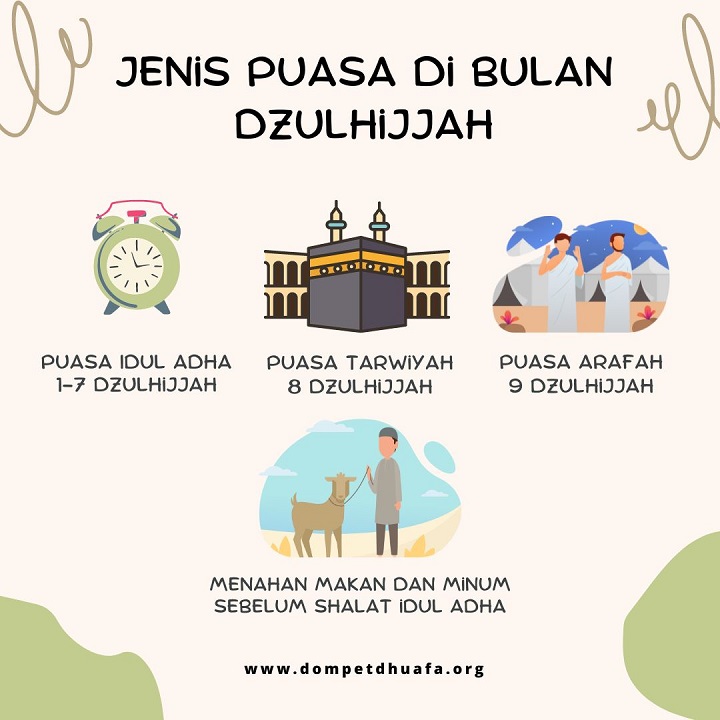
The intention to fast on Eid al-Adha must be verbalized in order to clarify the intention. Fast for the sake of Allah and expect blessings from Him, not to show off your worship. The following is the intention to fast on Eid al-Adha for the first 10 days. The implementation of the sunnah fast on Eid al-Adha on the first to ninth days is the same as the implementation of fasting in general. Start suhoor before dawn and break the fast at maghrib.
1. Intention for Eid al-Adha Fasting Days 1-7 Dhu al-Hijjah
Dhu al-Hijjah fasting is performed from the 1st to the 7th of Dhu al-Hijjah. This sunnah fast can be performed for seven consecutive days or intermittently.
Intention for Fasting Dhu al-Hijjah
Nawaitu Shouma Syahri Dzilhijjati Sunnatan Lillaahi Ta’aala.
Meaning: “I intend to perform the sunnah fast of Dhu al-Hijjah for the sake of Allah Ta’ala.”
Intention for Fasting Tarwiyah on the 8th of Dhu al-Hijjah
The eighth day of Dzulhijjah is called Tarwiyah Day. It can also be referred to as the day of the Sunnah Fast of Tarwiyah. Linguistically, ‘tarwiyah’ means ‘the process of thinking’. At this time, Prophet Ibrahim was thinking about his dream to sacrifice his only son at that time, Prophet Ismail. Therefore, it is called Tarwiyah Day.
Intention for the Tarwiyah Fast
Nawaitu Shoumat Tarwiyata Sunnatan Lillaahi Ta’ala.
Meaning, “I intend to perform the Sunnah Tarwiyah Fast for Allah Ta’ala.”
2. Arafah Fast on the 9th of Dhu al-Hijjah
The 9th of Dhu al-Hijjah is known as the Day of Arafah. It is a day of conviction in which Prophet Ibrahim fully believed in his dream, that it was a command from Allah. On this day, the pilgrims perform wukuf in Arafah. For Muslims who do not perform wukuf in Arafah, it is highly recommended to perform the sunnah of the Arafah Fast.
Intention for the Arafah Fast
Nawaitu Soauma ‘Arofata Sunnatan Lillaahi Ta’aala.
Meaning, “I intend to perform the Sunnah Arafah Fast for Allah Ta’ala.”
3. Intention to Refrain from Eating and Drinking Before Eid al-Adha Prayer
The intention to refrain from eating and drinking before Eid al-Adha prayer cannot be called sunnah fasting. However, refraining from eating and drinking is a highly recommended sunnah. There is no specific recitation for refraining from eating and drinking. However, as Muslims, we can intend in our hearts to refrain from eating and drinking until the Eid al-Adha prayer is over.
Read also: How to Make Online Qurbani Safe and Convenient Amid the Pandemic
Qurbani on Eid al-Adha
After performing a series of sunnah fasting practices and reciting the intention for Eid al-Adha fasting, on the tenth day, Muslims welcome the holiday. The Eid al-Adha celebration begins with the takbir, Eid al-Adha prayer, listening to the sermon until it is finished, then continuing with the slaughter of sacrificial animals. The slaughtered animals are then distributed to Muslims, especially the poor and needy.
Read also: Silaturahmi is a bond of brotherhood, meaningful and beneficial
Dompet Dhuafa has been accompanying Muslim friends in managing sacrifices for 27 years. The sacrificial animals are cared for in accordance with Islamic law, in collaboration with local farmers in rural areas. Spreading kindness through the distribution of sacrificial meat to remote areas. Click the banner below to start sacrificing with us.