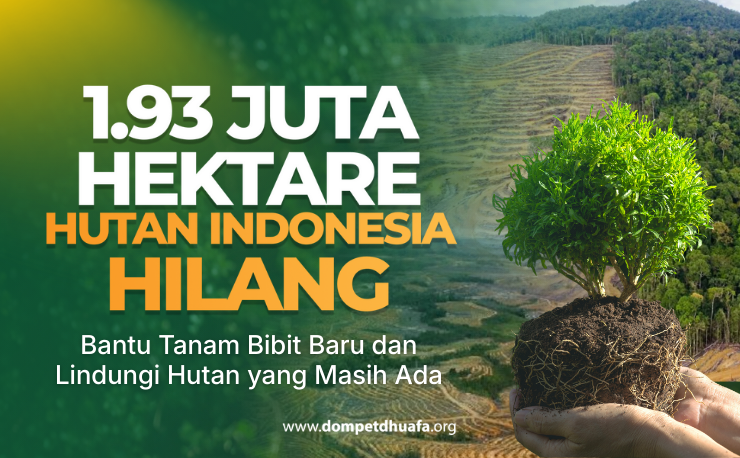


Tree donations are a relevant and tangible effort amid the environmental crisis that is increasingly triggering floods in various regions of Indonesia. Long-term forest destruction has robbed nature of its natural ability to retain water, protect the soil, and balance the climate. When heavy rains fall, areas that have lost their forest cover become highly vulnerable to flooding and landslides. In situations like this, almsgiving serves as social assistance while also supporting long-term efforts to restore nature.
Read also: Donations for Disaster Victims and Aid Priorities
Flooding Caused by Environmental Crisis
The recurring major floods in various regions did not appear suddenly. Many studies show that deforestation and land conversion are the main factors that exacerbate the impact of extreme rainfall. When forests are cleared for large-scale palm oil plantations and mining, the soil structure changes. Tree roots that previously held water and soil are lost. This causes rainwater to flow quickly into rivers without being absorbed by tree roots in the soil.
Data from Wahana Lingkungan Hidup Indonesia (Indonesian Environmental Agency) records significant forest loss in several areas of Sumatra over the past decade. Greenpeace Indonesia also reports a large-scale decline in natural forest cover due to land-based industrial expansion.
Forest destruction has a direct impact on the livelihoods of communities. Rivers overflow more quickly, settlements are flooded, and agricultural land is damaged. Floods and landslides are no longer a recurring threat.
Read also: Charity for Nature How to Do It?
Tree Donations as a Form of Environmental Responsibility
Tree donations are a response to deforestation. Planting trees means slowly and sustainably restoring damaged natural functions. Trees absorb rainwater, strengthen soil structure, and help stabilize water flow to rivers. In the long term, healthy forests reduce the risk of flooding and landslides. They can also become the lungs of the world that protect us from global warming.
Tree donations provide long-lasting benefits because the trees that are planted will continue to grow, retain water during rainfall, and support the surrounding life. Every living tree will work for decades to maintain the balance of the ecosystem. This is what makes tree donations strategically valuable in disaster mitigation efforts.
Apart from flooding, forest destruction also contributes to global warming. Trees play an important role in absorbing carbon dioxide from the air. When forests are cut down, nature’s ability to absorb emissions decreases dramatically. Carbon stored in the soil and tree biomass is released into the atmosphere. According to a report by the Intergovernmental Panel on Climate Change (IPCC), deforestation contributes to a large amount of greenhouse gas emissions globally. Tree donations serve as a concrete effort to curb the rate of climate change while restoring the local environment.
Read also: What is Global Warming and How to Prevent It
Tree Donations in the Islamic Perspective
Islam views humans as caliphs on earth who are responsible for maintaining the balance of nature. Allah says, “Do not cause corruption on earth after it has been set in order. Pray to Him with fear and hope. Verily, Allah’s mercy is very close to those who do good.” (QS. Al-A’raf: 56). This verse emphasizes that humans are prohibited from destroying the environment that Allah SWT has created in a balanced manner.
In another verse, Allah reminds us that the destruction of nature is related to human actions. “Corruption has appeared on land and sea because of what the hands of men have wrought. (Through this) Allah makes them taste some of the consequences of their deeds so that they may return (to the right path).” (QS. Ar-Rum: 41). This verse is relevant to the current condition of deforestation and its impact on disasters.
The Prophet Muhammad also emphasized the importance of planting trees. In a sahih hadith narrated by Ahmad, he said, “No Muslim plants a tree or sows seeds, then humans, birds, or animals eat from it, except that it becomes charity for him.” This hadith shows that planting trees is an act of worship whose benefits extend to many creatures.
Read also: Is it permissible to distribute zakat for climate change programs?
Social Impact of the Tree Alms Movement
Tree alms not only have an impact on the environment, but also on the social life of the communities surrounding the forest. Planting programs that involve local residents help create jobs, raise environmental awareness, and strengthen the community’s relationship with the surrounding nature.
When forests recover, water sources become more stable. Smallholder agriculture becomes productive again. The risk of disasters gradually decreases. These impacts are not always visible in the short term, but the benefits are real in the long term.
Dompet Dhuafa developed a tree donation program as part of its commitment to environmental restoration and disaster risk reduction. This program is designed to go beyond the initial planting. The trees planted are cared for together with conservation partners so that they can grow and provide sustainable benefits. Through this approach, tree donations are directed to areas experiencing high ecological pressure due to deforestation. The program also involves local communities so that they play an active role in protecting the restored forests.
Read also: Climate Change and Signs of Damage to the Earth’s Surface
Why Sumatra Needs Tree Donations
In Sumatra, large-scale forest clearing for plantations and mines has drastically changed the landscape. Many areas have lost their buffer forests, which previously served to retain rainwater. When rainfall increases, flooding spreads to areas that were previously relatively safe.
Tree donations are one effort to improve this situation. Planting trees in watersheds and critical areas helps restore lost ecological functions. This measure does not immediately eliminate the risk of flooding, but it is an important foundation for long-term prevention.
Read also: Climate Change and Signs of Damage to the Earth’s Surface
Planting Trees as a Long-Term Charitable Investment
Unlike consumptive almsgiving, tree almsgiving works over a long period of time. Consumptive almsgiving is almsgiving whose benefits are immediately used and completed in a short time, such as food, clothing, or daily necessities. This form of almsgiving is very much needed in times of emergency because it helps people survive in difficult conditions. Meanwhile, tree almsgiving works in a different way.
Trees that are planted continue to provide long-term benefits as long as they grow and live. Their leaves absorb carbon from the air, their roots prevent landslides, and they help conserve water reserves. Because their benefits last for years, tree charity is a form of caring that has a sustainable impact on the environment and human life.
The concept of tree charity is similar to the concept of jariyah charity. Its benefits are not limited by time and continue to be felt by humans and other creatures. It is this value that makes tree donations relevant in responding to current environmental challenges.
The environmental crisis cannot be solved by one party alone. It requires the involvement of the wider community to support nature restoration efforts. Tree donations provide an opportunity for anyone to make a real contribution, even if they are not directly involved in the planting.
Dompet Dhuafa invites the community to help protect the earth through a well-managed tree planting program. This support is part of a joint effort to restore the function of forests, reduce the risk of disasters, and provide future generations with a safer environment to live in. With this simple step, tree donations can become a way to care for nature and preserve life in a sustainable manner.