


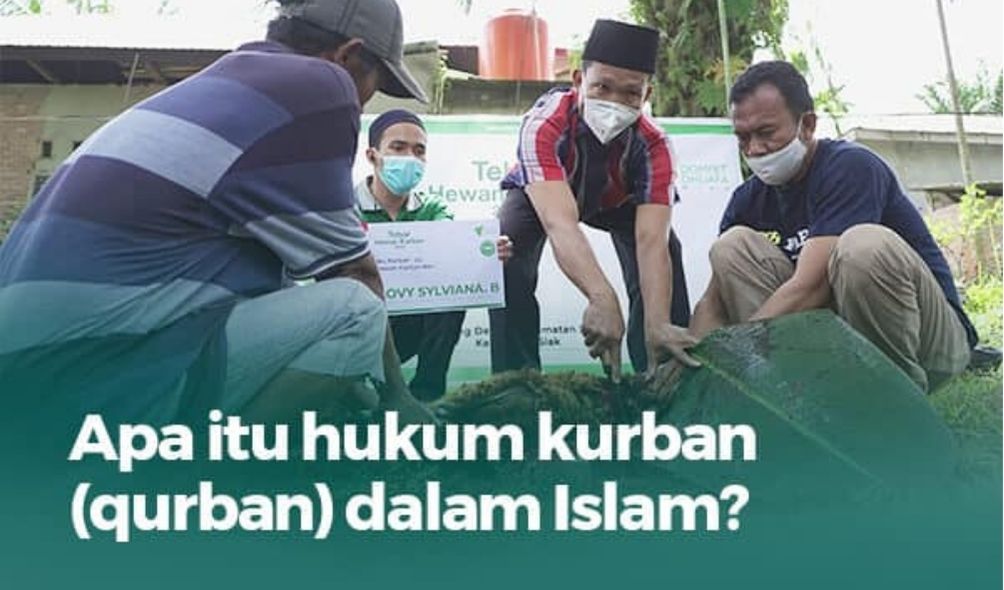
After going through a series of worship rituals during Ramadan, Muslims prepare to welcome Eid al-Adha. In addition to worship, qurban is a major annual socio-economic tradition that can improve the welfare of the mustahik. For a comprehensive understanding, let’s examine one by one what qurban is, its meaning, procedures, and laws, which are presented in full here.
What is Qurban (Sacrifice) in Islam?
Qurban in Arabic is called األضحية (al Udh-hiyyah / Ad-Dhahiyyah), which means four-legged slaughtered animals, such as camels, cows, and goats. Quoting from the book Panduan Kurban Dompet Dhuafa (download here), qurban performed on Eid al-Adha means the beginning of the day after sunrise, such as the time of the Dhuha prayer.
The slaughtering of sacrificial animals is carried out on Eid al-Adha and the days of Tasyriq, which are on the 10th of Dhu al-Hijjah after the Eid al-Adha prayer and the three days of Tasyriq, which are on the 11th, 12th, and 13th of Dhu al-Hijjah. This is based on a hadith from Jubair bin Muth’im which can be read in full here.
On the other hand, sacrifice is a special act of worship performed by Muslims who are able to help people who still lack access to meat. Someone who is able to perform sacrifice is called sohibul qurban. Of course, to be a good sohibul qurban, one must obey the rules of Sharia.
- Learn about the meaning and requirements of Shohibul Qurban to be valid and humble – click here
- Time of Slaughtering Sacrificial Animals – click here
- Arguments for Sacrifice in the Quran and Hadith – click here
History of Sacrifice
The origin of sacrifice in the world is based on the history of sacrifice in the time of the prophets. Before the command to sacrifice was revealed, the prophets from Prophet Adam AS, Prophet Ibrahim, to Prophet Muhammad SAW performed this social act of worship through Allah’s revelation.
On the other hand, sacrificial offerings have the potential to minimize the gap in meat consumption between the rich and the poor. Research from IDEAS in 2021 shows that the average population in the highest decile (the richest class) consumes 1.39 kg of meat per capita per year. Meanwhile, the poorest class only consumes 0.027 kg of meat per capita per year.
This means that the upper class consumes 51 times more meat than the average resident in the lowest decile (the poorest class). Due to this gap, Dompet Dhuafa presents the Tebar Hewan Kurban program as a breakthrough for community welfare while also elevating the status of farmers in remote areas of Indonesia.
From the stories of the prophets to the implementation of qurbani in social life, here is the complete history of qurbani that we need to know in this article:
- This is the History of Qurbani and the Reasons Why We Are Commanded to Perform Qurbani – Click here
- The Great Example of Prophet Ibrahim, the Father of the Prophets – Click here
- The Sincerity of Ibrahim and Ismail (Part One) – Click here
- The Sincerity of Ibrahim and Ismail (Part Two) – Click here
- A Brief History of THK’s “Crazy Breakthrough” for the Welfare of the People – Click here
The Intention to Perform Sacrifice
اَللَّهُمَّ هَذِهِ مِنْكَ وَإِلَيْكَ فَتَقَبَّلْ مِنِّيْ يَا كَرِيْمُ
Allâhumma hâdzihî minka wa ilaika, fataqabbal minnî yâ karîm
Meaning:
“O my Lord, this animal is a blessing from You. And with this I draw closer to You. Therefore, O Most Gracious Lord, accept my drawing closer to You.”
The intention is sufficient in the heart. Basically, according to some scholars, reciting, “I intend to sacrifice for myself for the sake of Allah Ta’ala” is also sufficient.
The Proper Conditions and Rules of Sacrifice
There are various unique questions every Eid al-Adha, one of which is about buying sacrificial animals online. Your doubts will disappear after watching this video because online sacrifice at trusted institutions such as Dompet Dhuafa maintains the quality of livestock, so your sacrifice remains valid!
To be valid, Islamic law has regulated the correct provisions and laws of sacrifice. Here is a summary of the provisions and laws of sacrifice:
- Types of Sacrificial Animals According to Islamic Provisions – Click here
- 4 Important Things to Consider When Participating in a Sacrificial Pool – Click here
- The Rules of Online Sacrifice for Ease and Speed – Click here
- The Rules of Sacrifice Arisan – Click here
- Is it permissible to make a sacrifice using a credit card? – Click here
- Is it permissible to distribute processed sacrificial meat? – Click here
- Here are the Rules for Sacrificing in the Name of the Deceased – Click here
- 4 Reasons Why Sacrificial Meat is Permissible for Non-Muslims – Click here
7 Requirements for a Valid Sacrificial Animal
Another important thing that Muslims must know is the requirement that sacrificial animals must be healthy and of good quality in order to be valid according to Islamic law. There are 7 requirements for a valid sacrificial animal, as follows:
- The sacrificial animal must be a type of livestock, namely a camel, cow, or goat, whether it is a sheep or a regular goat.
- It must have reached the age required by sharia, which is jaza’ah (half a year old) for sheep or tsaniyyah (one full year old) for other animals.
- Ats-Tsaniy from a camel is one that has reached the age of 5-6 years.
- Ats-Tsaniy from cattle is one that has reached the age of 2 years
- Ats-Tsaniy from goats is one that has reached the age of 1-2 years
- Al-Jadza’ah from sheep is one that has reached the age of 6 months
- Free from defects (flaws) that prevent its validity, namely what has been explained in the hadith of the Prophet, peace be upon him.
The conditions for a valid sacrificial animal are set out so that the sacrificer avoids animals that are prohibited from being sacrificed due to defects. This is solely so that the meat given to the mustahik is fresh and healthy. Defects are divided into two categories that must be monitored by farmers and sacrificers before purchasing.
- Defects that render an animal invalid for sacrifice are:
- Blindness
- Severe illness
- Lameness
- Extreme emaciation or weakness to the point of appearing to have no bone marrow
- Defects that render an animal makruh (disliked) for sacrifice are:
- Partial or complete loss of the ears
- Broken or fractured horns
- Broken or fractured teeth
Specific information on the 18 types of defective sacrificial animals, the timing of the sacrifice, and the Fiqh of sacrifice can be accessed quickly and easily at the following links:
- 18 Types of Animals Prohibited from Being Used as Sacrificial Animals – Click here
- Reasons for the Invalidation of Sacrifice if the Animal is Slaughtered Before the Time – Click here
- All in One Fiqh of Sacrifice and How to Perform It – Click here
- Tips for Choosing the Best Sacrificial Animals – Click here
Procedures for Slaughtering Sacrificial Animals
Islamic law regulates sacrifice from start to finish so that the sacrificial meat given to the mustahik can be used as well as possible. In addition, from the animal’s perspective, slaughter is carried out in accordance with Islamic law to reduce stress and fear. Negative reactions from animals will affect the quality of the meat.
- Ensure that the knife used for slaughter is sharp. Do not use blunt objects.
- Avoid sharpening the knife in front of the animal so as not to cause stress and fear.
- Slaughter facing the qibla and touching the ground.
- Recite the name of Allah when slaughtering.
- Slaughter quickly to minimize the pain felt by the animal.
- After slaughter, ensure that the throat, esophagus, and both right and left neck veins have been completely severed.
- If the animal is not completely dead, it is prohibited to break its neck.
In addition to this excerpt, there is more to read about the complete procedures for slaughtering sacrificial animals at the following link:
- Procedures for Slaughtering Sacrificial Animals According to Islam – Click here
- 13 Notes to Consider When Slaughtering Sacrificial Animals – Click here
What are the requirements for male or female sacrificial animals?
The sacrificial livestock used in the Dompet Dhuafa’s Tebar Hewan Kurban (THK) program are male animals, so that the female animals can continue to reproduce. This is also confirmed by the Livestock and Animal Health Service, which has issued a regulation prohibiting the slaughter of productive female ruminants.
Violators will be subject to administrative and/or criminal penalties under Article 86 of Law No. 41 of 2014 on Livestock and Animal Health:
a. Productive female small ruminants as referred to in Article 18 paragraph (4) shall be punished with imprisonment for a minimum of 1 (one) month and a maximum of 6 (six) months and a fine of at least Rp1,000,000.00 (one million rupiah) and a maximum of Rp5,000,000.00 (five million rupiah); or
b. Productive female large ruminants as referred to in Article 18 paragraph (4) shall be punished with imprisonment of at least 1 (one) year and at most 3 (three) years and a fine of at least Rp100,000,000.00 (one hundred million rupiah) and at most Rp300,000, 000,000 (three hundred million rupiah).
For more details, please read the article:
- Which is Better, Male or Female Sacrificial Animals? – Click here
Sacrificial Animals and Hajj
The pilgrimage and sacrificial animals are inseparable from each other, both historically, in terms of the time of implementation, and in terms of their virtues or benefits. Muslims around the world accompany the Hajj by performing the Eid al-Adha prayer and slaughtering sacrificial animals as a symbol of Allah’s religion. Allah SWT says: “So pray to your Lord and sacrifice” (QS. Al Kautsar).
For those performing the Hajj, some scholars differ on whether it is sunnah to perform the sacrifice or not. One of them is Imam Syafi’i, who said that people who are performing the Hajj pilgrimage are still recommended to perform qurbani because the Prophet Muhammad once performed qurbani on behalf of his wives when he performed the Hajj.
On the other hand, the Hajj pilgrimage and qurbani require financial capability. Therefore, it is important to remember that people performing the Hajj are allowed to perform qurbani, as long as they have sufficient funds. Do not perform the ritual of sacrifice during Hajj, but then neglect the needs of yourself and your family.
Sacrifice during Hajj usually revolves around the issue of paying dam (penalty). Dam is divided into two types, namely dam nusuk and dam isaah, each of which has different provisions. To find out more about the types of dam, you can read the following articles:
- Laws and Procedures of Sacrifice for Hajj Pilgrims – Click here
- Understanding the Meaning of Hajj and Sacrifice (Part One) – Click here
- Understanding the Meaning of Hajj and Sacrifice (Part Two) – Click here
- Understanding the Meaning of Hajj and Sacrifice (Part Three) – Click here
- Understanding the Meaning of Hajj and Sacrifice (Part Four) – Click here
- 9 Meanings of Hajj and Qurbani – Click here
Qurbani and Aqiqah
Similar but not the same. That is aqiqah and qurbani, which both involve the slaughter of goats or sheep. There are various differences between qurbani and aqiqah, one of which is that qurbani is the responsibility of all Muslims, while aqiqah is the responsibility of the parents of the child.
Both are important, but kurban is a worship that is performed at a specific time, namely on the 10th, 11th, 12th, and 13th of Dhu al-Hijjah. Meanwhile, aqiqah can be performed at any time when the parents are financially capable.
So, which one should be prioritized between kurban and aqiqah? That is why it is important to determine your priorities first. If the time for qurban is approaching, then prioritize qurban. It is okay if the child has not yet been given an aqiqah because there is no argument that explains the prohibition of qurban if aqiqah has not yet been performed. If qurban is still far away, then aqiqah becomes the priority.
- Qurban and Aqiqah, Which is More Important? – Click here
- Understanding Qurban and Aqiqah in Islam – Click here
- Can Sacrifice and Aqiqah Be Combined? – Click here
- 9 Important Differences Between Sacrifice and Aqiqah in Islam – Click here
Sacrifice Becomes a Shared Benefit with Dompet Dhuafa
The tangible evidence of your sacrifice is clearly recorded in this documentary video. Thanks to you, our brothers and sisters in remote areas of Indonesia can eat healthy meat. Come on, keep following Dompet Dhuafa’s adventures!
Welcome the month of Dzulhijjah by sharing hygienic qurbani at Dompet Dhuafa. Don’t worry, online qurbani from Dompet Dhuafa must consider all aspects of health and hygiene. Come on, don’t miss this precious opportunity for safe and healthy qurbani at Dompet Dhuafa!