


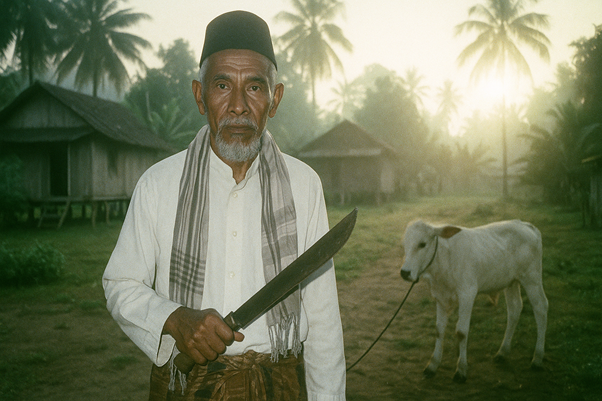
JAKARTA -— The world is fun, exciting, but also funny. Now, with the onslaught of increasingly sophisticated AI (Artificial Intelligence), this world of falsehoods feels even more real. Honestly, sometimes I wonder, is this real or am I living in a movie like I, Robot, Her, In Time, or Doraemon?
In response to these concerns, I started daydreaming: what if even religious practices became “advanced”? For example, praying using AI. Imagine this: you’re feeling lazy about memorizing a verse, and suddenly a beautiful AI voice, just like a famous reciter, guides you through each verse. Or when you’re feeling lazy about the final salutation, a notification pops up: “Your movement isn’t perfect, please adjust your hand position!” Isn’t that frustrating? But on the other hand, it might be useful for those who are still learning or for those who occasionally forget the number of raka’at. Who knows, AI might even help with discipline. So you won’t be late or make mistakes in your prayers, right? But then again, will our prayers become “high-tech”? Or will they just become the most ‘autopilot’ form of worship? Maybe there’ll even be a “fast forward” feature for Tarawih prayers because they’re so long. Oh, that’s getting a bit too much!


But when you think about it, AI is just a tool. Like a knife, it can be used to cut vegetables into delicious meals, or it can be used for harmful purposes. So, if AI is used to help learn religion, to check readings so that they become more fluent, then that’s fine. Think of it like using a calculator to calculate zakat, so you don’t make a mistake. The purpose of worship is to be solemn and correct. If AI can help us be more solemn and correct, why not? But then again, prayer is about our personal relationship with God. It feels strange to have a “third party” in the form of AI interfering. Unless AI can foster faith in our hearts, then that’s something worth questioning!
Now, regarding Eid al-Adha, this is what really makes me think hard. Me and my friends from Dompet Dhuafa sometimes go on field trips to remote areas of Indonesia. Once, we even had to “jump” into a boat with cows in Papua because the only way to reach the remote island was by boat. Seeing firsthand how in remote villages, sacrificial meat becomes a rare commodity. I even celebrated Eid al-Adha amid the Lombok earthquake disaster. Prayers were held in a makeshift mosque, and sacrificial meat became “gold” for survivors because it became a rare addition to the communal kitchen menu in the evacuation camps.
Read also: Procedures for Kurban Slaughter in Accordance with Islamic Law
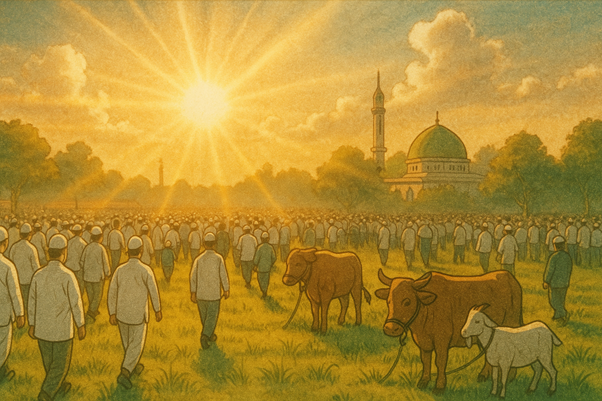
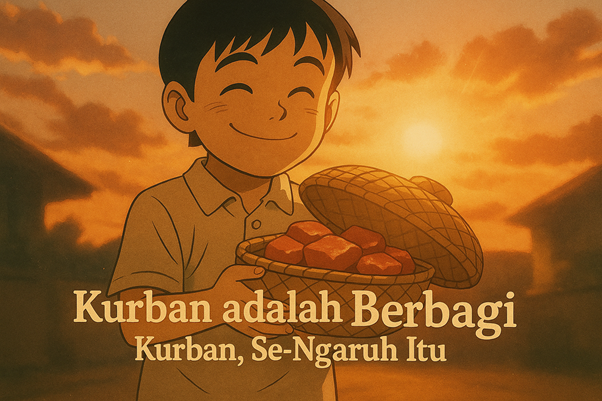
In the remote areas, Eid al-Adha is celebrated with a completely different kind of euphoria. On the night before, people parade around the village carrying torches, mosques are cleaned until they shine, and the atmosphere is very harmonious and spiritual. When it is time to slaughter the sacrificial animals, the residents work together to prepare everything, as if they have never seen a goat before. Everyone’s faces are beaming with joy. Especially when the meat is distributed, it feels like finding a treasure. Even in the remotest areas, the meat is delivered in rattan containers and wrapped in leaves—the effort is truly heartwarming. This isn’t a soap opera; it’s real life!
Now, in the city, the story can be different. Sacrificial meat sometimes piles up at the mosque, and even those who can afford to sacrifice end up getting more meat than they know what to do with. Meanwhile, in the countryside, if there’s meat, it’s immediately distributed again, spreading to neighboring villages where people might have never tasted sacrificial meat in their entire lives. This is like a fantasy movie, but it’s real?
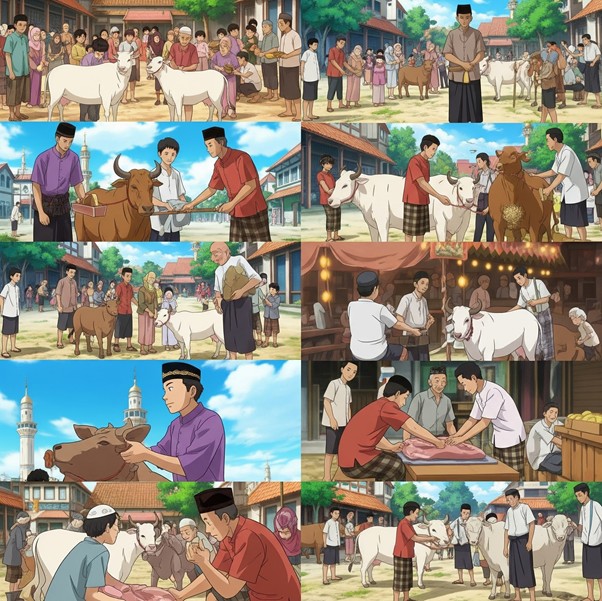
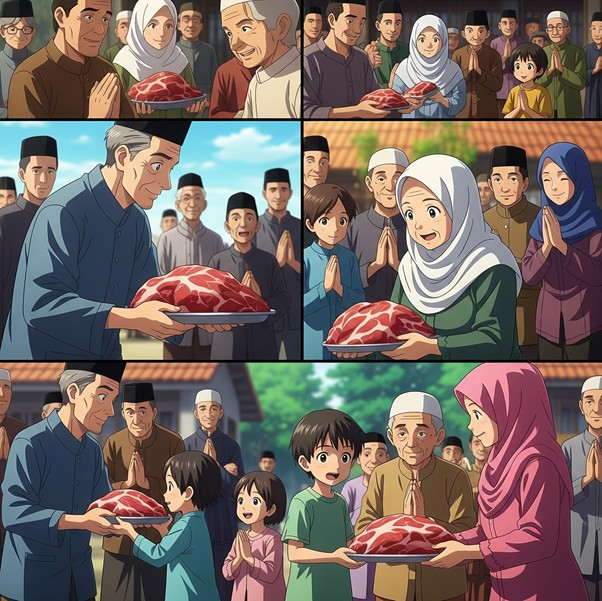
Then, my mind wandered again: what if my sacrifice was AI? For example, I “Qurban” a super-advanced server containing the best algorithms, and consider that as my sacrifice. Would the reward be the same as sacrificing a cow or goat, which can actually feed many people? After all, the essence of sacrifice is selflessness and sharing. Giving something valuable that can be directly felt by others. Sacrificial animals can actually be delicious meals, a source of protein for people who rarely eat meat. AI? Can it be eaten? Well, it can only “eat” data.
Maybe the point isn’t that AI is bad. It’s great. AI can be an incredible tool for good. It can assist in health research, serve as a virtual teacher, or even help make social programs more efficient. However, there are fundamental aspects of life that cannot be replaced by the sophistication of code. The essence of mutual cooperation, the warmth of a smile, the tears of joy when sharing, and the sincerity in worship. These are all the “human touch” directly programmed by the Creator.
No matter how advanced AI becomes, the essence of sacrificial worship with all its regulations will never be replaced by AI. Because sacrifice is not just about “giving,” but also about the form and manner of giving that have been established. Not only can it not be replaced by AI, but even sacrificial animals with all their regulations cannot be replaced by chickens.
Read also: Qurban for Palestine: Efforts to Bring Hope Amidst a Famine Emergency
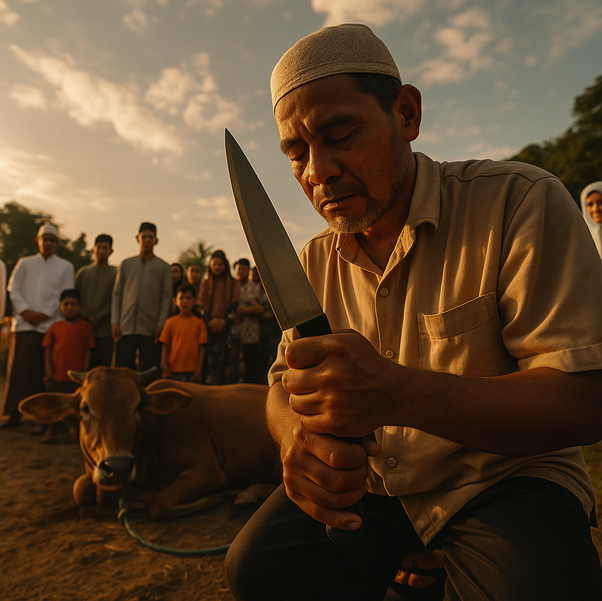
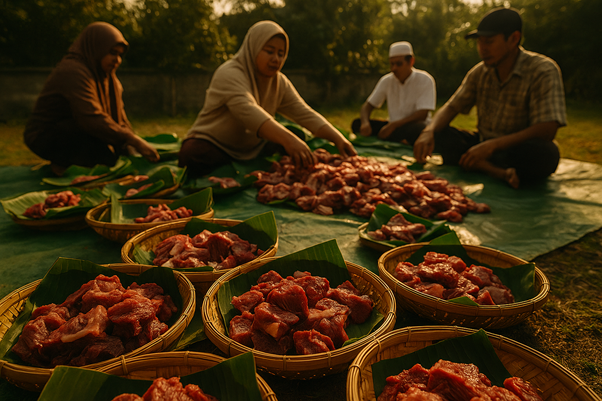
So, using AI for worship? It might serve as a guide, but it can’t replace the essence of devotion and the personal connection with the Almighty. AI-powered sacrifices? It might be a technological donation, but it can’t replace the joy of sharing sacrificial meat that is felt both in the stomach and in the heart.
In the end, amidst the onslaught of instant and virtual technology, we are reminded once again of the things we must hold dear: humanity, togetherness, and sincerity. If everything becomes digital, we might forget the feeling of shaking hands during Eid, or the sweat and effort of working together to slaughter the sacrificial animal. In the end, our lives might become like a JPG file—easy to copy and paste, but losing their original meaning. Don’t you think so?

But if you think about it more deeply, sacrifice can also be “advanced,” you know! Like using AI, you can make a sacrifice and share its benefits with our brothers and sisters in remote areas of Indonesia even though you’re at home with your family during Eid al-Adha. Just click this link: Kurban Dompet Dhuafa, your sacrificial animal will bring joy to your brothers and sisters in other parts of Indonesia who are in need. The distribution of meat will also be more equitable. Try Kurban Saruh, give it a try! (Dompet Dhuafa)
Text and Image: Dhika Prabowo
Editor: Dedi Fadlil