


CROATIA – Osijek – the fourth largest city in Croatia, may not be familiar to many people. This city has a remarkable history, especially related to the presence of Muslims. To be honest, I did not expect to find such a rich and winding story here.
The presence of Muslims in Osijek has been recorded for a long time, even before the Ottoman era. According to the Charter of King Emeric in 1196, there was already an Ismaili community—the first Muslim community—living in Osijek as merchants. This charter is the oldest record of the city’s name and the existence of its inhabitants, a clear indication that this area has been a crossroads of culture and trade for centuries.
The arrival of Sultan Suleiman al-Qanuni (Suleiman the Magnificent) and his army in 1526, following their decisive victory in the Battle of Mohacs, which severely weakened the Kingdom of Hungary, paved the way for Ottoman dominance in Central Europe and transformed the face of Osijek. I imagine the bustling construction of the Suleiman Bridge spanning the Drava River, a masterpiece stretching over six kilometers. Just thinking about it fills me with awe—no wonder it was once called a “wonder of the world.” This bridge, which has been destroyed and rebuilt multiple times, stands as a silent witness to how strategically important Osijek was to the Ottoman Empire.
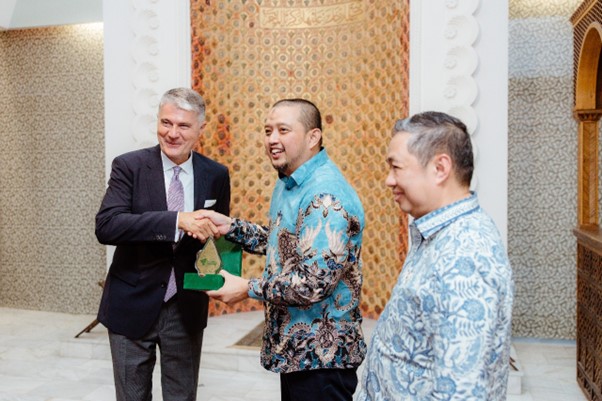
While at the construction site of the Osijek Islamic Center, my imagination wandered to the grandeur of the Kasim Pasha Mosque, built in 1558, which must have exuded a strong spiritual aura. Not only that, there is also the Mustafa Pasha Mosque, built in 1569, which I believe served not only as a place of worship but also as a center of learning with a madrasah there.
Based on local historiography studies, there were at least six mosques standing tall in Osijek before Ottoman rule ended in 1687. The atmosphere of the city at that time must have been very different, filled with the echoes of the call to prayer and religious activities. After a long period without an organized Muslim presence, a new chapter began in the early 20th century.
In late 1927, the Osijek Muslim Community was established. This made them the second oldest Muslim community in Croatia. They formed a governing body in Zagreb, 280 km away from Osijek. The majority of the administrators had migrated from Bosnia and Herzegovina to Osijek in search of livelihood, and then fought to rebuild their community.
While at the Osijek Mosque, I could also feel the joy of the congregation when they opened the first prayer hall in 1936, led by Imam Husein ef. Jahić, when there were only about 500 Muslims in Osijek. There were actually efforts to build a mosque during World War II, and the first stone was even laid in 1942—a moment full of hope. Unfortunately, it was not realized at that time. It was not until 1978 that a 70-square-meter house at Zagrebačka 35 was opened as a mosque and remains in use to this day. It is truly heartwarming to hear the story of the fund-raising efforts for the mosque that was never built back then, a testament to how strong their desire was. Imam Enes ef. Poljić, who led the community for nearly four decades until 2018, must have left a deep mark on them.
Reaching for Dreams: The Future of the Osijek Islamic Center
Today, the Muslim community in Osijek is increasingly diverse, comprising around 3,000 Muslims in the Osijek area alone. They are native Croatians or have backgrounds from Albania, Bosnia, Herzegovina, Serbia, Arab, and Turkish—all coming together in Osijek’s cultural mosaic. Their current prayer space is an old house that is no longer adequate. I can feel how much they long for a more suitable place.
There has been enthusiasm since the early 2000s. I feel proud to see how Muslims in Osijek have been persistent in finding solutions, until they finally succeeded in purchasing land in the Jug 2 area, near the Muslim cemetery. It was a long journey that finally came to fruition in 2015, when the city government granted a building permit for the Islamic Center in Osijek.
When I saw the model and description by architect Davor Mateković, who described the project as a “small town,” I could sense the grand vision behind it. It’s not just a mosque, but a spiritual, cultural, educational, and humanitarian center spanning over 900 square meters. This is a dream passed down from generation to generation in Osijek. I am determined to be part of the moment when the doors of the Islamic Center open, and the first congregants step inside to pray at the Istiqlal Mosque. The name is also inspired by the mosque in Sarajevo, which was begun by Indonesia in 1995 as a symbol of friendship between Indonesia and Bosnia and Herzegovina. In the future, the Istiqlal Mosque at the Islamic Center in Osijek will not only be a physical building, but also a manifestation of a long-awaited mandate, the fruit of brotherhood between Indonesia and Croatia. (Dompet Dhuafa)
Text: Prima Hadi Putra
Photo: Indonesian Embassy in Zagreb