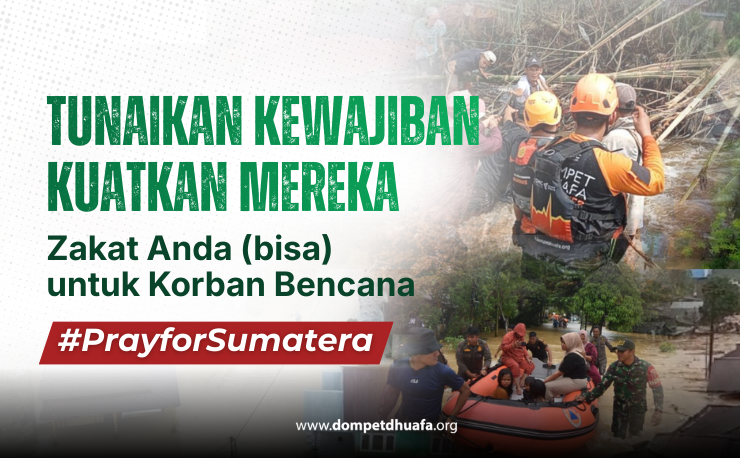


Zakat for the environment is one of the efforts we can make when natural destruction begins to cause major disasters, such as the floods that have hit a number of areas in Sumatra. These disasters are not only triggered by high rainfall, but also by forest destruction in upstream areas. Years of logging and land conversion to plantations have weakened the soil’s ability to absorb water. When heavy rains fall, the water flows uncontrollably, causing massive floods that devastate many settlements. In conditions like this, zakat can be directed to help restore the environment so that similar disasters do not continue to recur.
Read also: Allahs Warnings about Disasters in the Quran and Hadith
The Law of Zakat for the Environment in Islam
In Islamic teachings, in Surah Al-Baqarah verse 30, humans are given the mandate to care for the earth. If humans neglect to care for the earth, Allah reminds us in Surah Ar-Rum verse 41 that damage to the land and sea is caused by human actions. When the environment is damaged, the impact will return to humans. When nature is restored, it is humans who will reap the benefits.
The use of zakat funds for the environment is basically not justified if it is given purely to physical objects such as forests, land, or rivers because zakat must be given to people who belong to the eight categories of mustahik as stated in the Quran, Surah At-Taubah verse 60. However, contemporary scholars allow zakat to be used for environmental restoration programs as long as the benefits return to humans, especially the poor or communities affected by disasters. In the context of the floods in Sumatra caused by forest destruction, ecosystem restoration can be considered an effort to protect and stabilize the lives of mustahik so that they are spared from repeated losses.
This permissibility is based on the fiqh rule of al umūr bi maqāṣidihā, which judges an action based on its purpose. If the goal of an environmental program is to protect the safety and sustainability of the lives of the poor, then it is considered a permissible public interest. In addition, the Prophet Muhammad said, “Do not harm yourself and do not harm others” (HR Ibnu Majah). Environmental damage that causes floods and landslides clearly poses a danger. Therefore, directing zakat towards environmental restoration as an effort to protect mustahik from danger is a sharia-compliant action.
Read also: Zakat for Humanitarian Aid Accelerates Recovery in Affected Areas
Zakat for the Environment as an Effort to Reduce Disaster Risk
After a flood, people not only lose their possessions, but also experience disruption in their daily lives. Clean water is difficult to obtain, land cannot be used, and the psychological condition of residents is shaken. If the environment is left damaged, the risk of future disasters will be even greater. Therefore, zakat for the environment can be a step that helps strengthen nature’s resilience to heavy rains and weather changes.
Environmental restoration is only effective if the community is involved. Local residents are the ones who live side by side with forests, rivers, and agricultural land. They understand the conditions of the area better than anyone else. When environmental zakat is used for programs that involve the community, the results will be more noticeable and longer lasting. The community can be involved in tree planting, forest area monitoring, and educational activities on how to manage land responsibly.
Read also: Are Victims of Natural Disasters Eligible to Receive Zakat?
Post-Disaster Economic Empowerment Through Zakat Funds
Floods not only destroy forests, but also devastate the livelihoods of many families. Rice fields are covered in mud, gardens are washed away, and work equipment is damaged. Without empowerment, communities will find it difficult to recover. Zakat for the environment can be a means of helping communities restart economic activities in an environmentally friendly way. For example, by supporting sustainable agriculture, agroforestry, or businesses that do not contribute to deforestation.
In this way, zakat not only provides material assistance, but also gives a new direction for communities to coexist with nature without destroying it. This approach restores harmony between humans and the environment. This is in line with Islamic values that encourage humans to seek sustenance in a good way that does not harm nature or others.
Read also: Zakat for Disasters Efforts to Reduce the Impact of Humanitarian Crises
Zakat for the Environment as a Form of Gratitude and Care
Protecting the environment is not only a social obligation, but also a form of gratitude to Allah. A healthy environment is a great blessing that is often taken for granted. When that blessing is lost due to destruction, humans realize the importance of protecting it. Zakat for the environment is one way to restore that blessing so that the earth remains a good place to live.
Allah says in Surah Al-Zalzalah verse 7, “Whoever does an atom’s weight of good will see its reward.”
Even if a good deed seems small, Allah will still reward it. This is especially true for the obligatory act of zakat, which has a special status. When zakat is directed towards restoring nature, its benefits are felt by many creatures, thus multiplying its rewards.
Read also: These are the 4 Causes of Natural Disasters According to the Qur’an
Restoring the Ecosystem and Lives of Flood Victims in Sumatra with Dompet Dhuafa
Zakat for the environment offers new hope in facing the environmental damage caused by deforestation and flooding in Sumatra. By directing zakat towards forest rehabilitation, river basin improvement, community empowerment, and environmental education, recovery can be more comprehensive. This step not only helps the affected people but also revives the damaged ecosystem.
Let us pray that zakat distributed with sincere intentions may bring positive change for both nature and society. May the restored environment serve as protection for future generations. And may the small efforts made with sincerity become part of worship that draws us closer to Allah. Aamiin yaa Rabbal Alamin.